What Is Adda? The Bengali Art of Talking for Hours, Explained
If you grew up Bengali, you have watched an আড্ডা swallow an entire evening. Someone says “just one cup of cha,” the kettle goes on, a cousin wanders in, and four hours later nobody can say what the conversation was about, only that it was the best part of the week. Adda (pronounced roughly UD-dah) is the Bengali art of long, aimless, sacred talk with people you like. There is no agenda, no host speech, and no conclusion. That is the whole point.
This guide explains what adda means, where the word comes from, the unwritten rules every Bengali seems to know, where adda lives in Bangladesh and West Bengal, why চা is its fuel, and how the diaspora keeps it going in kitchens from Queens to Toronto. If you have ever tried to explain to a non-Bengali friend why your family “just talks” at every dawat, this one is for you.
What is adda? The word and what it really means
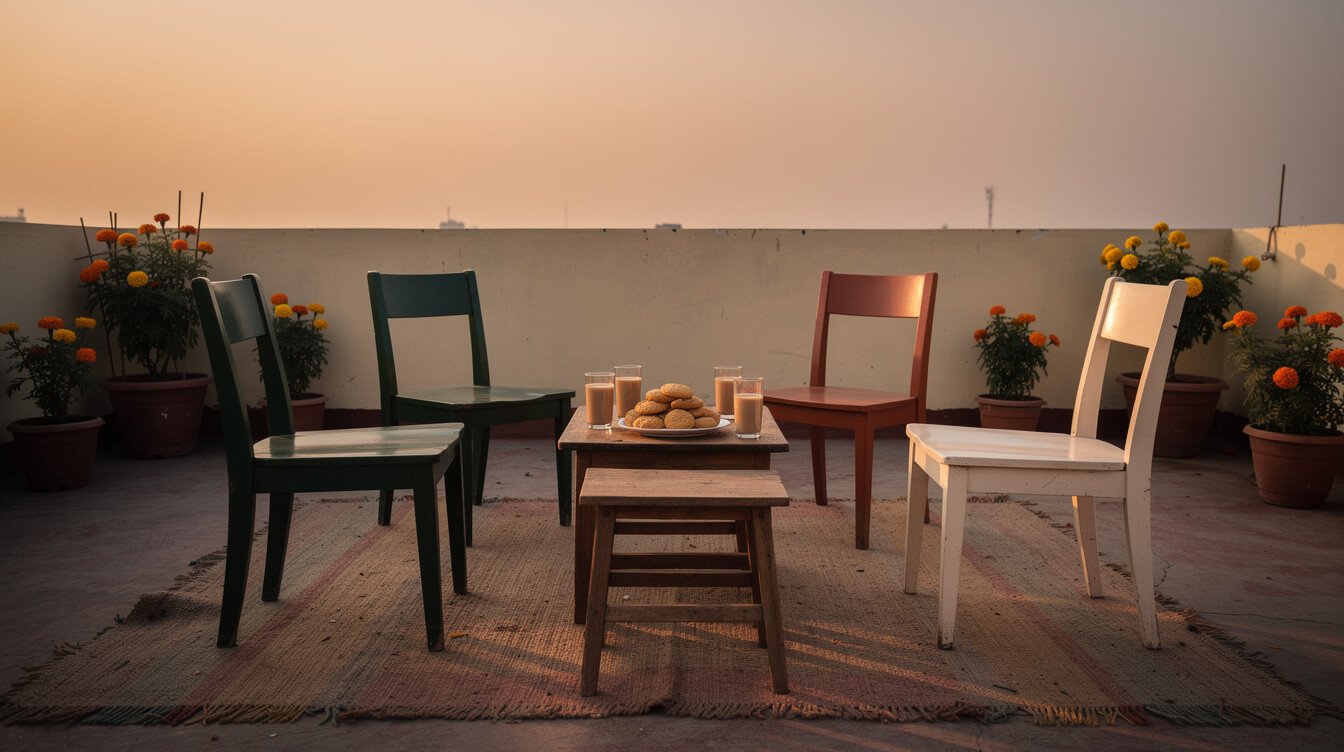
At its simplest, an adda is an informal gathering of friends who talk for a long time about everything and nothing. The historian Dipesh Chakrabarty, in his well-known essay “Adda, Calcutta: Dwelling in Modernity”, quotes the great Bengali linguist Sunitikumar Chattopadhyay, who defined adda as “a place” for “careless talk with boon companions.” Notice the double meaning. Adda is both the talk and the spot where the talk happens.
In Bangla it works as a noun and as part of a verb. In Bangladesh you will mostly hear adda dewa (to “give” adda, to hang out and talk). In Kolkata you will also hear adda mara. Someone who lives for it is an addabaj, the person who says “five more minutes” at 11 p.m. and means two more hours.
The word is not only Bengali. Chakrabarty points out that it also exists in Hindi and Urdu, where it means “place of gathering,” which is why bus terminals in north India are called bus addas. What Bengalis added was the idea that the practice itself is part of who they are. The Oxford English Dictionary now has an entry for adda, and its earliest English evidence is from 1951, in the writing of Nirad C. Chaudhuri, who was born in Kishoreganj in what is now Bangladesh.
So when someone asks “what is adda in Bengali culture,” the honest answer is this: it is conversation as a way of being together. You are not there to solve anything. You are there because these are your people.
The unwritten rules of a good adda
Nobody hands you a rulebook, but every adda runs on the same quiet code. Aditi Ghosh, who heads the linguistics department at the University of Calcutta, put the first rule best in a 2021 BBC Travel feature: “We are not expected to produce something out of an adda.”
1. No agenda, no finish line
A meeting has minutes. An adda has tangents. The talk drifts from cricket to a film to whoever’s cousin just got engaged to a half-remembered line of Tagore, and nobody tries to steer it back. If things go quiet, someone tosses in a new subject and off it goes again.
2. Everything is on the table
The BBC piece lists the ideal ingredients as “a little bit of everything”: art, literature, science, debate, gossip, jokes, rumours, food, and tea. The more outlandish the claim, the longer the argument lasts. Being wrong with confidence is a respected skill.
3. People drift in and out
An adda is not a fixed guest list. Latecomers pull up a stool, early birds leave, and by the end of the night the whole group may have changed while the conversation never stopped. Nobody announces an arrival or a departure. You just join the current.
4. Food and cha keep coming
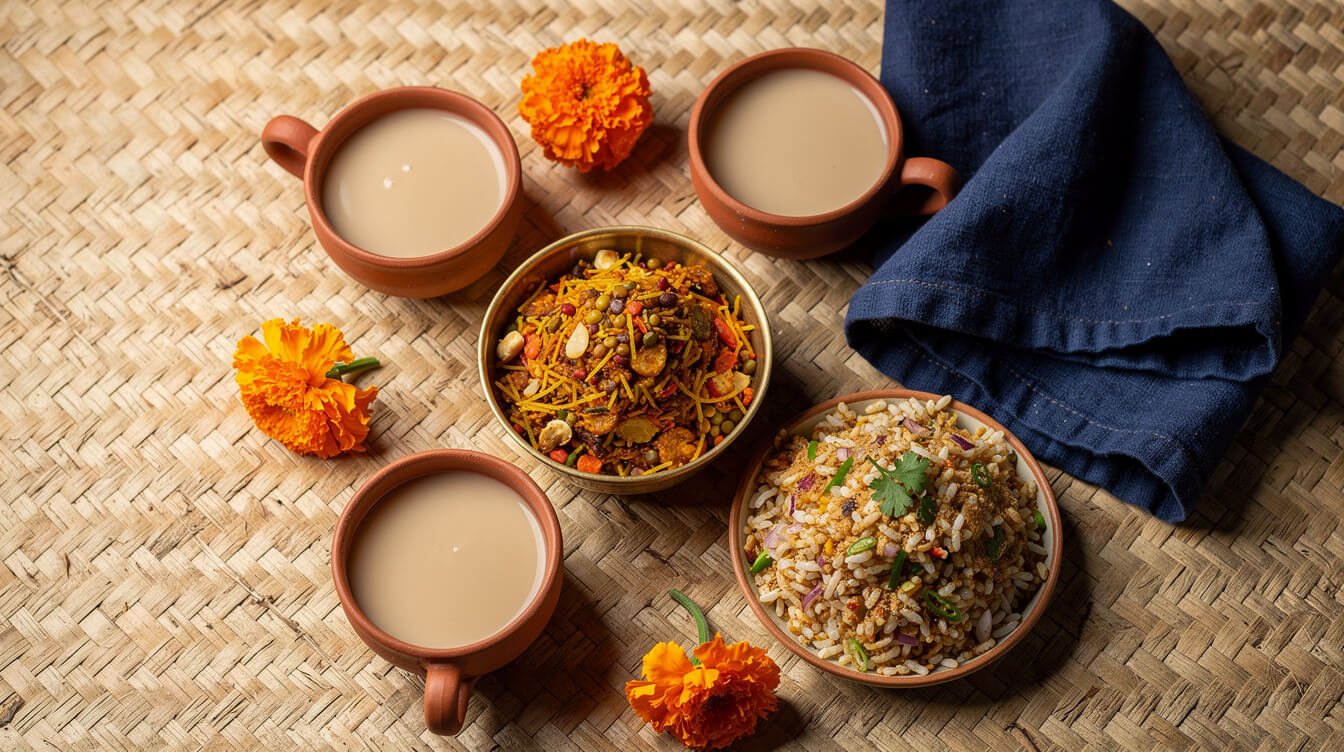
An adda without cha is just a conversation. Someone always appears with a plate of চানাচুর, jhal muri, অথবা শিংগারা, and the cups get refilled before they are empty. (If your adda happens in winter, you are allowed to expect পিঠা.)
If adda is the thing you would cancel other plans for, there is a shirt that says it out loud: our Adda Amar Nesha Bengali T-Shirt, which roughly translates to “adda is my addiction.”
Where adda happens: the tong, the rooftop, and the campus
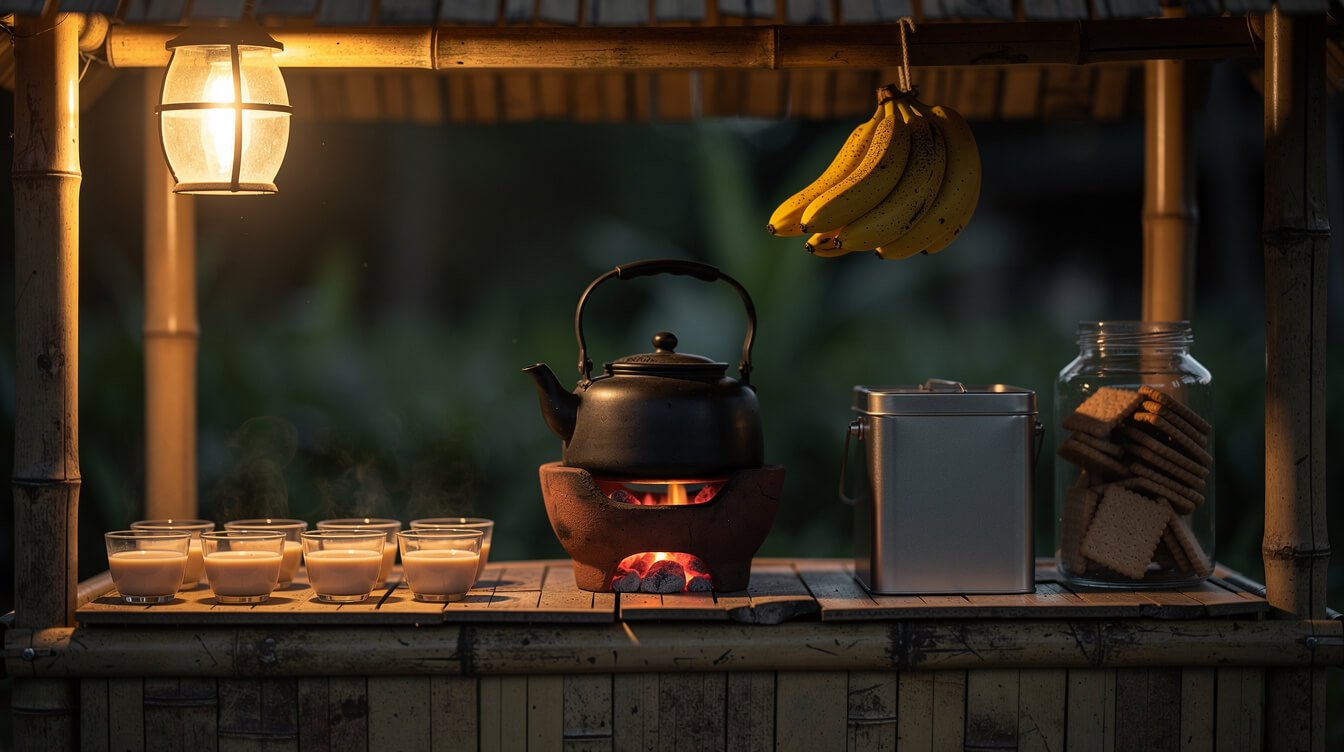
Adda can happen anywhere two or more Bengalis can sit down, but a few places are famous for it.
The tong (tea stall)
In Bangladesh the roadside tea stall, the টং, is the people’s adda hall. The numbers are remarkable. According to the Bangladesh Bureau of Statistics Hotel-Restaurant Survey 2021, as reported by দ্য ডেইলি স্টার, the country has some 344,687 roadside tea stalls, 159,393 of them in cities and the rest in villages. Each one has a blackened kettle, a row of small glasses, a tin of biscuits, and a bench where the same faces show up every evening for tong er cha, strong tea sweetened with condensed milk.
The rooftop and the courtyard
For a lot of families, the adda lived at home. A Daily Star essay from 2026 remembers summer afternoons on rooftops, with kites in the sky, a carrom board in the corner, and aunties trading opinions about their favourite TV serials. In village homes the setting was the courtyard, where a shitolpati (a cool, woven floor mat) got rolled out for anyone who wanted to sit.
The rowak, the campus, and the mess
Old Calcutta houses had a rowak (বানানও করা হয়) rawk), a raised platform by the street door that Chakrabarty describes as a classic adda spot. In Dhaka, generations of University of Dhaka students have spent hours at the TSC (Teacher-Student Centre) with friends, guitars, and cha. And in Kolkata, the old mess bari, a boarding house for single working men, gave Bengali literature some of its best fictional addas.
Cha: the fuel of every Bengali adda

The first words you hear in almost any Bangladeshi home are “Cha khaben?” (Will you have tea?). Saying yes is how an adda begins. Saying no is technically allowed but rarely accepted.
Tea has deep roots in the country. The first known tea cultivation in present-day Bangladesh started in 1843 in Chittagong (Chattogram), beside the Karnaphuli River, and commercial cultivation began in the Sylhet region in 1857. Today Moulvibazar district alone has 91 tea estates, and its town of Sreemangal is known as the tea capital of Bangladesh.
Sreemangal is also home to one of the country’s most photographed drinks: saat rong cha, seven-layer tea, introduced by Romesh Ram Gour at the Nilkantha Tea Cabin. It comes in a clear glass with distinct bands of color, each with a different strength and sweetness. It is the kind of thing people drive hours to try, then argue about all the way home, which is very much in the spirit of adda.
At a regular tong, though, the order is simpler: milky, sweet, very hot, and in a small glass you can hold by the rim. Pair it with a biscuit for dunking, and you have the full menu of a thousand evening addas. For the snacks that usually come along, our guide to বাংলাদেশী খাবার covers the street-food hour, and our piece on বাঙালি মিষ্টি covers what arrives when someone has good news to share.
বাড়ি থেকে চিঠি
আপনার ইনবক্সে আরও একটু দেশি খাবার।
সপ্তাহে একটি সংক্ষিপ্ত ইমেল: কোনো প্রতীক, উৎসব বা খাবারের পেছনের গল্প, সাথে দোকানের নতুন ডিজাইন। কোনো স্প্যাম নেই। যেকোনো সময় আনসাবস্ক্রাইব করুন।
One Bengal, one long conversation: adda in books and history
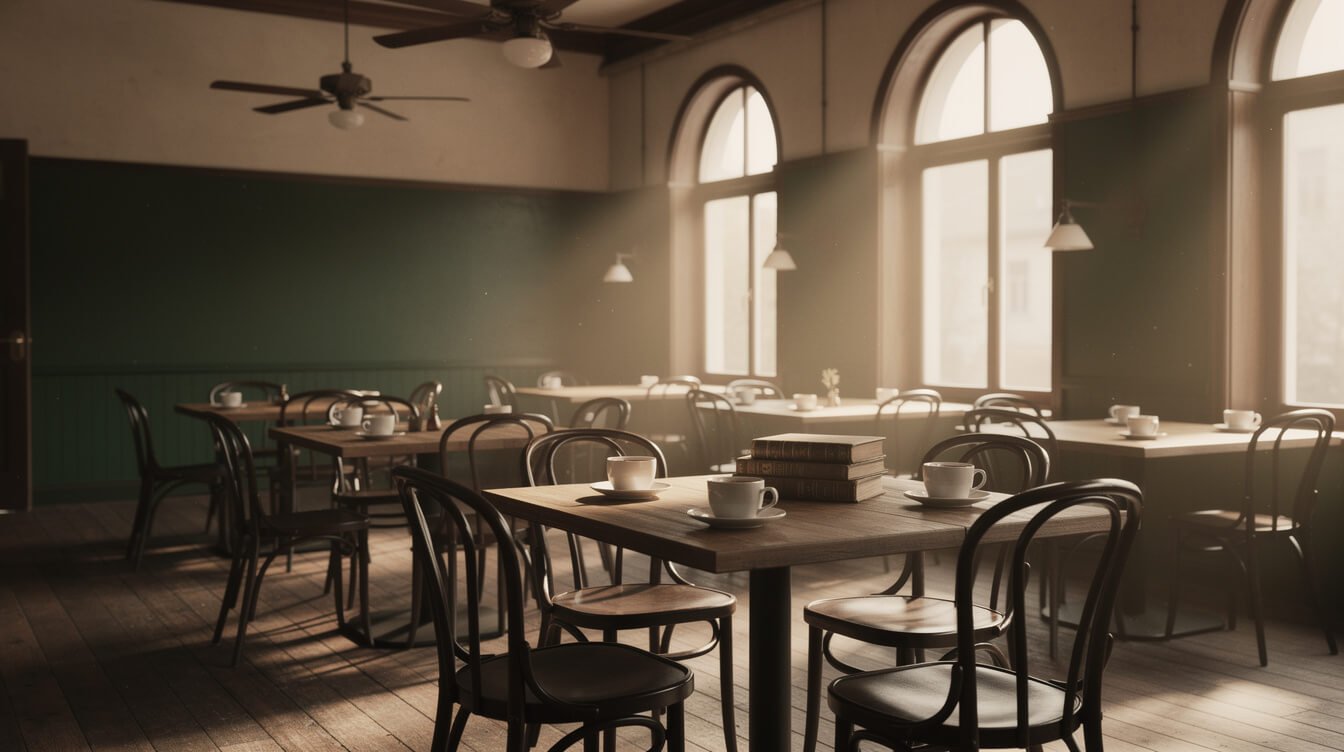
Adda belongs to both Bengals, and its literary history crosses the border at every turn.
The magazine that was born in an adda
অনুসারে বাংলাপিডিয়া, the monthly literary magazine Manasi was born in an adda of friends that met at a photography company’s office on Chowringhee in Calcutta. Its first issue came out in 1909 with an article by Rabindranath Tagore. Banglapedia notes that such literary addas had grown popular in late 19th and early 20th century Bengal around the major periodicals of the day.
The coffee house and the song
In 1942 a coffee shop opened on College Street, Kolkata’s book-market street, and in 1947 it took the name Coffee House. Students and writers made it the most famous adda room in Bengal. In 1983 the singer Manna Dey turned it into a legend with “Coffee Houser Sei Addata,” a song about the old gang that used to meet there and the adda that is no more. Ask any Bengali uncle to hum it and watch his eyes.
Writers from the eastern side
Some of adda’s best champions came from what is now Bangladesh. The poet Buddhadeva Bose, born in the Comilla region and a student of English at the University of Dhaka, wrote an entire essay explaining what adda is, and later ran a famous one at home in Calcutta. The humorist Syed Mujtaba Ali, born in Karimganj in the old Sylhet district, joked in one essay that in their devotion to adda, the men of Calcutta came second only to the men of Cairo, who were home only from midnight to six in the morning. He spent his last years in Bangladesh and died in 1974.
Adda in fiction
Bengali kids grow up on fictional addas too. Premendra Mitra’s Ghanada tells his impossible tales to fellow boarders in a mess at 72 Banamali Naskar Lane, and Narayan Gangopadhyay’s Tenida holds court with his gang of four in Potoldanga. Half the fun of those stories is the arguing in between.
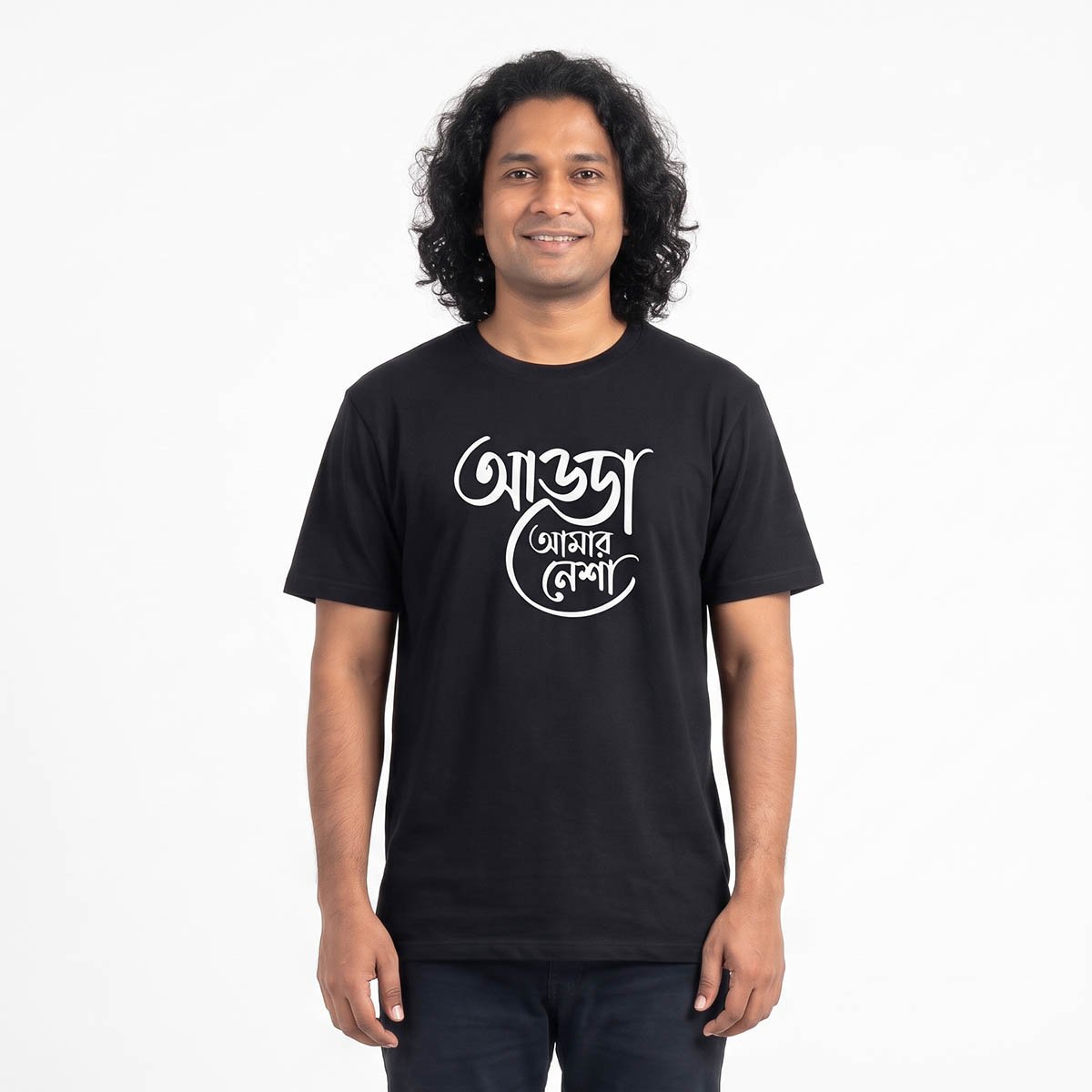
Adda Amar Nesha: adda is my addiction
For the addabaj who says “one more cup” at midnight. A soft tee with the line every Bengali friend group already lives by.
Adda in the diaspora: from the dawat kitchen to the group chat
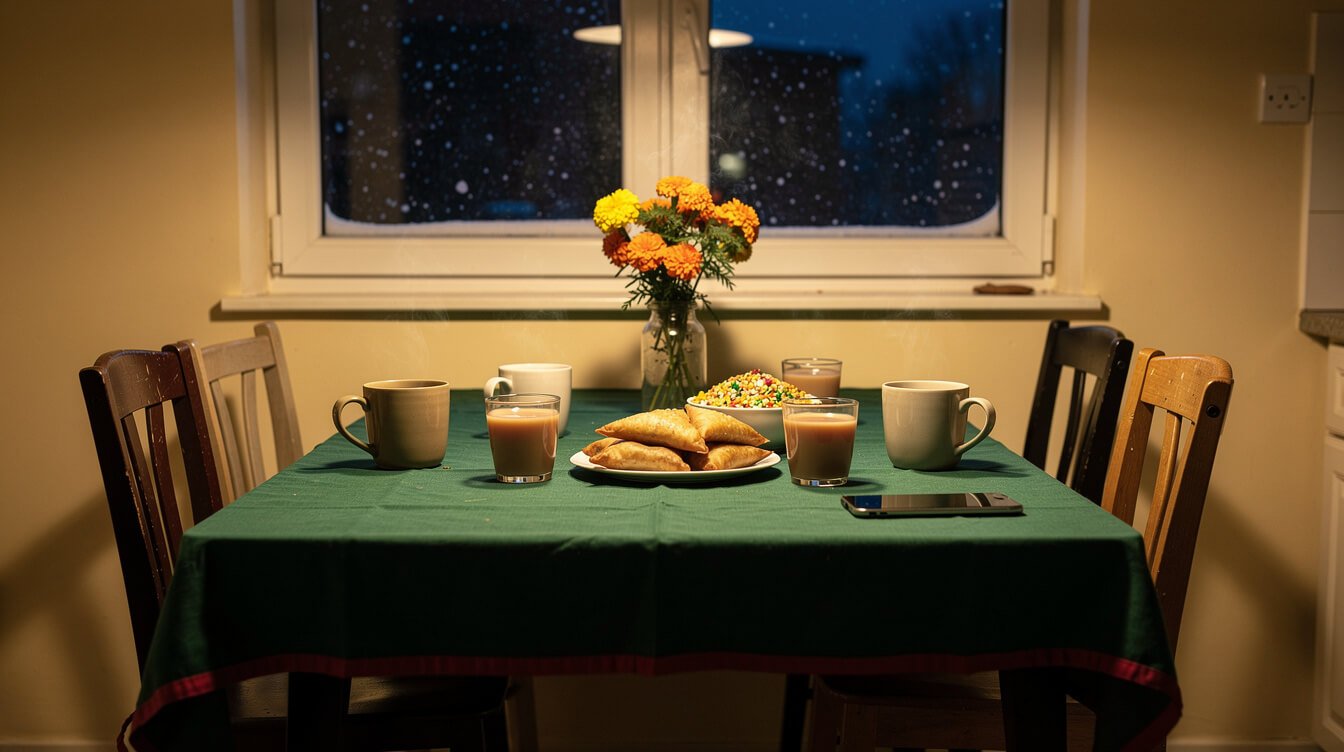
Moving abroad does not end the adda. It just changes the furniture.
If you grew up Bangladeshi in America, Britain, or Canada, you know the shape of it. At every dawat, the uncles take over the living room and the aunties take over the kitchen, and both rooms run their own adda until well past the time your parents said you would leave. The kids have a third adda on the stairs. Somebody’s khala, fupu, or mama is always holding court.
It is also harder to keep. In the BBC piece, a doctoral student who moved from Kolkata to Michigan in 2016 said the addas she loved were with people she had known since childhood, and “it is not possible to recreate that here.” A 2026 Daily Star essay says the same from the other side: the people who once made adda possible “have been scattered by the winds of globalisation,” and their talk has shrunk to messages and status updates.
So the diaspora improvises. Chakrabarty noticed back at the end of the 1990s that online chat groups for Bengalis of both West Bengal and Bangladesh were already calling themselves addas. Today that is the family WhatsApp group, the Sunday video call with Dhaka, and the college Bangladeshi Students Association hangout that was supposed to be a planning meeting. Students know the purest form of it: the night before an exam, when everyone suddenly has a lot to talk about. That exact mood is printed on our Samne Porikkha Ashen Golpo Kori Bengali Mug, which says “exam’s coming up, come, let’s chat.”
The details change, but the core holds. Cha, snacks, people who know you, and nowhere to be.
How to host an adda (without calling it one)
Here is the secret: you cannot schedule a real adda, but you can make one very likely. This works in a dorm, a studio apartment, or a backyard.
- Put the kettle on first. Make a big pot of milky cha with sugar on the side. Paper cups are fine. Glass is better.
- Serve snacks you can eat with one hand. Chanachur, jhal muri, biscuits for dunking, a plate of shingara if someone is feeling ambitious. See our বাংলাদেশী সংস্কৃতির নির্দেশিকা for why the guest always gets served first.
- Arrange seats in a loose circle. Not a dinner table with assigned spots. Floor cushions and a mat count.
- Do not make a plan. No game, no movie, no “agenda.” If someone asks what you are doing tonight, the answer is “nothing, just come.”
- Leave room for latecomers. The best part of an adda is the friend who shows up at 10 p.m. with a story.
- Phones face down. Not banned, just resting. Someone will still pull one out to settle an argument, and that is part of it.
- Keep it warm. Adda thrives on friendly argument. If a topic starts pushing people away from the table, change the topic. The goal is that everyone stays.
Do this once and your non-Bengali friends will ask when the next one is. That is when you tell them the word.
Adda FAQs
What does adda mean in English?
There is no exact translation. “Hanging out” is close but misses the depth. Adda is long, informal group conversation, usually over tea and snacks, with no goal except being together. The word can also mean the place where that talk happens.
How do you pronounce adda?
Roughly UD-dah, with a short first vowel like “up” and a doubled, firm “d.” The Oxford English Dictionary gives the British pronunciation as UD-uh.
Is adda only a Bengali thing?
The word also exists in Hindi and Urdu, where it means a place of gathering. People everywhere gather to talk, from the salons of old Paris to the cafes of Cairo. What is distinctly Bengali is how strongly people tie the practice to their identity, in both Bangladesh and West Bengal.
What is the difference between adda and gossip?
Gossip can be part of an adda, but adda is bigger. A single evening can cover books, sport, film, family news, and a heated debate about the best biryani, all without anyone trying to win.
Is adda only for men?
Historically, public adda in places like tea stalls and coffee houses was mostly male, as Chakrabarty and the BBC both note. Women’s addas at home, like the aunties trading opinions on TV serials, rarely made the history books. In a 2019 Daily Star conversation a Dhaka poet recalled women enjoying tea and adda at roadside stalls with friends in the 1960s and 70s. Today mixed addas are everywhere, especially on campuses and in the diaspora.
What do you eat at an adda?
Cha first. After that: chanachur, jhal muri, biscuits, shingara, and in winter, pitha. Nothing that needs a knife and fork.
Before the cha gets cold
Adda is one of those words that explains a whole people. It says that time spent talking with friends is not wasted time. It says that the guest who wanders in late still gets a cup. It says that being together matters more than reaching a conclusion.
So this week, call someone. Put the kettle on. Do not plan anything. If they ask why, tell them it is a Bengali thing, and then talk until the cha gets cold. For more on the words and habits that travel with us, read our guide to বাংলাদেশের ভাষাগুলো.
যাওয়ার আগে
পরবর্তী খবরটি ইমেইলে পান।
আমরা প্রতিদিন বাংলাদেশি ঐতিহ্য ও প্রবাসী জীবন নিয়ে লিখি। এর সেরা লেখাগুলো একটি সংক্ষিপ্ত সাপ্তাহিক ইমেইলে প্রকাশিত হয়।