What Does Shapla Mean? The Water Lily of Bangladesh Explained
If you have ever asked what does shapla mean, the short answer is this: shapla (SHAP-la) is the Bangla word for the water lily, and the shapla is the national flower of Bangladesh. The longer answer takes in monsoon wetlands, a national emblem, a curry your nani probably still makes, and one very common mix-up with the lotus.
This is the guide your cousin wishes she had when her American friends asked about the flower on her shirt.
What does shapla mean?
Shapla is simply the Bangla name for the water lily. It is not a metaphor or a code word. It names a plant that grows in ponds, ditches, and the flooded edges of fields across the Bengal delta.
It became a symbol because it is everywhere. If you grew up in a Bangladeshi village, or visited one in the rainy season, you have seen it. If you grew up in Queens, Hamtramck, or Brick Lane, you have probably seen it on a relative’s wall hanging or a school poster.
It is also a name. Plenty of Bangladeshi girls and women are called Shapla, the same way English families name daughters Lily. So when someone asks what shapla means, the honest answer is: it means “water lily,” and it stands for Bangladesh.
The plant itself: white shapla, red shapla

Shapla belongs to Nymphaea, the water lily genus. Here is where it gets a little botanical, so stay with me.
Most English-language references give the national flower’s scientific name as Nymphaea nouchali, a species that goes by names like star lotus and blue water lily. Banglapedia, the national encyclopedia of Bangladesh, splits it more finely. It lists two native species: Nymphaea nouchali, the blue variety, and Nymphaea pubescens, the white variety. It names the white one as the national flower and calls it the more common and popular of the two. Water lilies hybridize and vary a lot, and botanists have been arguing about the names for a long time. You do not need to settle it. What matters: the national flower is the white shapla.
Then there is lal shapla, the red water lily. Banglapedia notes a red species, Nymphaea rubra, grown in ponds and tanks as an ornamental. Red shapla also carpets some wetlands in the wild, which is where the famous photos come from (more on that below). It is gorgeous, and it is not the national flower.
Three things to notice when you look at any shapla:
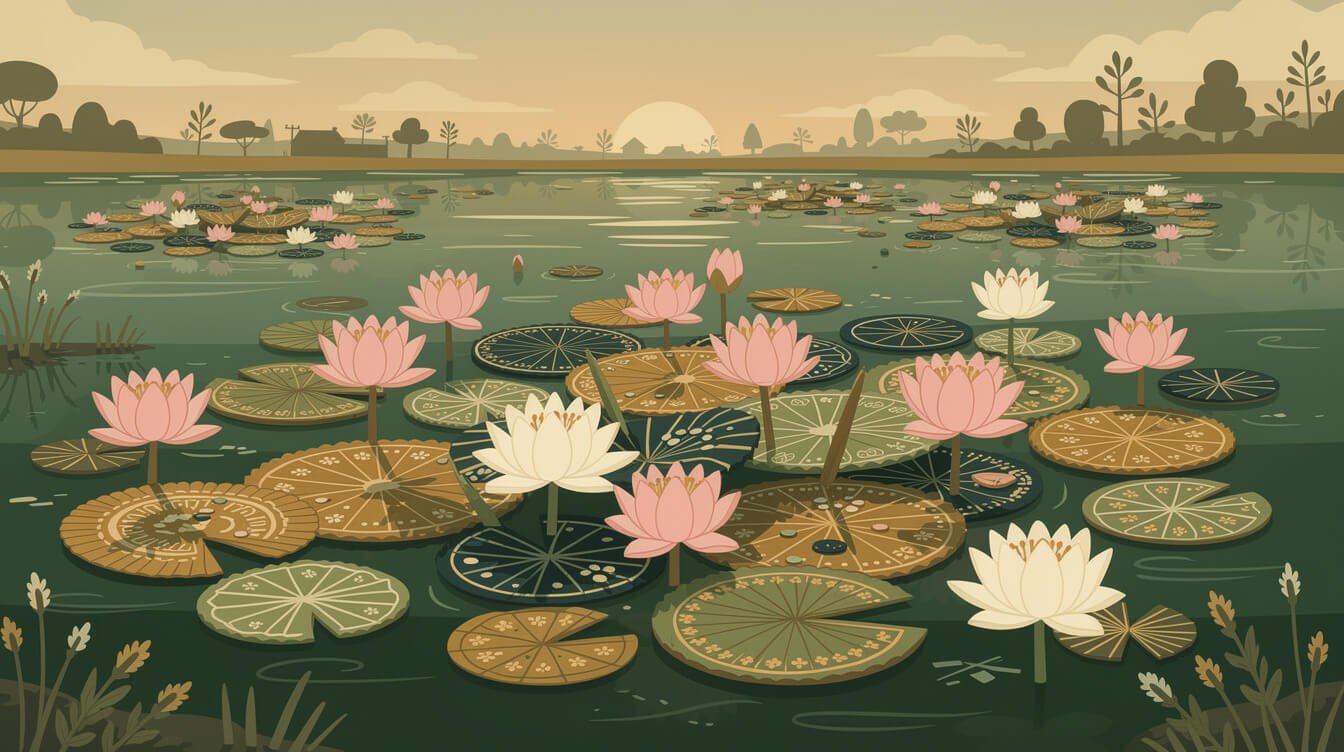
- The flower sits low, at or just above the surface of the water.
- The petals are pointed, so the open bloom looks like a star.
- The round leaves float flat on the water, each with a notch cut into it.
A fun fact for the next family trivia night: Nymphaea nouchali is also the national flower of Sri Lanka, where the blue form is the one people celebrate.
Where shapla grows: beels, haors, and village ponds

Banglapedia says shapla grows abundantly in almost all shallow natural water bodies in Bangladesh and is seen in abundance in the monsoon. In a country shaped by rivers and floodwater, that covers a lot of ground. Two Bangla words help you picture it.
A beel is a low, saucer-shaped depression that collects runoff. Many shrink or dry up in winter and spread back out into wide, shallow lakes when the rains come. Chalan Beel in the northwest is one of the best known.
A haor is bigger: a bowl-shaped basin that becomes a vast inland sea in the monsoon and drains in the dry months. Haors are found mainly in greater Sylhet and greater Mymensingh, including Sunamganj, Habiganj, and parts of Maulvi Bazar. Banglapedia counts about 47 major haors in the northeast basin, along with roughly 6,300 beels.
That rhythm of water rising and falling is the shapla’s whole life. It lines up with borsha, the rainy season, one of the six seasons of the Bengali calendar (choy ritu). Borsha covers the Bangla months of Asharh and Srabon, and the blooms often carry on into sharat, the early autumn of Bhadro and Ashwin.
If you want to see shapla at full volume, people point to Satla Beel in Barishal division, mostly in Ujirpur (also spelled Wazirpur) upazila and partly in Agailjhara. It is known locally as a lal shaplar beel, a red water lily wetland. News reports from Barishal describe red lilies blooming there roughly from August into October, with visitors paddling through in small boats and local families gathering the plants for a living.
Shapla vs. lotus: the mix-up everyone makes

People often call the shapla a lotus. They are two different plants. The lotus is padma in Bangla, and it carries its own meaning in Bengali culture. Botanically they are not even in the same family: lotus is Nelumbo, water lily is Nymphaea.
Here is the quick way to tell them apart:
- Water lily (shapla): leaves float flat on the surface and have a notch. Flowers sit at or just above the water.
- Lotus (padma): leaves are round with no notch and are often held up above the water. Flowers rise high on tall, stiff stalks.
Bangladesh chose the shapla, the low flower that floats. Next time someone says “nice lotus,” you can smile and say, “water lily.”
Letters from home
A little more desh in your inbox
One short email a week: the story behind a symbol, a festival, or a dish, plus new designs from the shop. No spam. Unsubscribe anytime.
Shapla on the national emblem
The shapla is not only the national flower. It is also the center of the National Emblem of Bangladesh, and the emblem is worth describing precisely because it gets redrawn wrong all the time.
Here is what is actually on it:
- At the center: a shapla resting on water.
- On each side: an ear of paddy, the rice plant, curving around the flower.
- Above the flower: three connected jute leaves.
- Beside the jute leaves: two stars on each side, four stars in all.
Not five stars, and not wheat. Banglapedia’s reading is that water, paddy, and jute define the country’s landscape and economy, so the emblem is basically a portrait of the delta: water, rice, jute, and the flower that grows out of all that water.
If you want the flower that anchors the emblem, without the full official design, our Shapla National Flower Bangladesh Water Lily T-Shirt is the one to look at: a single white shapla, nothing else.

Wear the shapla
The Shapla National Flower Bangladesh Water Lily T-Shirt puts the flower of the monsoon ponds on your chest. No explaining needed, though you will get asked.
Water flowers in folk art: alpana and nakshi kantha
Bengali folk art loves water flowers, and here honesty matters. The flower at the heart of the old patterns is usually the lotus, not the shapla.
Nakshi kantha (embroidered quilt) is made by layering old saris, dhotis, and lungis and stitching them together. Banglapedia describes the classic layout as a central lotus motif ringed by circles of vines or sari-border patterns, with paisley-like kalka or tree-of-life motifs in the corners pointing toward the center. Around them go fish, boats, elephants, peacocks, and scenes from village life.
Alpana is the floor and courtyard art painted with rice paste, often with a scrap of cloth dipped in it. It is drawn for pujas, weddings, and other ceremonies, and in Bangladesh it famously covers the ground around the Shaheed Minar on February 21, Ekushey February. Traditional motifs include the sun, rice stalks, fish, betel leaves, and the lotus.
So where does the shapla fit? It is part of the same visual world: round floating leaves, star-shaped petals, water all around. It became the country’s official flower, and that is why you now see it everywhere in modern Bangladeshi design. Just do not tell your khala that the big flower in the middle of her nani’s kantha is a shapla. Count the petals, look at the stalk, and you will probably find a padma.
Shapla on the plate
Here is the part that surprises non-Bangladeshi friends: people eat it.
The long, soft stalk that holds the flower up from the bottom of the pond is a popular vegetable in rural Bangladesh. Banglapedia lists the flower stalk as a village favorite and notes that the tuberous rootstocks are eaten too, and that in some places the seeds are fried and eaten as puffed grains, a bit like popcorn.
The stalks are usually peeled of their thin outer skin, cut into short pieces, and cooked as a torkari (vegetable dish) or a quick stir-fry. Some families add small fish or shrimp, some keep it simple. Every household does it differently, so we are not going to hand you a recipe and pretend it is the only one.
Call your nani instead. Ask her how she cooked shapla, who taught her, and whether she still would. You will get a recipe, an opinion about everyone else’s recipe, and probably a story about the pond.
Shapla and the village pond, from far away

Ask a Bangladeshi aunty about shapla and she will often skip the botany and talk about the pukur (pond) behind the house. The pond is where the flower lives, and for many families it is a memory as much as a place.
That is why the shapla works as a symbol for the diaspora. If you grew up between two countries, you know the problem: you want to show where you come from, but you do not want every piece of clothing to start a debate. The shapla does that job. You can carry it without carrying a slogan. It says desh (home country) in a way that needs no flag and no argument.
Next time you call your nani, ask her where she saw shapla growing. You will get a story, and probably a lecture on how the ponds were cleaner back then.
Frequently asked questions
What does shapla mean in English?
Water lily.
Is shapla the national flower of Bangladesh?
Yes. The white shapla, a water lily, is the national flower of Bangladesh.
Is shapla the same as a lotus?
No. The lotus is called padma in Bangla and belongs to a different genus, Nelumbo. Lotus flowers rise high above the water on tall stalks, while water lily leaves float flat and the flowers sit at or near the surface.
What is on the National Emblem of Bangladesh?
A shapla resting on water, an ear of paddy on each side, three connected jute leaves above, and two stars on each side of the leaves.
Final thoughts
Shapla means water lily. It is the white flower of the monsoon ponds, the red carpet of the beels, a vegetable on your nani’s stove, and the center of the national emblem. It is a quiet way to say where you come from.
If a friend asks what that flower on your shirt is, you now have the whole answer.
Before you go
Get the next story by email
We write about Bangladeshi heritage and diaspora life every day. The best of it lands in one short weekly email.