National Animal of Bangladesh: The Royal Bengal Tiger of the Sundarbans
The national animal of Bangladesh is the Royal Bengal tiger, the bagh (tiger), and it lives in one place in the country: the Sundarbans, the giant mangrove forest where the rivers of Bengal meet the sea. Ask any Bangladeshi kid abroad what the national animal is and they will say “tiger” before you finish the question. Ask them what makes the Sundarbans tiger different from every other tiger on earth, and most of us go quiet.
This is the full answer, from inside the family. What the Royal Bengal tiger is, where it lives, how it swims, how many are left (the latest count is good news), the forest goddess the honey collectors pray to before they go in, and how to see the Sundarbans yourself.
The national animal of Bangladesh is the Royal Bengal tiger

In Bangla, a tiger is a bagh. In English, the one we mean is the Bengal tiger, Panthera tigris tigris, and in Bangladesh nobody calls it by that plain name. It is the Royal Bengal tiger, every time, the way your nani calls your uncle by his full good name when she means business.
Banglapedia, the national encyclopedia of Bangladesh, records the Bengal tiger as the national animal of Bangladesh and notes that it is “renowned as the Royal Bengal Tiger.” It is one of the largest living cats on the planet: a rich yellow to reddish-ochre coat, black stripes that thicken toward the rump, a ringed tail with a black tip, and a white spot on the back of each black ear. Cubs are born already striped.
Here is the part that should land with every diaspora kid. Banglapedia says tigers were once found in every forest in Bangladesh. Today they survive in only one: the Sundarbans. The tiger on the national symbol list is not a memory of the whole country. It is a very specific animal living in a very specific forest in the southwest, in Khulna Division, where the land breaks up into tidal islands before it reaches the Bay of Bengal.
One tiger, two countries
The Bengal tiger is also the national animal of India. That is not a rivalry. It is geography. The Sundarbans runs across the border into West Bengal, and the tigers swim across it without paperwork. Like Pohela Boishakh and the Baul songs, the bagh belongs to one Bengal that happens to sit in two countries. (If you want the longer version of that story, start with our guide to who Bengali people are, from Dhaka to Kolkata to Queens.)
The Sundarbans: where the tiger lives

The Sundarbans is a mangrove forest on the delta built by three great rivers, the Ganges (the Padma, once it enters Bangladesh), the Brahmaputra, and the Meghna, where they empty into the Bay of Bengal. UNESCO describes it as one of the largest mangrove forests in the world, about 10,000 square kilometers of land and water, with roughly 60% in Bangladesh and the rest in India.
What does Sundarbans mean?
Bon means forest. The name is usually read as “the forest of the sundari tree,” after Heritiera fomes, the most common tree in the forest. Banglapedia lists two other theories, a forest of the sea (samudra) and a corruption of an old tribal name, but calls the sundari explanation the generally accepted one. You will also hear people translate it as “beautiful forest,” because sundor means beautiful. Both readings are in circulation. Only one is backed by the tree.
A mangrove is a forest that lives in salt water. Twice a day the tide rolls in, the mud disappears, and the trees stand in the sea. Then it pulls back, and you see thousands of pencil-thin roots poking straight up out of the mud. Those are breathing roots: the soil is so waterlogged that the trees send roots up into the air to get oxygen. Along almost every canal you see thick clumps of golpata (nipa palm), whose leaves people cut for thatch.
The three wildlife sanctuaries at the heart of the Bangladesh Sundarbans were inscribed as a UNESCO World Heritage Site on December 7, 1997, next to the Indian Sundarbans, which was listed in 1987. The sanctuaries themselves date to 1977, and the forest was first gazetted as a reserve back in 1878. That is a long time to be protecting one swamp, and it shows.
If your family is from anywhere near Khulna, Bagerhat, or Satkhira, the Sundarbans is not a postcard. It is the reason the fish is good and the honey is wild. For everyone else in the diaspora, it is the purest picture of what our parents mean when they say Bangladesh is a land of rivers. We put that exact idea on the Bangladesh Land of Rivers T-Shirt: a fisherman, a boat, and a river curving through green.
What makes a Sundarbans tiger different

Tigers live in snowy Russian forests, Himalayan foothills, and dry Indian grasslands. Only one population in the world lives in a mangrove forest: the tigers of the Sundarbans, on both sides of the border. Life in a tidal swamp changed them.
They swim
Most cats avoid water. The Sundarbans tiger cannot. The forest is a maze of islands cut by tidal rivers and creeks, so a tiger patrolling its territory has to cross open water again and again. Banglapedia calls the tiger an agile animal that “swims well,” and in the Sundarbans that is not a fun fact. It is how they get to work.
They are smaller
Field studies that weighed tigresses in the Bangladesh Sundarbans recorded adult females of about 75 to 80 kg (165 to 176 lb), the smallest weights recorded for Bengal tigers anywhere. For comparison, Banglapedia gives a general range of 115 to 185 kg for Bengal tigresses. Researchers think the small size probably comes from tough competition between tigers and the smaller prey on offer in the mangroves, compared with the big deer tigers hunt elsewhere.
They hunt what the tide leaves
Their main prey is the chital (spotted deer), along with wild boar, barking deer, and rhesus macaques. The ground cover helps them hide: Banglapedia notes that the tiger fern that carpets much of the saltwater forest floor is exactly the kind of bush tigers use for camouflage. Stand on a boat and look at a wall of green fern and roots, and you understand why so few visitors ever see one.
The tiger also shares the forest with some neighbors worth knowing: estuarine crocodiles, the Ganges river dolphin and the Irrawaddy dolphin, and a long list of birds. The 2024 survey report counts around 300 bird species, 400 fish species, and 42 mammals in the Bangladesh Sundarbans.
How many Royal Bengal tigers are left in Bangladesh?

Good news first, because there is real good news. The latest official count, released by the Bangladesh Forest Department in October 2024, estimated 125 tigers in the Bangladesh Sundarbans. The two counts before it found 106 in 2015 and 114 in 2018. That is a slow, steady climb.
The way they count is clever. Survey teams strapped 1,210 cameras to trees at 605 spots across about half of the forest, and also logged pugmarks (paw prints) along 1,306 km of narrow rivers and canals. The cameras photograph any tiger that walks past, and since every tiger’s stripes are unique, the team can tell individuals apart. From the images and prints they identified 84 adult tigers, then used the density, about 2.64 tigers per 100 square kilometers, to estimate the total of 125.
Conservationists credit the rise to net fences along the forest edge, more patrols against poaching, and tighter control over illegal activity inside the forest. Earlier surveys also found prey animals like the chital increasing, which is what a healthy tiger forest needs.
The tiger is still in danger. Bangladesh lists it as critically endangered, and it is on Appendix I of CITES, the international treaty that bans commercial trade in the most threatened species. But for a forest that people worried about a decade ago, 125 and rising is a number worth repeating at the dinner table.
Letters from home
A little more desh in your inbox
One short email a week: the story behind a symbol, a festival, or a dish, plus new designs from the shop. No spam. Unsubscribe anytime.
The tiger in Bengali culture: Bonbibi, Gazir pat, and rickshaw art

Very few people live inside the Sundarbans, but plenty work in it. Banglapedia names them: the moual (wild honey collectors), the bawali (who cut golpata), woodcutters, and fishers. They build their homes at the edge of the forest on platforms raised three to five meters on poles. If you have ever had a jar of Sundarbans honey sent over in a suitcase, a moual went into the forest for it.
Bonbibi, lady of the forest
Before they go in, many forest workers call on Bonbibi, the “lady of the forest,” a guardian figure honored by both Hindu and Muslim families of the Sundarbans. In the stories, her great rival is Dakkhin Rai, “lord of the south,” who takes the form of a tiger. Bonbibi is the one who keeps the forest workers safe from him.
Her stories are told in verse in the Bonbibir Johuranama, and communities gather for her on the first day of the Bengali month of Magh (mid-January). What makes Bonbibi so Bengali is how the faiths share her: Hindu families often make clay images of her, while Muslim families honor her with red flags and garlands on small earthen mounds. Same lady, same forest, different ways of saying thank you.
Gazir pat: the tiger on a scroll
Until not so long ago, a traveling performer might unroll a long painted cloth scroll in a village courtyard and sing its story panel by panel. One famous type is the Gazir pat. Its central panel shows Gazi Pir, a folk saint, seated on a tiger, and because Gazi is believed to command animals, the scroll is full of tigers. The painters worked mostly in red and blue, with flat, bold figures. It is one of the old ways Bengal has drawn its bagh.
Rickshaw art and the everyday tiger
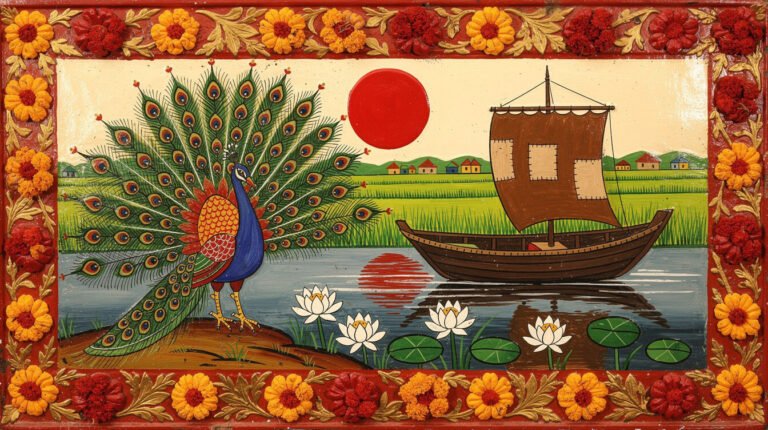
Tigers never left Bengali folk art. Today you find them on the back of the cycle rickshaw. Rickshaw art panels in Dhaka are packed with peacocks, lotus flowers, film stars, and tigers, painted in the same loud, proud palette. (Our guide to Bangladeshi culture has more on rickshaw art.) And on the living-room wall of every aunt who has ever visited Khulna.
That is the spirit of our Royal Bengal Tiger Sundarbans Mug: a tiger mid-stride on a riverbank, mangrove roots, lotus flowers floating below, and kingfishers overhead, wrapped all the way around. It is folk-art Sundarbans for your morning cha.

The bagh, on your morning cha
Our Royal Bengal Tiger Sundarbans Mug wraps the whole forest around your cup: the national animal of Bangladesh mid-stride on a riverbank, mangrove roots, lotus flowers, and kingfishers. A good gift for anyone whose family is from Khulna, or who just loves the bagh.
The national animal of Bangladesh and its fellow symbols
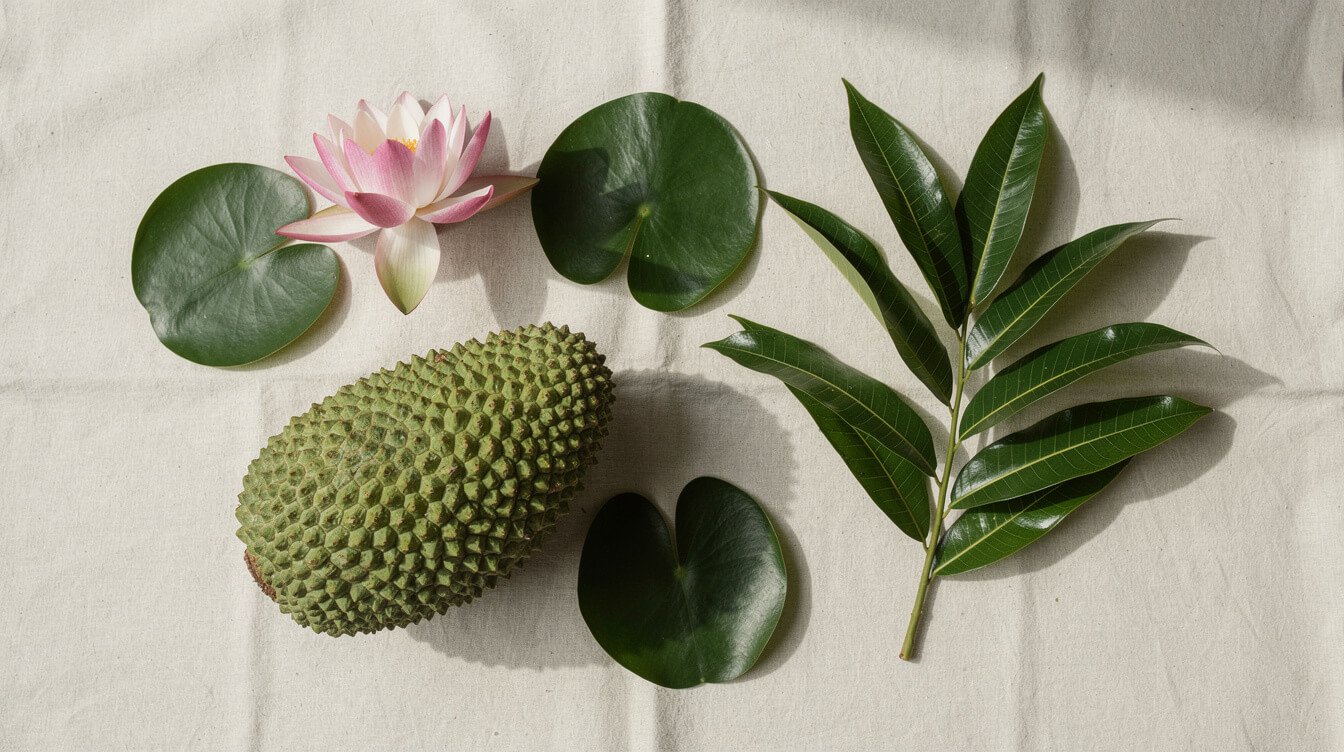
The tiger is one of a set. If you are helping a kid with a school project, or you just want to win the next family quiz, here is the full lineup of the natural national symbols of Bangladesh:
- National animal: the Royal Bengal tiger (bagh).
- National flower: the water lily, shapla, which also sits at the center of the national emblem. We wrote a whole post on what shapla means.
- National bird: the oriental magpie-robin, the doyel, the little black-and-white bird singing on every village rooftop.
- National fruit: the jackfruit, kathal. Yes, the giant one your nana insisted on cutting on newspaper on the kitchen floor.
- National tree: the mango tree.
- National fish: the ilish (hilsa), the fish that starts arguments about mustard. More in our insider’s guide to Bangladeshi food.
- National instrument: the dotara, the folk lute of the Baul singers.
Look at that list and you can see the whole country: a river delta (the water lily and the ilish), a village courtyard (the mango tree, the jackfruit, the doyel), music, and, at the wild southern edge where the land meets the sea, the tiger. Most of the symbols on that list live alongside people. The national animal of Bangladesh is the one that still lives on its own terms.
The flag, by the way, does not carry a tiger. The green field is for the land and the red disc is for the sun rising over Bengal. Our post on what the Bangladesh flag means covers that one.
Visiting the Sundarbans, and two dates to remember

If your next trip to the desh has room for something other than wedding season and relatives, the Sundarbans is worth it. A few honest notes:
- Go in the cool, dry months. October to February is the comfortable window. June to September is monsoon: wet, windy, and rough on the water.
- You travel by boat. The forest is a maze of waterways, so boats are how you get around. Most visitors book a boat trip with a tour operator from Khulna (some start in Dhaka), and trips run from overnight to about a week.
- You need a permit. Entry needs a permit from the Bangladesh Forest Department, issued through the Divisional Forest Office in Khulna. If you book a tour, ask whether the operator arranges it for you.
- Know the names. Popular stops include Katka (a forest rest house and observation tower, good for deer and birds), Hiron Point (also called Nilkamal), and Dublar Char, an island where a big fishing camp runs each year from about mid-October to mid-February.
- Manage expectations. You will almost certainly see spotted deer, monkeys, kingfishers, and maybe dolphins. You will probably not see a tiger. You might see pugmarks in the mud, and somehow that is even better.
We are not listing prices or schedules because they change. Check with the operator and the Forest Department before you go.
Two dates for the calendar
February 14: Sundarban Day. While the rest of the world does Valentine’s Day, Bangladesh marks Sundarban Day. It was declared at a national conference in Khulna on February 14, 2001, and is observed every year to remind people to protect the forest.
July 29: Global Tiger Day. Also called International Tiger Day, it was created in 2010 at a tiger summit in Saint Petersburg, Russia, and is marked by tiger range countries around the world. A good day to post your best bagh.
Frequently asked questions

What is the national animal of Bangladesh?
The Royal Bengal tiger, known in Bangla as bagh. In Bangladesh it lives only in the Sundarbans mangrove forest in the southwest of the country.
Is the Royal Bengal tiger a different species from other tigers?
No. “Royal Bengal tiger” is the popular name for the Bengal tiger, which belongs to the mainland tiger subspecies Panthera tigris tigris. The Sundarbans tigers are the same animal, adapted to a very unusual home: they swim, and the females are smaller.
Is the Royal Bengal tiger the national animal of India too?
Yes. The Bengal tiger is the national animal of both Bangladesh and India, which makes sense: the Sundarbans spans the border between Bangladesh and West Bengal.
How many tigers are in the Sundarbans of Bangladesh?
The latest official survey, released in October 2024, estimated 125 tigers in the Bangladesh Sundarbans, up from 114 in 2018 and 106 in 2015.
What does “Sundarbans” mean?
“Bon” means forest. The generally accepted origin is the sundari tree, the most common tree in the forest, so roughly “the sundari forest.” Many people also read it as “beautiful forest.”
Where can I see a Royal Bengal tiger in Bangladesh?
In the wild, only in the Sundarbans, on a licensed boat trip from the Khulna side. Sightings are rare, so go for the forest, the deer, and the birds, and count any tiger as a bonus.
Why the bagh still matters
Most national symbols are easy to love from far away. A flower, a bird, a fruit. The tiger is harder, and that is the point. It lives in a forest that floods twice a day, it swims between islands, and it has survived in the one corner of Bangladesh wild enough to hold it. The people who work beside it built a shared lady of the forest to keep them safe, and the painters who never saw one put it on scrolls and rickshaws anyway.
So next time someone asks you what the national animal of Bangladesh is, give them more than one word. Tell them about the mangroves, the swimming tigers, Bonbibi, and the count that went from 106 to 125. Then call your nani and ask if anyone in the family ever went to the Sundarbans. Someone did. They have a story about the honey.
Before you go
Get the next story by email
We write about Bangladeshi heritage and diaspora life every day. The best of it lands in one short weekly email.