Bangladeshi Food: An Insider’s Guide to What We Actually Eat
Ask ten Bangladeshis to describe Bangladeshi food and you will get ten arguments and one agreement: it starts with rice. Everything else, the fish, the mashes, the lentils, the biryani your khala makes only for weddings, exists to go with bhaat (cooked rice). If you grew up in Queens or Hamtramck or East London, you already know the rule. The rice cooker is always on, and “have you eaten?” is how your Ammu says hello.
This guide is for two readers. One is the second-gen kid who can eat a full plate of shorshe ilish without choking on a bone but has never had to explain it to a friend. The other is that friend. We’ll cover what Bangladeshi food actually is, how a meal is eaten, the fish that defines it, how Dhaka, Chattogram, and Sylhet cook differently, the street snacks, the sweets, and where the diaspora keeps it all alive.
What is Bangladeshi food? Rice, fish, and mustard oil

Bangladesh is a delta. The Padma, the Meghna, and the Jamuna, plus hundreds of smaller rivers, split the country into wet green pieces, and the food follows the water. Rice grows in the flooded fields. Fish lives in the rivers, ponds, and beels (seasonal wetlands). It’s the same water that grows the country’s national flower, which we covered in what the shapla means. Put rice and fish together and you have the backbone of the cuisine.
There is an old Bengali saying for it: maache bhaate Bangali, “fish and rice make a Bengali.” Rice is the staple and fish is the most common protein, so lunch on an ordinary weekday in Bangladesh is still, at heart, rice with a few things to eat it with.
The third pillar is mustard oil. It was the traditional cooking fat of Bengal long before soybean oil reached Bangladeshi kitchens, and it’s what gives so many Bangladeshi dishes their sharp, nose-tingling edge. Raw mustard oil drizzled over a mash of potatoes and green chilies is a completely different experience from anything cooked in neutral oil. If your house smelled a little pungent when Nani cooked, that was mustard oil doing its job.
Everyday food and company food
Bangladeshi food has two registers. The first is everyday dal-bhaat (lentils and rice) food: mashes, stir-fried vegetables, leafy greens, fish curries, and dal. The second is the Mughlai food that came through Dhaka’s centuries as a Mughal provincial capital: polao, biryani, korma, roast chicken, and kebabs. That’s the food of Eid, weddings, and the day guests come over. Most Bangladeshi aunties will tell you, firmly, that you do not pour dal over biryani. The two worlds don’t mix on the plate.
How a Bangladeshi meal works: from bhorta to dal

A Bangladeshi meal has no starters and mains. Everything lands on the table at once, family style. There is, however, an order. You eat from lighter to heavier, mixing a little of one dish at a time with rice, and you work your way down the line:
- Bhorta (mashed dishes). Potato, eggplant, tomato, lentils, dried fish, or greens, mashed with raw onion, green or dried chili, coriander, salt, and mustard oil. It’s always the opener. A dinner party might have five or six.
- Bhaji and shaak. Bhaji is a lightly spiced, dry-ish vegetable fry; shaak means leafy greens, like lal shaak (red amaranth) or lau shaak (bottle gourd leaves).
- Maach (fish). Fried, in a jhol (thin curry), a bhuna (thick, dry curry), or with mustard.
- Mangsho (meat). Chicken, beef, goat, or mutton, usually one dish on a normal day.
- Dal. Lentils come last. They soften the last of the rice and clean the plate, so not one grain gets wasted.
This is the Bangladeshi order specifically. Families in West Bengal, who share the language and much of the food, often eat in a different sequence with different dishes. It’s one Bengal, two kitchens, and both sides will defend their version.
Most people eat with the right hand. It isn’t a quirk. The fingers tell you where the fish bones are, and mixing rice with a bit of bhorta by hand is how you get the ratio right. Forks show up for guests and for your American friend’s first visit.
Ilish: the fish at the center of Bangladeshi food

If one ingredient stands for Bangladeshi food, it’s ilish, the hilsa. It’s the national fish of Bangladesh, and on August 6, 2017, Bangladesh registered ilish as a Geographical Indication, the country’s second after the Jamdani sari. Hilsa is also the state fish of West Bengal next door, which tells you how deep the love runs on both sides of the border.
Ilish is a silver, oily, very bony fish that swims up the rivers from the Bay of Bengal to spawn. The bones are the price of the flavor, and every Bangladeshi kid has a memory of a parent picking a piece clean for them. Classic preparations include:
- Shorshe ilish: hilsa in a sharp mustard-seed paste with green chilies and mustard oil, often steamed or simmered.
- Ilish bhaja: fried hilsa. The oil left in the pan is poured over hot rice, and some people consider that the best part.
- Ilish polao and smoked or baked versions for special occasions.
In Dhaka, panta bhaat (rice soaked overnight in water) with fried ilish has become the classic breakfast for Pohela Boishakh, the Bengali New Year on April 14. Hilsa isn’t the only fish, either. Bangladeshi kitchens cook rui (rohu), koi, pabda, shing, tiny mola, and prawns, plus the dried fish called shutki, which you either love or leave the house for.
Bangladeshi food by region: Dhaka, Chattogram, Sylhet, and beyond

Bangladesh is about the size of Iowa, yet the food changes noticeably from one division to the next. Here is the short tour.
Dhaka: Mughal kitchens and Old Dhaka biryani
Dhaka was the Mughal capital of Bengal, and its old city still cooks like it. Kacchi biryani is the wedding standard. Kacchi means “raw”: marinated mutton or goat is layered raw with rice and potatoes and slow-cooked sealed in a large pot. Tehari is its everyday cousin, with the meat cooked first and the rice cooked into it. Morog polao (chicken pilaf) is another Dhaka signature, and Haji biryani is goat biryani named after the Old Dhaka restaurant that made it famous. With tea, Old Dhaka eats bakarkhani, a crisp, layered flatbread baked in the city for centuries. During Ramadan, Chawkbazar’s iftar market is one of the city’s great food sights.
Chattogram (Chittagong): mezban beef and the sea
Chattogram cooking is hotter and leans on beef. The region’s signature is the mezban, a huge communal feast, and its star dish is mezbani gosht, a deeply spiced beef curry. The city’s Hindu community holds its own mezbans with fish and vegetable curries. Kala bhuna (literally “black fry”) is beef shoulder cooked down with spices until it is dark and tender. Being on the coast, Chattogram also eats sea fish like rupchanda (pomfret) and loitta (Bombay duck), which is often dried into shutki.
Sylhet: citrus, chilies, and tea country
Sylhet, in the tea-growing northeast, cooks with ingredients you won’t find elsewhere. Shatkora is a bitter, fragrant citrus whose rind is cooked into beef and fish curries. The naga morich chili is fierce. Akhni is Sylhet’s mixed rice dish of meat and rice. In Srimangal’s tea country, stalls pour the famous layered “seven-color” tea, with each band a different brew.
The north, the hills, and the south
Bogura is famous across the country for its doi, a sweet set yogurt. Mymensingh’s Muktagacha has made a sweet called monda since 1824. In the Chittagong Hill Tracts, Chakma and Marma cooks use fermented fish pastes, forest herbs, and bamboo, and some dishes are cooked right inside a bamboo tube. The Garo community of greater Mymensingh has its own distinct cuisine too. Down south, Barishal cooks with coconut, and in the Khulna region chui jhal, the stem of a pepper vine, adds a heat that was in Bengal before chilies arrived from the Americas.
Wherever you start, every road leads back to the same plate of rice, which is exactly why our Bhaat Is My Comfort Food Bangladeshi Rice T-Shirt exists.
Letters from home
A little more desh in your inbox
One short email a week: the story behind a symbol, a festival, or a dish, plus new designs from the shop. No spam. Unsubscribe anytime.
Street food, cha, and the iftar table

Bangladeshi street food is built for the hour between school and dinner, or for a long adda (aimless, sacred hangout talk) with friends. The essentials:
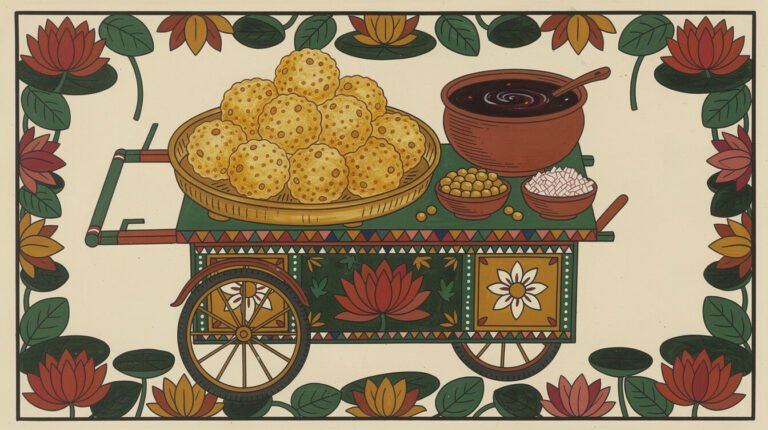
- Fuchka: crisp, hollow semolina shells filled with mashed potato, chickpeas, chili, and egg, then dunked in tamarind water. Bangladesh’s answer to the pani puri/phuchka family, and the subject of fierce loyalty to particular stalls.
- Chotpoti: warm dried yellow peas with potato, onion, chili, grated egg, and tamarind, often served right alongside fuchka.
- Jhalmuri: puffed rice tossed with mustard oil, onion, chili, and spices, mixed in a paper cone.
- Singara: the Bengali samosa, usually filled with spiced potato.
And then there’s cha. Bangladesh grows its own tea, and the roadside tong (tea stall) is the country’s social network: a kettle, a clay stove, small glasses of sweet milky tea, and a bench where the arguments happen. Many Bangladeshi parents abroad still take their cha the same way, with a biscuit to dip.
The iftar spread
During Ramadan, the evening iftar table has its own canon: piyaju (lentil and onion fritters), beguni (eggplant in chickpea batter), spiced chola (chickpeas), jilapi, and muri (puffed rice) mixed with all of it in one big bowl. In Sylhet, akhni and khichuri are favorites for breaking the fast. Neighbors of every faith know the smell of frying beguni at 5 p.m. in Ramadan.
Speaking of khichuri: rice and lentils cooked together, soft or dry, with egg, beef, or fried eggplant on the side. It’s the official food of a rainy day. When the monsoon sky goes dark in the afternoon, someone in the house says “khichuri” and nobody disagrees.

Bhaat Is My Comfort Food T-Shirt
A brass plate of steaming rice, a golden piece of fried fish, a bowl of dal, and a wedge of lime, drawn in vintage saffron, teal, and crimson. For everyone whose idea of comfort is a second helping of bhaat.
Mishti, doi, and winter pitha

No good news in a Bangladeshi family arrives without mishti (sweets). A new job, a wedding proposal accepted, exam results, a new baby: someone goes to the sweet shop and comes back with a box. The classics are mostly made from chhana, fresh milk curd:
- Roshogolla: soft, spongy white balls in light syrup.
- Chomchom: oval, dense, and brown, a sweet that traces back to Porabari in Tangail.
- Kalojam and pantua: fried, syrup-soaked, the Bengali relatives of gulab jamun.
- Roshmalai: chhana discs in cardamom-scented thickened milk.
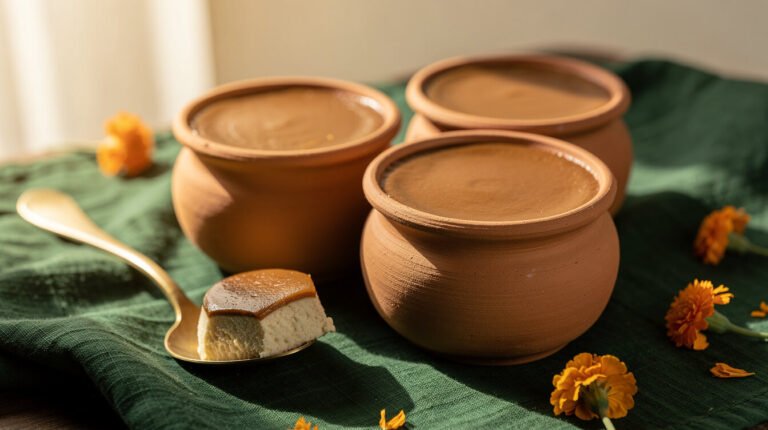
- Mishti doi: sweet yogurt set in clay pots, with Bogura’s the most famous.
After a heavy biryani at a wedding, you’ll also be handed borhani, a spiced, salty yogurt drink with mint and green chili that helps the feast go down.
Pitha season
Winter is pitha season. Pitha are rice cakes, steamed, fried, or griddled, made with new-harvest rice flour and often sweetened with khejur gur (date palm jaggery) that’s only fresh in the cold months. Bhapa pitha is steamed with jaggery and coconut inside. Chitoi pitha is a plain griddle cake eaten with curry or molasses. Patishapta is a thin crepe rolled around coconut and jaggery. The season grows out of Nabanna, the harvest festival of new rice, and pitha fairs pop up across Bangladesh, and in diaspora community halls, every winter.
Bangladeshi food abroad: from Brick Lane to Jackson Heights

Here’s a fact that surprises a lot of British people. Many of the UK’s “Indian” restaurants have long been run by Bangladeshis, most with roots in Sylhet. Sylheti seamen (lascars) settled in Britain in the early 20th century, and their families built the curry house trade. Brick Lane in East London, nicknamed Banglatown, is the best-known result. The menus there, though, are often curry house classics rather than what those same families eat at home.
In the US, Jackson Heights in Queens, Hamtramck in Michigan, and Paterson in New Jersey have Bangladeshi grocery stores, sweet shops, and restaurants where you can find home-style bhorta, kacchi, and fuchka. In Canada, the Danforth area of Toronto plays the same role. Opening hours and menus change, so check before you make the trip.
The real Bangladeshi food in the diaspora, though, lives at home. It’s in the freezer full of fish from the Bangladeshi store, the steel tiffin carrier going home with leftovers, the jar of achar (pickle) somebody’s mother made, and the rice cooker that has never once been unplugged. If you want to learn, the best recipe source is still the same. Call your nani. She’ll tell you the real recipe, then tell you that you’re doing it wrong.
Frequently asked questions about Bangladeshi food
Is Bangladeshi food the same as Indian food?
No, though they share a lot. Bangladeshi food is closest to the cooking of West Bengal, since Bengal is one cultural region split between two countries. Compared with the North Indian dishes most Western restaurants serve, Bangladeshi food uses more fish, more mustard oil and mustard seed, more mashed bhorta, and less cream.
Is Bangladeshi food spicy?
It can be. Green chilies show up in almost everything, and Chattogram and Sylhet cook hot. Plenty of everyday food is gentle, though, like dal, bhaji, and khichuri, and heat is often added at the table with a raw chili on the side.
What is the national dish of Bangladesh?
There is no single official national dish, but most Bangladeshis would point to rice with ilish, the national fish. Kacchi biryani is the most common answer for celebration food.
What should I order at a Bangladeshi restaurant for the first time?
Get rice with two or three bhortas, one fish curry (shorshe ilish if they have it), dal, and a kacchi or tehari if you’re hungry. Finish with mishti doi and a cup of cha. Eat the bhorta first.
What do Bangladeshis eat for breakfast?
Typical breakfasts include paratha or ruti (flatbread) with egg, bhaji, or dal, plus tea. In villages, leftover rice from the night before is common, and on Pohela Boishakh many families eat panta bhaat.
Bangladeshi food is a plate of rice, a little of everything, and somebody insisting you take one more piece of fish. Learn the order, learn the words, and the next time someone asks what you grew up eating, you’ll have the whole answer.
Before you go
Get the next story by email
We write about Bangladeshi heritage and diaspora life every day. The best of it lands in one short weekly email.