
Baul: The Wandering Mystic Singers of Bengal, Explained
Maybe you first heard it at a cousin’s gaye holud, when an older uncle closed his eyes and sang a Lalon song from start to finish without missing a word. Maybe it was on Coke Studio Bangla, or in a playlist your nani kept on repeat. Either way, you heard a voice, a single plucked string, and a melody that sounded older than everyone in the room. That is Baul music, and the people who carry it are the Bauls of Bengal.
Most of what ranks in English for “baul” is a video link or a short note filed under West Bengal. This guide gives you the whole picture: what the word means, who the Bauls are, why Lalon Shah of Kushtia matters so much, what the songs are actually about, the instruments, how Baul shaped Rabindranath Tagore, and where to start listening tonight.
What is Baul? The meaning of the word and the people
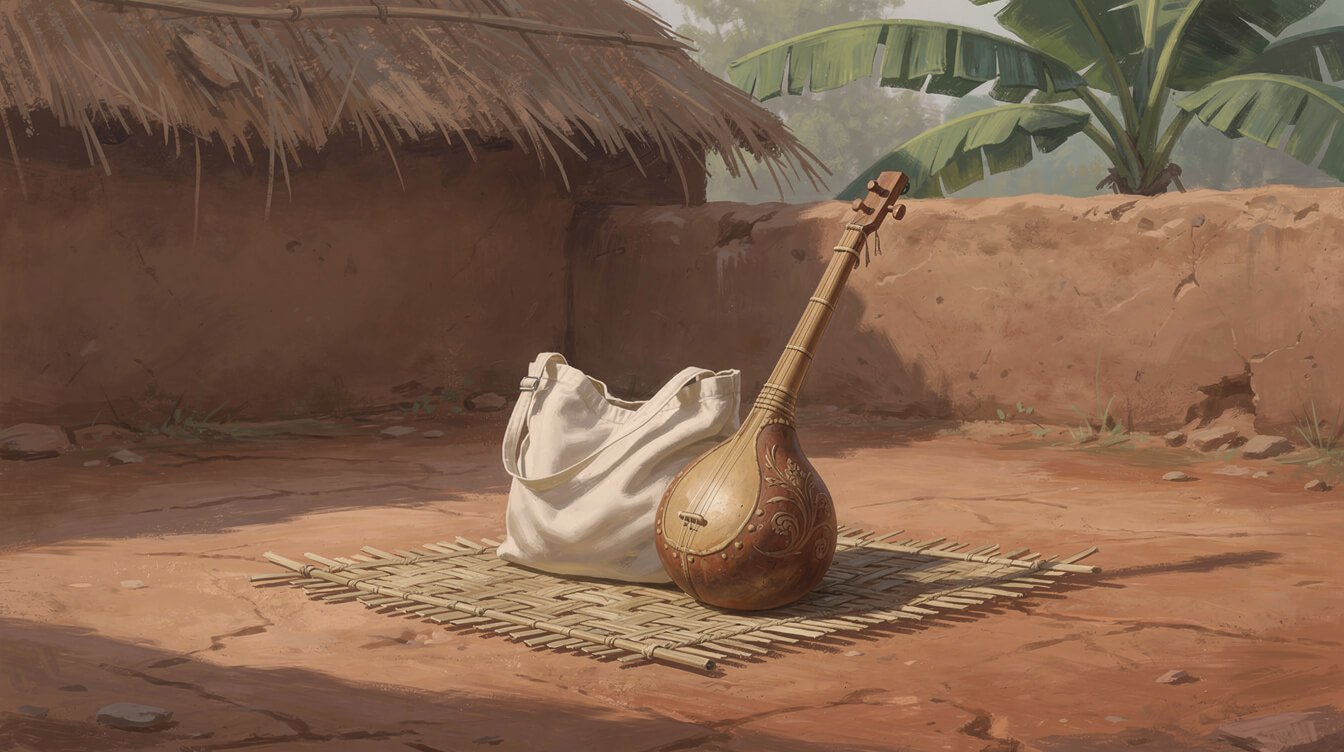
The Baul (বাউল) are mystic minstrels of Bengal: singers, poets, and seekers whose songs are their teaching. You find them in Bangladesh and in the Indian state of West Bengal, with smaller communities in Tripura and Assam’s Barak Valley. Baul is both a musical tradition and a way of life, and the two can’t really be pulled apart.
Where the word comes from
Nobody agrees on the origin of the word, and anyone who tells you otherwise is guessing. The most common view links it to the Sanskrit vatula (mad, crazy) or vyakula (impatiently eager, restless). Either way, the sense is the same: someone “mad” with longing for something beyond the everyday. The word already appears in Bengali texts from the 15th century. If that sounds like an odd thing to call yourself, listen to one of Lalon’s song titles, Tin Pagoler Holo Mela, roughly “the three madmen have gathered.” In Baul language, being a little pagol (mad) is a compliment.
Who becomes a Baul
Bauls come from both Muslim and Hindu families. Many draw on Sufi traditions, many on Vaishnava ones, and a lot of Baul thought sits right where those two meet. The tradition has no single founder, and Bauls are famously uninterested in leaving records behind. Their songs were passed down orally, guru to student, until outside collectors began writing them down at the end of the 19th century.
There are, broadly, two ways to live as a Baul. Some renounce family life and move from one akhra (a Baul gathering place or hermitage) to another, living on alms. Others live with their spouses and children in a village and sing on the side. Shah Abdul Karim, one of the greatest Baul composers of the last century, was married and farmed most of his life.
You can often spot a Baul by the clothes and the instrument. In Bangladesh, Bauls mostly dress in white. In West Bengal, you’ll more often see orange, red, and other bright colors. If you want the wider picture of how this fits into everyday life back home, our guide to Bangladeshi culture from inside the family is a good place to start.
Lalon Shah: the most celebrated Baul of all

Ask any Bangladeshi to name one Baul and you’ll hear the same name: Lalon, also called Lalon Shah, Lalon Fakir, or Lalon Sain. He is widely regarded as the most celebrated Baul in history.
Reliable details about his early life are thin, partly because Lalon himself didn’t talk much about his past. His birth year is traditionally given as 1774. What we do know: he founded his akhra at Chheuriya, about 2 kilometers from Kushtia railway station in southwestern Bangladesh, and he died there on 17 October 1890. He was buried in the middle of the akhra, and a mausoleum and research center were built on the site in 1963.
The songs that made him
Lalon never wrote his songs down. Estimates of how many he composed run from 2,000 to 10,000, and about 800 are generally accepted as authentic. A few you’ve probably heard, even if you didn’t know they were his:
- Shob Loke Koy Lalon Ki Jat Shongshare: “Everyone asks, what is Lalon’s jat in this world?” (jat means caste or community). His answer, more or less: some people wear one kind of prayer beads, some wear another, but nobody is born or buried wearing a label.
- Khachar Bhitor Ochin Pakhi: “the unknown bird inside the cage,” and how it comes and goes. Most listeners hear the cage as the body and the bird as the soul.
- Milon Hobe Koto Dine: “how many days until we meet,” a song of pure longing.
Lalon’s refusal to sort people by caste or creed is a big part of why Bangladeshis of every background claim him. He inspired Rabindranath Tagore and Kazi Nazrul Islam, and even the American poet Allen Ginsberg, who wrote a poem called “After Lalon” in 1992. In 2004, a BBC poll of the Greatest Bengali of all time ranked Lalon 12th, and the same year a bridge over the Padma was named the Lalon Shah Bridge.
The gatherings at Chheuriya
Twice a year, thousands of Bauls, fakirs, and fans fill Lalon’s akhra for three days of songs and conversation. One gathering falls on Dol Purnima, the full moon of the Bangla month of Falgun (February to March). The other marks the anniversary of his death in October. If you are planning a trip home around those dates, Kushtia is worth the detour.
What Baul songs are about: the moner manush
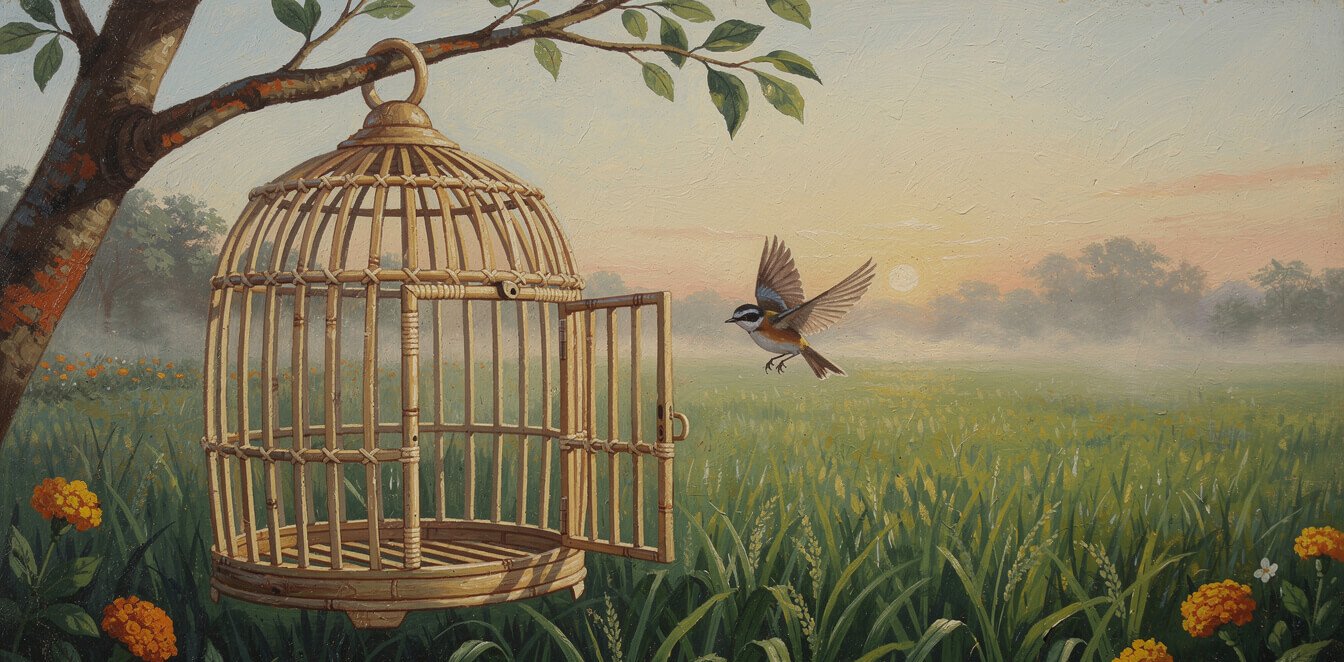
If you remember one phrase from this whole post, make it moner manush: the person of the heart. Baul songs are, again and again, about searching for that person. It might sound like a love song, and it is one, but the Beloved a Baul is looking for is usually something greater, hidden inside the seeker.
The search is inside you
UNESCO’s description of the tradition puts it simply: Bauls emphasize the human body as the place where God resides, and they do not identify with any organized religion, caste, or particular temple. That is why so many Baul songs gently tease outward labels and point inward instead. You don’t need theology to feel it. You only need to have once looked for something everywhere except where it actually was.
Rivers, ferries, and markets
The other thing you’ll notice is how rural and concrete the imagery is. Baul songs talk about boats and ferrymen, the far shore of a river, a market at closing time, a bird in a cage, a field at harvest. Lalon’s Pare Loye Jao Amay is literally “take me across,” a passenger calling to the boatman. These are images every Bengali village knows, which is exactly why the songs travel so well.
For a lot of us in the diaspora, that is the gut-punch. A Baul song sounds like the desh your parents describe: a river, a tin roof, a field outside the window. If your heart lives in a gram (village) you’ve only visited in summer, our Amar Gram Amar Roots Bangladesh Village Hoodie was made for exactly that feeling: “my village, my roots.”
Old songs, new words
Baul is not a museum piece. The tradition has always absorbed the present. Researchers note that newer Baul compositions mention mobile phones, radio channels, football matches, and television, using today’s vocabulary to talk about the same old questions. UNESCO describes the language of the songs as “continuously modernized.” The search for the moner manush just picked up a phone signal.
Baul instruments: the ektara, dotara, and friends
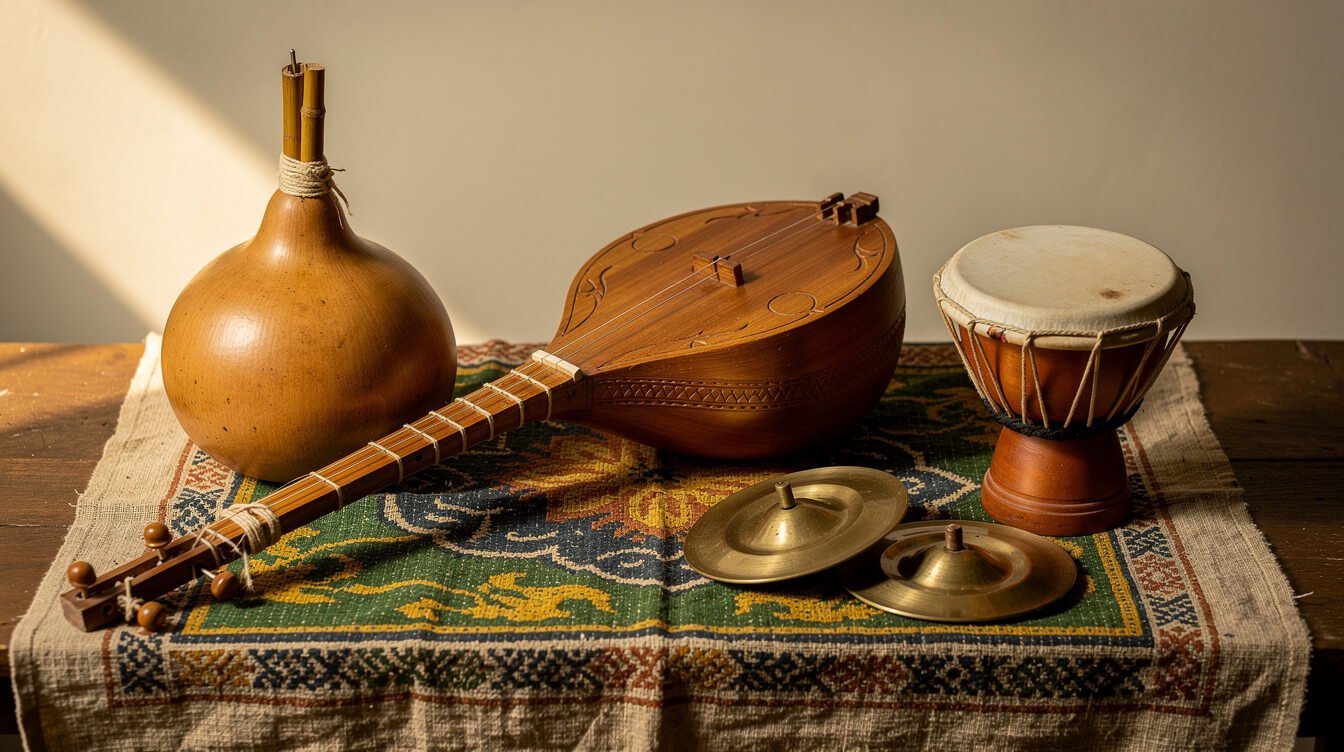
Baul music is built to travel. Almost everything a Baul plays can be carried on one shoulder, and several instruments can be made from things found around a village home.
Ektara: one string, endless sound
The ektara (literally “one string”) is the instrument most people picture when they hear the word Baul. It is a gourd covered with skin, with a split bamboo neck rising from it and a single string running down the middle. The player plucks the string with one finger and squeezes the two halves of the bamboo neck to change the tension, bending the pitch up and down. There are no markings telling you where the notes are. You find them by ear, which feels very Baul.
Dotara: “two strings” that usually has four
The dotara is a long-necked, fretless lute, traditionally carved from jackfruit or neem wood, often with a peg box shaped like a peacock or swan head. The name means “two strings,” but most dotaras today have four metal strings. It is old: a 14th-century Assamese Ramayana mentions it, and Bauls and fakirs later made it their own. It is common across Bangladesh, Assam, West Bengal, and Bihar.
Drums, cymbals, and ankle bells
The khamak is a one-headed drum with a string attached. The player holds the drum under one arm, pulls the string tight with that hand, and plucks it with the other, which gives a twangy, talking sound. Add a small hand drum (the duggi), the larger khol and dhol, small cymbals called kartal and manjira, a bamboo flute, and ghungur (ankle bells), and you have a full Baul ensemble. The ankle bells are there for a reason: Bauls dance while they sing.
Not everyone loves what happens when Baul meets a studio. Purna Das Baul, one of the most famous Baul singers of West Bengal, has argued that mixing the ektara with modern sounds is “destroying the true beauty” of Baul music. Others argue fusion is how the next generation finds the old songs at all. Both sides love the music. That argument will probably outlive all of us.
Letters from home
A little more desh in your inbox
One short email a week: the story behind a symbol, a festival, or a dish, plus new designs from the shop. No spam. Unsubscribe anytime.
How Baul shaped Rabindranath Tagore
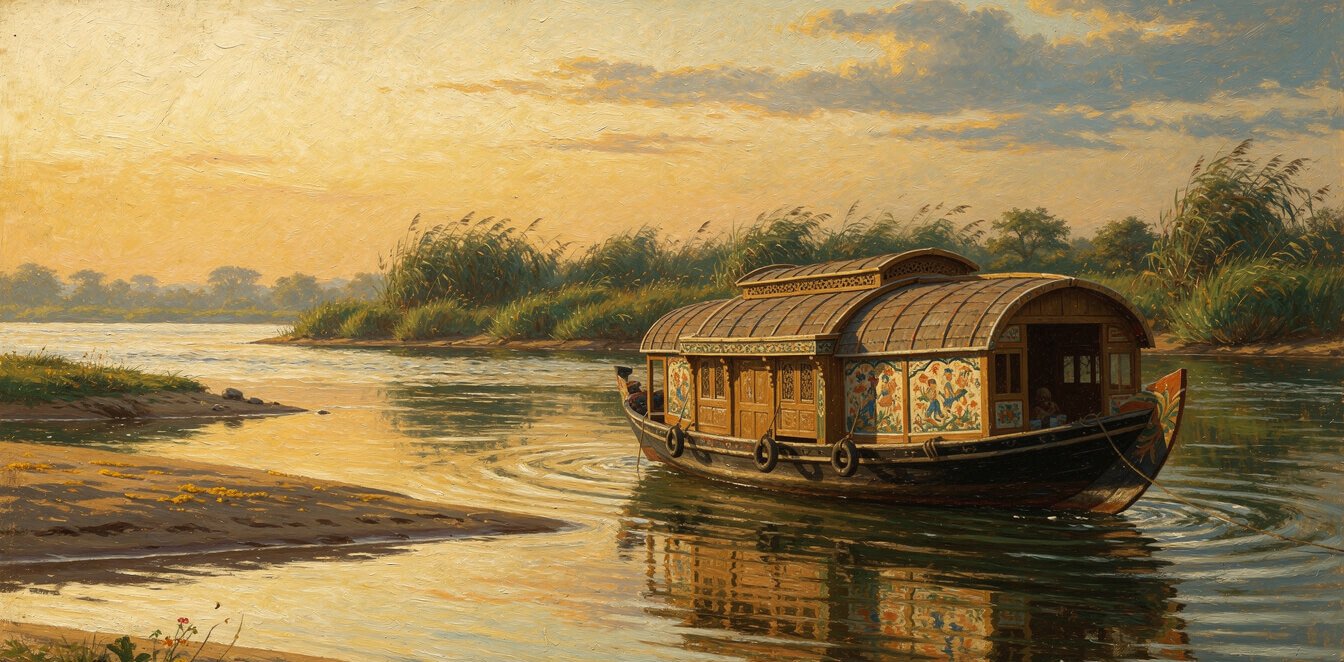
Here is the part of the story that surprises people. Rabindranath Tagore, Bengal’s Nobel-winning poet, owed a real debt to the Bauls, and part of that story happened in what is now Bangladesh.
The postman who sang
The Tagore family managed estates in the Kushtia region, and Lalon lived within their lands. Tagore spent long stretches at Shelaidaha, on the Padma. The local postman there was a man named Gaganchandra Das, known as Gagan Harkara (harkara means messenger or postman). Gagan delivered and collected Tagore’s letters, and he was also a Baul poet. Tagore was collecting Gagan’s songs as early as 1889, and he later published one in the magazine Prabasi. He published some of Lalon’s songs in Prabasi too, bringing them to readers in Kolkata.
Gagan’s most famous song is Ami Kothay Pabo Tare, Amar Moner Manush Je Re. Tagore rendered its opening in English like this:
“Where shall I meet him, the Man of my Heart? He is lost to me and I seek him wandering from land to land.”
From Baul tune to Tagore song
Tagore talked about the Bauls in lectures he gave in Europe in the 1930s, and an essay drawn from them appears in his English book The Religion of Man. More importantly, you can hear the Bauls in his music. Many of his songs carry Baul tunes and Baul ideas. His Amar Praner Manush Achhe Prane (“the man of my heart lives inside me”) is the moner manush idea almost word for word. UNESCO’s own description of Baul singles out Tagore’s compositions in particular as shaped by Baul music and way of life, and Kazi Nazrul Islam was influenced by Baul music as well.
This is One Bengal heritage at its best: a postman in Kushtia, a poet on the Padma, and songs that now belong to both Bangladesh and West Bengal. If Tagore is your poet too, our Rabindranath Tagore Ekla Cholo Re Bengali Poet T-Shirt carries his portrait and one of his best-loved lines: if no one answers your call, walk on alone. It is Tagore’s song, not a Baul one, but any wandering Baul would understand the advice.
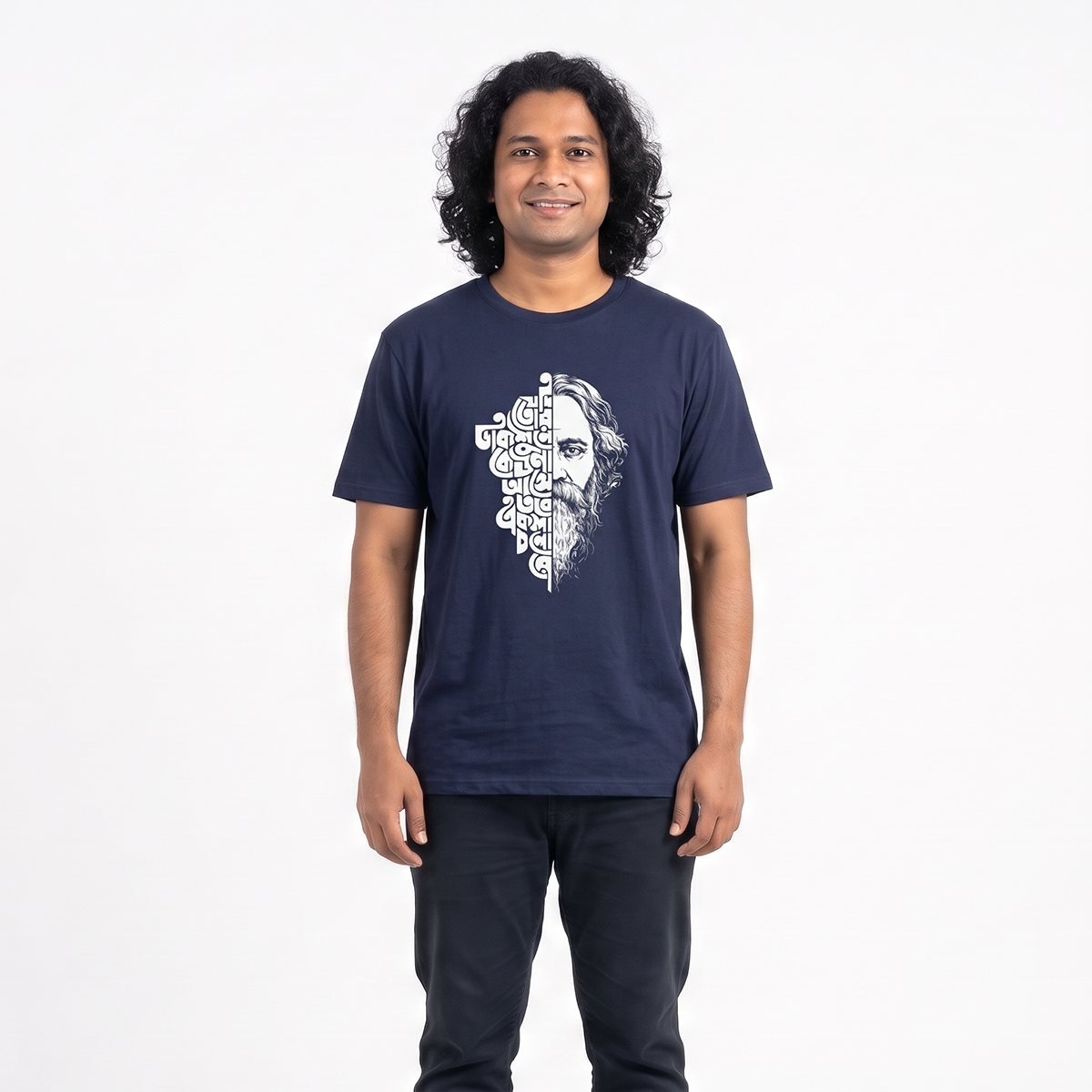
Walk on alone, sing on anyway
Tagore’s portrait drawn half in Bengali calligraphy, with the words of Ekla Cholo Re woven into the lines. For the poet in the family, and for anyone who learned his songs from a parent’s humming.
Baul today: UNESCO, festivals, and Coke Studio

In 2005, UNESCO proclaimed the Baul songs of Bangladesh a Masterpiece of the Oral and Intangible Heritage of Humanity, and in 2008 it inscribed them on its Representative List of the Intangible Cultural Heritage of Humanity. UNESCO notes that the Baul movement peaked in the 19th and early 20th centuries and has regained popularity in rural Bangladesh.
Where Bauls gather
- Chheuriya, Kushtia (Bangladesh): Lalon’s akhra, at Dol Purnima in spring and on his death anniversary in October.
- Jaydev Kenduli, Birbhum (West Bengal): a fair held at Makar Sankranti in mid-January, in memory of the poet Jayadeva. So many Bauls come that people simply call it the Baul fair.
- Santiniketan (West Bengal): Bauls perform at the Poush Mela, the winter fair in Tagore’s university town.
- Kolkata: the Baul Fakir Utsav, an annual festival since 2006 that brings in Bauls from both sides of the border.
In Bangladesh, the Bangladesh Shilpakala Academy also regularly organizes national and international festivals and seminars on Baul music.
From the akhra to your headphones
For a lot of younger Bangladeshis, the door into Baul was fusion. Habib Wahid’s debut album, Krishno, brought Shah Abdul Karim’s songs back into the mainstream in the early 2000s, on an album heavily influenced by British Bangladeshi musicians of Sylheti origin who already knew Karim’s work. (If you grew up Sylheti in London or New York, you know how that bridge works. Our guide to Bangladeshi languages, Sylheti included explains why.) Lalon Band, a folk-rock group from Khulna, built its sound around Lalon’s songs. And when Coke Studio Bangla launched on 7 February 2022, its first season focused on the folk heritage of Bangladesh, which meant a lot of younger listeners met Bangladeshi folk music for the first time on a phone screen.
Bauls and Bob Dylan
Here is a fact to win any family argument. The cover of Bob Dylan’s 1967 album John Wesley Harding shows a squinting Dylan standing between two Bengali Bauls, the brothers Luxman and Purna Das, who had been brought to Woodstock by Dylan’s manager. Purna Das went on to perform around the world, and in 2013 India awarded him the Padma Shri. Baul made it to American rock history decades before most of our parents made it to JFK.
Where to start listening: Baul singers to know

Here is a short, honest starter list. Search the names, put on a pot of cha, and listen to the words.
Lalon songs
Start with Lalon’s own songs. In Bangladesh, the voice most families connect with them is Farida Parveen, renowned for her Lalon recordings. Lalon songs were mostly sung within Baul circles until, after independence, established singers like her carried them to city audiences. Anusheh Anadil is also internationally known for singing Lalon.
Shah Abdul Karim, the Baul Samrat of Bangladesh
Shah Abdul Karim (1916 to 2009) was born in Derai in Sunamganj, Sylhet, and is called Baul Samrat, the Baul Emperor. He wrote and composed more than 1,600 songs and received the Ekushey Padak, one of Bangladesh’s highest civilian honors, in 2001. Start with Keno Piriti Baraila Re Bondhu and Ashi Bole Gelo Bondhu. Sylheti families, this one is yours.
Purna Das Baul and Parvathy Baul from West Bengal
On the West Bengal side, Purna Das Baul (born 1933 in Birbhum) is also widely known as Baul Samrat, and his recordings with his family are a classic entry point. Parvathy Baul is one of the best-known women Baul singers today. She trained under the Baul gurus Sanatan Das Baul and Shashanko Goshai Baul in Bengal, performs with an ektara and a duggi, and runs a school for Baul music in Kerala.
One song to start tonight
If you only listen to one thing, find a recording of Gagan Harkara’s Ami Kothay Pabo Tare. It is short, the melody sticks, and now you know the story of the postman behind it. Then call your nana or nani and ask which Baul song they grew up with. You’ll get a name, a memory, and probably a performance. Need more family context? Our post on Bengali people, from Dhaka to Kolkata to Queens covers the shared heritage that makes Baul belong to both sides of the border.
Baul FAQ
What does the word baul mean?
The origin is debated. The most common explanations connect it to the Sanskrit vatula (mad) or vyakula (restless, eagerly longing). In practice it describes someone “mad” with spiritual longing, and the word appears in Bengali texts from the 15th century.
Is Baul from Bangladesh or India?
Both. Baul is a tradition of the whole Bengal region, alive in Bangladesh and in West Bengal, with smaller communities in Tripura and Assam. UNESCO’s listing is under Bangladesh, and Lalon’s akhra is in Kushtia, but some of the biggest Baul gatherings, like the Jaydev Kenduli fair, happen in West Bengal.
Who is called Baul Samrat?
In Bangladesh, Baul Samrat (Baul Emperor) means Shah Abdul Karim of Sunamganj. In West Bengal, the same title is used for Purna Das Baul. Same crown, two kings, one Bengal.
Who is a famous female Baul singer?
Parvathy Baul is one of the best-known women Baul singers performing today. In Bangladesh, Farida Parveen is renowned for her Lalon songs, and Nigar Sultana Sumi, who leads Lalon Band, is widely recognized as a Baul singer in both Bangladesh and West Bengal.
What instrument do Bauls play?
The signature instrument is the ektara, a one-string gourd instrument. Bauls also play the dotara (a long-necked lute), the khamak, small hand drums, cymbals, the bamboo flute, and ankle bells for dancing.
Is Baul a religion?
Baul is best described as a spiritual and musical tradition. It draws on Sufi and Vaishnava strands, and Bauls come from both Muslim and Hindu families. UNESCO notes that Bauls do not identify with any organized religion or with the caste system. For most listeners, Baul is simply the music of longing, and that is a fine place to start.
Baul survived for centuries without a single book, a single founder, or a single building to call its own. It survived because people kept singing. So keep singing. Learn one Lalon song, play it for someone who doesn’t know it yet, and wear your roots.
Before you go
Get the next story by email
We write about Bangladeshi heritage and diaspora life every day. The best of it lands in one short weekly email.