
Magpie Robin: The Doyel, National Bird of Bangladesh
If you grew up spending summers in the desh, you already know this bird, even if you never knew its English name. The magpie robin is the little black-and-white bird on the tin roof, the one hopping across the courtyard with its tail stuck straight up like an exclamation mark, the one singing on the electric wire before the azaan or the temple bell or the first rickshaw horn. In Bangladesh we call it the doyel (also spelled doel; দোয়েল in Bangla script), and it is the national bird of Bangladesh.
This guide covers what the oriental magpie robin actually is, why a bird this small became a national symbol, how to tell the males from the females, what makes its song special, and where it shows up in Bangladeshi life, from a famous square in Dhaka to an old two-taka note. Send it to the cousin who has a school project due, or to the American friend who asked why there is a bird on your shirt.
What is a magpie robin?
The oriental magpie robin, scientific name Copsychus saularis, is a small songbird from South and Southeast Asia. It is about 19 centimetres (7.5 inches) long, and a good chunk of that is tail. Banglapedia, the national encyclopedia of Bangladesh, describes it simply as a “bulbul-sized” bird, which is the most Bangladeshi unit of measurement possible.
The name is a bit of a trick. It is called a “magpie” because of the black-and-white pattern, and a “robin” because of its shape and its upright, alert posture. It is neither a true magpie (those are crows) nor an American robin. Scientists used to file it with the thrushes, but it is now placed in the Old World flycatcher family, Muscicapidae, the same family as the European robin.
Where magpie robins live
The species is a resident breeder, which means it stays put all year and does not migrate. Its range runs across Bangladesh, India, Nepal, Sri Lanka, and eastern Pakistan, then east through Thailand, Malaysia, Singapore, Indonesia, and southern China. In Sri Lanka it is called polkichcha; in southern Thailand, binlha.
What it does not do is hide. The magpie robin likes open woodland, farmland, and gardens, and it is happiest close to people. It nests in tree hollows, in holes in walls, under the eaves of buildings, and it will happily move into a nest box. Banglapedia notes that it is “usually not afraid of human habitations.” Anyone who has been woken up by one outside their nanu’s window can confirm.
Where the name “saularis” comes from
The Latin name has a funny history. Early European naturalists heard the Indian name dhyal and assumed it had something to do with a sundial, which gave the bird its odd scientific spelling. The naturalist Edward Blyth later argued that saularis was really a Latinized version of a Hindi name, saulary, which may mean “a hundred songs.” Whichever story you believe, the “hundred songs” version fits the bird a lot better than the sundial.
Why the magpie robin is the national bird of Bangladesh

Plenty of countries pick a bird that looks good on a coat of arms: an eagle, a falcon, a peacock. Bangladesh picked the bird that lives next door.
The proposal is usually credited to Kazi Zakir Hossain, a professor at Dhaka University, and the reasoning was simple. You can see the doyel everywhere in the country, in towns and in villages, in Dhaka apartment courtyards and on bamboo fences in Sylhet. It is not a bird you need a boat trip or a pair of binoculars to find. It belongs to everyone.
The numbers back that up. A Daily Star column on national birds notes that of the roughly 700 bird species that can be seen in Bangladesh, the doel “is one of the most common.” The full column is a lovely read if you want to see how Bangladesh’s choice compares with the bald eagle and the Philippine eagle.
There is something very Bangladeshi about that choice. It is the same instinct that made the shapla, the humble water lily of every village pond, the national flower. Not the rarest thing. The thing that is always there.
One Bengal, one doyel
The doyel is not only Bangladesh’s. It sings just as loudly across the border in West Bengal, and Bengalis on both sides use the same word for it. Ornithologists even note that the magpie robins in Bangladesh and Bhutan carry a little more black on the tail than birds farther west, and that eastern population was once named as its own race. The bird has never cared about borders, and that is part of its charm.
How to tell a male magpie robin from a female

This is the part that surprises people. The crisp black-and-white bird on every poster and every shirt is the male. The female is the same shape, with the same pattern, but painted in a softer palette.
- Male: glossy blue-black head, throat, breast, and back. Clean white belly. A long white stripe along the wing. A black tail with white outer feathers.
- Female: the same layout, but the black is replaced by slate grey and brownish grey, and the underparts are a greyer white. Banglapedia puts it as “black portions are replaced by brown and slaty grey.”
- Young birds: brownish and scaly-looking on the head and back, before they grow into adult colors.
Both sexes share the signature move: the tail held cocked upright while the bird hops along the ground or perches in plain view. If you see a black-and-white bird with its tail pointing at the sky, you are almost certainly looking at a doyel.
What a magpie robin eats
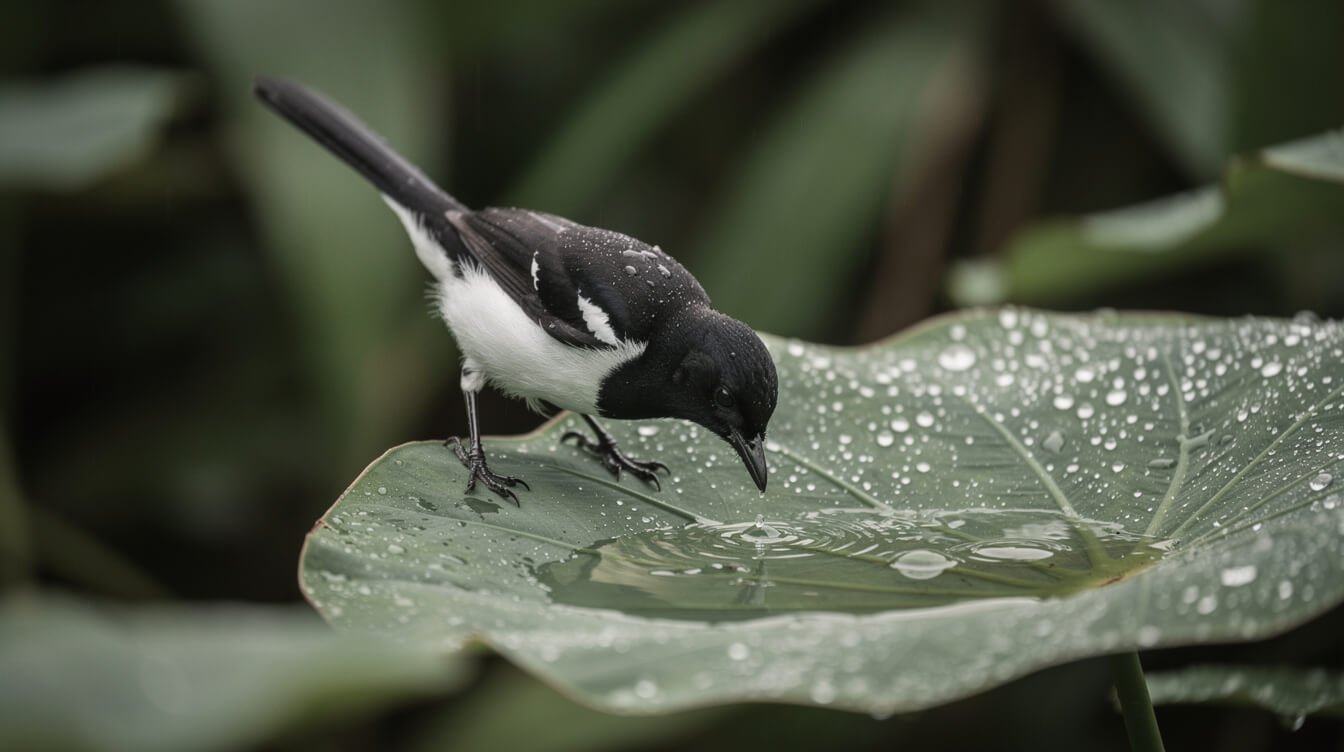
Mostly insects. Banglapedia lists insects, snails, earthworms, centipedes, small lizards, and some plant matter. Researchers have also recorded the occasional sip of flower nectar, and even geckos, leeches, and small fish. They feed largely on the ground, which is why you so often see one working its way across a courtyard, or across freshly dug soil after rain. They have also been seen bathing in rainwater that collects on tree leaves, which is about the most monsoon thing a bird can do.
The song of the doyel

Ask anyone from Bangladesh what they remember about the doyel and they will talk about the song. Banglapedia describes it as “a spirited, clear, rather thin and varied whistling,” divided into short phrases repeated over and over, “occasionally interlarded with mimicry of calls of other birds.” In plain English: it sings a lot, it sings well, and it borrows other birds’ lines.
A few things make the magpie robin’s song more interesting than it first sounds.
- It is seasonal. The bird goes fairly quiet outside the breeding season. In Bangladesh, Banglapedia gives the breeding season as February to July, with the peak in April and May. So the doyel is at its loudest right around Pohela Boishakh, which feels correct.
- It has dialects. Studies of magpie robin song have found that neighboring birds sing in slightly different “dialects,” a bit like how your Sylheti and Chittagonian relatives say the same thing very differently.
- It is a performance. During courtship the male puffs out his chest, points his bill stiffly at the sky, fans his tail, and struts in front of rivals. He sings from the highest perch he can find: the top of a tree, a TV antenna, the edge of a roof.
- It is territorial. Males defend their patch hard in the breeding season. They respond to the songs of intruders, and they have even been seen squaring up to their own reflections.
Many of us first heard that song through a bedroom window in the desh, half asleep and jet-lagged, and only realized years later that it was the national bird giving us a private concert. If you want that bird on your chest, our Oriental Magpie-Robin National Bird Bangladesh T-Shirt catches him in exactly that pose: beak open, tail up, mid-song on a golden branch.
Letters from home
A little more desh in your inbox
One short email a week: the story behind a symbol, a festival, or a dish, plus new designs from the shop. No spam. Unsubscribe anytime.
The doyel in everyday Bangladesh: Doel Chattar and the two-taka note
For a small bird, the doyel turns up in a lot of places once you start looking.
Doel Chattar, Dhaka
The most famous is Doel Chattar, or Doel Square, on the University of Dhaka campus in Shahbag. In the middle of the square stands a sculpture of two magpie robins, designed by the architect Azizul Jalil Pasha. The square sits right in front of Curzon Hall, the red-brick landmark of Dhaka University, so for generations of students “meet me at Doel Chattar” has been an easy instruction.
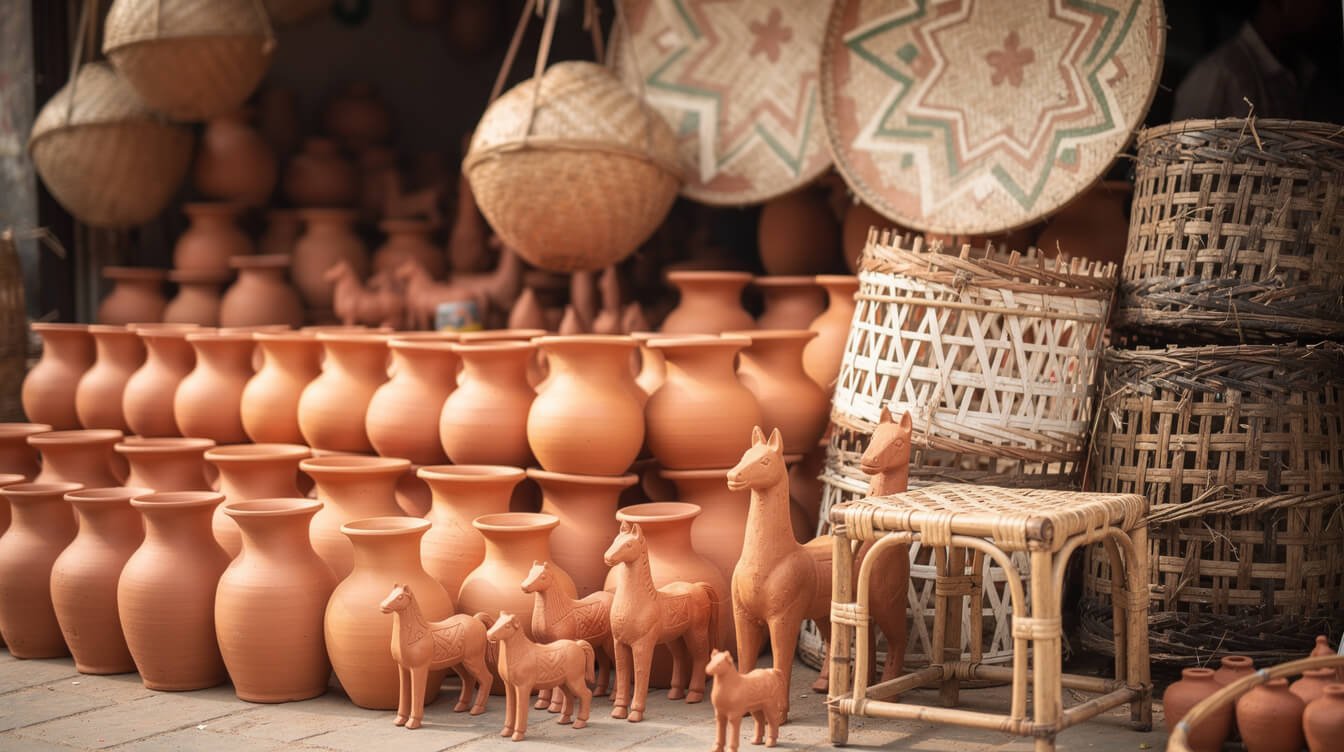
Doel Chattar is also one of the best places in Dhaka to buy traditional crafts. By one count there are around 40 pottery shops and 50 bamboo, cane, and wood handicraft shops around the square. Expect terracotta pots and pitchers, clay toys and clay birds, jute shika (hanging rope baskets), Baishakhi bangles, painted kulo (winnowing trays), bamboo flutes, and gourd ektara, the one-string instrument of the Baul singers. It is a good place to buy gifts to bring home, and a good place to remember how much of Bangladeshi design is handmade.
If Doel Chattar and Curzon Hall are where you spent your student years, or where your parents did, our Curzon Hall Dhaka University Watercolor Wall Art puts that red-brick facade, palm trees, and green lawn on your wall.
The two-taka note
Ask a Bangladeshi parent where they saw the doyel growing up and many will say: in their wallet. According to Bangladesh Bank, the two-taka note issued on 28 January 2007 carries the Shaheed Minar of the Language Movement on the front and “the National Bird-Doyel” on the back. You can see the official description on Bangladesh Bank’s two-taka page. That pairing of the Language Movement memorial and the doyel says a lot about which symbols Bangladesh holds closest: language and the everyday.
The rooftop doyel
And then there is the doyel nobody built a monument to: the one on your nani’s roof. Because the magpie robin nests in wall cavities and under eaves, it lives in and around houses in a way few wild birds do. For a lot of diaspora families, the doyel is less a national symbol and more a neighbor.

The doyel, mid-song
Our Oriental Magpie-Robin National Bird Bangladesh T-Shirt prints a male doyel in full color, beak open and tail cocked, singing on a golden branch. The bird from your nani’s rooftop, the national bird of Bangladesh, on a soft everyday tee.
The magpie robin and its fellow national symbols

The doyel is one of a set. Here is the full lineup of the natural national symbols of Bangladesh, the list every Bangladeshi kid memorizes for school:
- National bird: the oriental magpie robin, the doyel.
- National animal: the Royal Bengal tiger, bagh. We wrote a full guide to the national animal of Bangladesh and the Sundarbans.
- National flower: the water lily, shapla, which also sits at the center of the national emblem.
- National fruit: the jackfruit, kathal.
- National tree: the mango tree.
- National fish: the ilish (hilsa). More on that in our insider’s guide to Bangladeshi food.
- National instrument: the dotara, the folk lute of the Baul singers.
Look at that list and a pattern jumps out. Apart from the tiger, almost every symbol is something ordinary Bangladeshis meet every day: a pond flower, a fruit tree in the yard, the fish on the Sunday table, the bird on the roof. The country chose symbols you can actually touch. If you want the bigger picture of how all these pieces fit together, our guide to Bangladeshi culture is a good next read.
Is a magpie robin the same as an American robin?
No, and this is the question every diaspora kid gets asked eventually. The robin in American backyards, with the orange breast, is a thrush, Turdus migratorius. It is a completely different bird from a different family, and it got the name “robin” because early English settlers were reminded of the robin back home.
The magpie robin’s real relatives are other Old World flycatchers and chats. A few of its family members worth knowing:
- The European robin. The red-breasted garden bird of British Christmas cards is in the same family, Muscicapidae. So if you live in London, the bird on your Christmas card is a closer cousin of the doyel than any American robin.
- The white-rumped shama. A long-tailed forest cousin, also famous for its song. You will see it listed right next to the magpie robin in bird guides.
- The Philippine magpie-robin. Once treated as part of the same species, it is now usually recognized as a species of its own.
- The Seychelles magpie-robin. A separate species found only on a few islands in the Seychelles, far out in the Indian Ocean.
Globally, the oriental magpie robin is listed as a species of “least concern,” which is good news. But it is not doing equally well everywhere. In Singapore it was common in the 1920s and declined in the 1970s, partly because of trapping for the pet bird trade. The magpie robin has long been sold as a cage bird across Asia because of its voice. The best place to hear a doyel sing is on a rooftop, free.
Frequently asked questions about the magpie robin
What is the national bird of Bangladesh?
The oriental magpie robin (Copsychus saularis), known in Bangla as the doyel or doel. It was chosen because it is common and can be seen all over the country, in towns and villages alike.
What does “doyel” mean?
Doyel is simply the Bangla name of the bird. It is related to the older Indian name dhyal, which shows up in early European bird books.
Is the magpie robin a magpie or a robin?
Neither, strictly. It is an Old World flycatcher. “Magpie” describes its black-and-white colors and “robin” describes its shape and posture.
When does the magpie robin sing the most?
In the breeding season. In Bangladesh that runs from about February to July, with a peak in April and May. Males sing loudly from high perches.
How can you tell a male doyel from a female?
The male is glossy black and white. The female has the same pattern but in slate grey and greyish white.
Where is the doyel sculpture in Dhaka?
At Doel Chattar (Doel Square), on the University of Dhaka campus in Shahbag, in front of Curzon Hall. The sculpture of two magpie robins was designed by the architect Azizul Jalil Pasha.
Can you see a magpie robin in the US, UK, or Canada?
It lives in South and Southeast Asia, so not in the wild in North America or Britain. For the real song, recordings on bird sites like eBird and xeno-canto are the next best thing, and a summer trip home is the best thing.
Why a small bird is the right symbol
There is a quiet lesson in the magpie robin. Bangladesh could have picked something grand. Instead it picked the bird that wakes up the house, nests in the wall, and sings from the rooftop of a tin-roofed home in Barishal just as loudly as from a tree on the Dhaka University campus. It is small, it is everywhere, it is loud when it matters, and it is not going anywhere.
That sounds a lot like the people, at home and abroad. So the next time someone asks about the black-and-white bird on your shirt, you have the answer: it is the doyel, the magpie robin, the national bird of Bangladesh, and it has been singing outside your nani’s window the whole time.
Call your nani. Ask her what the doyel sounded like when she was a girl. She will have a story.
Before you go
Get the next story by email
We write about Bangladeshi heritage and diaspora life every day. The best of it lands in one short weekly email.