Bangladeshi Culture: A Guide From Inside the Family
Ask ten Bangladeshis to explain Bangladeshi culture and you will get ten answers, three cups of cha (milky tea), and an invitation to stay for dinner. That last part is the answer. Bangladeshi culture lives in the small, stubborn habits: the guest who gets fed first, the elder whose feet you touch on Eid morning, the rice that is always on the stove, the rickshaw painted like a movie poster.
This is a guide from inside the family. It covers what Bangladeshi culture is, who it belongs to, how we eat, what we celebrate, the art you can see from across the street, the music and the poets, the textiles we keep for generations, and how all of it travels to Queens, Hamtramck, and Brick Lane. If you grew up with it, you will nod. If you just married into it, keep reading. There will be food.
What Bangladeshi culture actually means

Bangladesh sits on the largest river delta in the world, where the Padma, the Jamuna, and the Meghna run down to the Bay of Bengal. That geography shaped almost everything: the rice, the fish, the boats, the songs about boats, and the six seasons the Bangla calendar still counts.
Bangladeshi culture is Bengali culture first. The language, the poetry, the food, and festivals like Pohela Boishakh are shared with West Bengal in India, and we say that honestly. Rabindranath Tagore wrote the national anthems of both countries. A Bangladeshi and a Kolkata Bengali can argue about whose roshogolla came first and still share a plate of it. One Bengal, two countries.
What makes it Bangladeshi is the mix. Muslims are around 90 percent of the population, Hindus are the largest minority, and Buddhist and Christian communities have been here for centuries. In the hills and the north live Indigenous peoples with their own languages and festivals: Chakma, Marma, Tripura, Garo, Santal, and many more. Eid, Durga Puja, Buddha Purnima, and Christmas are all national holidays. Nobody needs to explain that to a Bangladeshi kid. It is just the calendar.
And then there is the language. Bangla is the heart of the country’s identity, and the 1952 Language Movement is the reason February 21 is now International Mother Language Day, adopted by UNESCO on 17 November 1999. If you want the full story of Bangla, Sylheti, Chittagonian, and the Indigenous languages, we wrote a whole guide to Bangladeshi languages.
Hospitality, elders, and the house rules of Bangladeshi culture

If you only learn one rule of Bangladeshi culture, learn this one: a guest is never allowed to leave hungry. Drop by for five minutes and you will be handed cha, a plate of shingara (the Bengali samosa) or biscuits, and probably a question about whether you have eaten. Say you are full. It will not matter. The host will insist, and the polite move is to accept a little more.
The rest of the house rules, the ones every second-gen kid knows by heart:
- Shoes off at the door. Always.
- The guest gets the first plate and the biggest piece of fish.
- Pass things with your right hand, or with both hands when you want to show respect.
- Elders come first. You greet them first, you do not cross your legs in front of them, and on Eid or Pohela Boishakh you may bend down and touch their feet. They answer with a blessing, and sometimes with a crisp note of salami (festival money for the kids).
- An invitation to one is an invitation to the family. Invite your coworker Rahim and do not be surprised when Rahim’s mother comes too.
- Nobody says a flat “no” to a dawat (a dinner invitation). We say “I’ll try.” Everyone understands.
Respect also lives in the words. Nobody calls an elder by their first name. Every relative has a precise title: dada and dadi for your father’s parents, nana and nani for your mother’s parents, chacha and fupi for your father’s brother and sister, mama and khala for your mother’s brother and sister. Your mother’s best friend becomes khala too, and so does the nice lady from the grocery store. In a Bangladeshi family, the circle is always bigger than the bloodline.
Food: bhaat, maach, and a serious sweet tooth
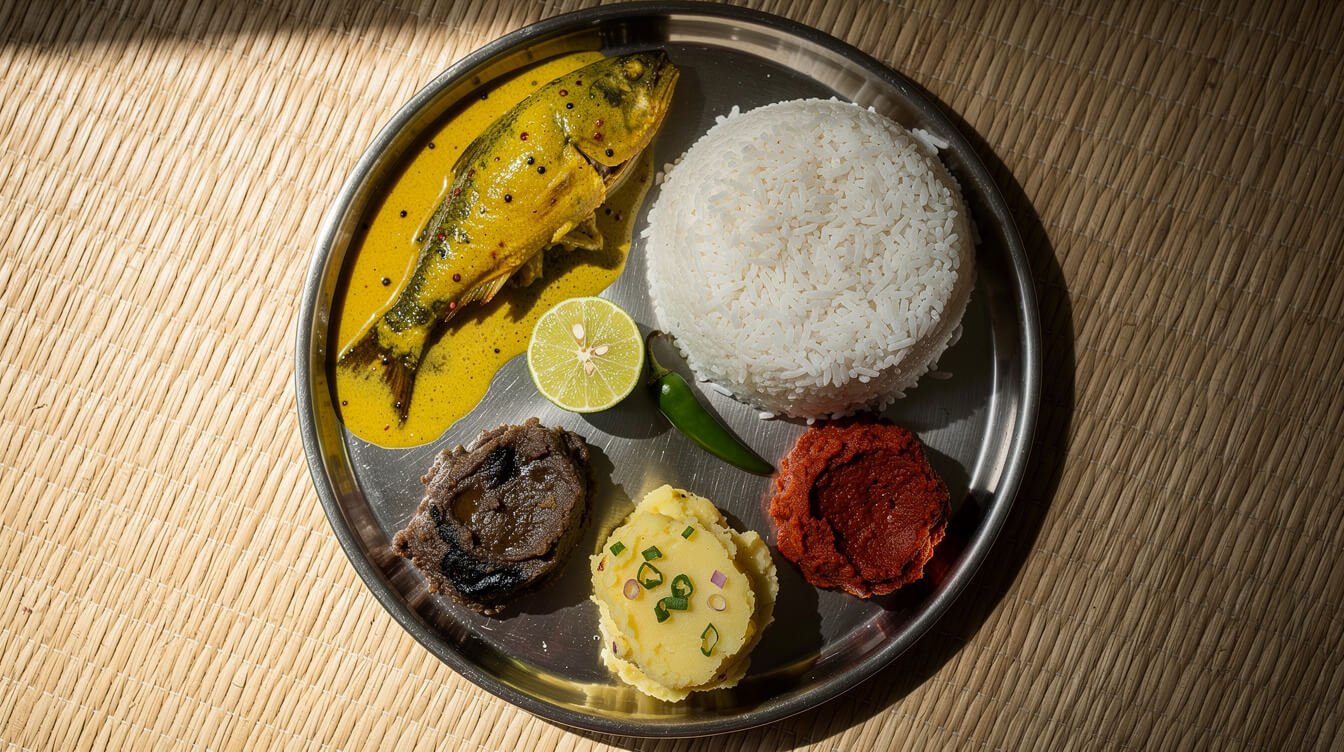
There is an old Bengali saying: maache bhaate Bangali, fish and rice make a Bengali. It is still true. Bhaat (steamed rice) is the center of the plate, and around it go lentils, vegetables, and fish from the rivers and ponds. The ilish (hilsa) is the national fish and the one we will talk about at family dinners for hours, usually in mustard sauce.
Then there is bhorta, which means “mashed”: eggplant charred over a flame, potatoes with raw onion and green chili, dried fish, tomatoes, lentils, all mashed by hand with mustard oil. A good Bangladeshi lunch can have four kinds of bhorta and nobody calls it a lot.
We eat with our right hand, mixing rice and curry with the fingertips. It is not a lack of cutlery. The food tastes better this way, and every Bangladeshi parent will tell you so.
And the sweets. Bangladeshis are proud of their mishti: roshogolla, chomchom, shondesh, and mishti doi (sweet yogurt), with Bogura famous for the last one. Good news, an exam result, a new job, a new baby: someone is bringing a box of mishti to the house. In winter comes pitha, the rice cakes made fresh with date-palm jaggery and coconut.
The last piece is adda, the long, aimless, sacred conversation over cha. A tea stall, a balcony, a cousin’s living room at midnight. Nobody is in a hurry. Our full guide to Bangladeshi food goes dish by dish.
Festivals and the six seasons

The Bangla calendar has six seasons, the choy ritu, each two months long: grishmo (summer), borsha (monsoon), shorot (early autumn), hemonto (late autumn), sheet (winter), and boshonto (spring). The festivals follow the seasons and the harvest.
Pohela Boishakh, the Bengali New Year, falls on April 14 in Bangladesh. Women wear white saris with red borders, men wear panjabi (the long kurta-style shirt), and families eat panta bhaat (soaked rice) with ilish for breakfast. In Dhaka the day opens with songs under the banyan tree at Ramna Park, and the New Year procession from Dhaka University’s Faculty of Fine Arts, with its giant painted masks and animals, was added to UNESCO’s heritage list in 2016. In the Chittagong Hill Tracts, the Chakma, Marma, and Tripura communities celebrate their own New Year festivals at the same time of year.
Nabanna means “new rice.” It marks the harvest of the late-autumn aman rice at the start of the month of Ogrohayon, in mid-November. In villages, the first rice of the season becomes payesh (rice pudding) and pitha, and it is shared with neighbors.
Winter pitha season follows in Poush and Magh. Steamed bhapa pitha, thin patishapta rolled around coconut, and chitoi pitha dipped in date jaggery syrup. Cities hold pitha festivals, and every nani has her own version.
Alongside these come the festivals of faith. Eid al-Fitr and Eid al-Adha empty the cities as everyone goes home to the village. Durga Puja fills the streets with pandals (temporary decorated shrines), and Dhakeshwari Temple in Dhaka draws thousands. Buddhists mark Buddha Purnima, and Christians greet each other on Christmas with Shubho Boro Din, “Happy Big Day.” The calendar also holds the national days: February 21, March 26, and December 16. Every one of them comes with food.
Letters from home
A little more desh in your inbox
One short email a week: the story behind a symbol, a festival, or a dish, plus new designs from the shop. No spam. Unsubscribe anytime.
Rickshaw art and the street as a gallery

Stand on any Dhaka street and the art comes to you, on three wheels. Rickshaw art is the most visible piece of Bangladeshi culture, and it has been painted by hand since the middle of the twentieth century. The back of every cycle rickshaw carries a painted metal panel: peacocks, lotus flowers, tigers, village rivers, mosques, city skylines, film heroes and heroines. The hood is covered in cut-out appliqué shapes, the frame is hung with tinsel and plastic flowers, and every surface that can take paint gets some.
The painters learn as apprentices to a master, an ustad, and the colors are loud on purpose: hot pink, emerald, crimson, and gold, so they stay bright in the sun and the rain. In December 2023, UNESCO inscribed rickshaws and rickshaw painting in Dhaka on its list of the intangible cultural heritage of humanity. The rickshaw walas of Dhaka had been running a moving gallery the whole time. The world finally noticed.
Rickshaw art is also why the peacock on our Rickshaw Art Club Dhaka Bangladesh Heritage T-Shirt looks the way it does: a fanned tail on a crimson oval, lotus flowers and folk vines around it, painted in the same bold palette as a Dhaka rickshaw panel.
Look closely at other parts of the country and you will find more of this everyday art. Terracotta plaques on old temples tell stories in fired clay. Painted clay dolls and horses are sold at village fairs. Cinema banners were once painted by hand too. Bangladeshi art has never been only for galleries.

A Dhaka rickshaw panel you can wear
The Rickshaw Art Club tee puts a rickshaw-style peacock on a crimson oval, framed by lotus flowers and folk vines in the loud, happy colors of a Dhaka street. It needs no words. Anyone who has ridden a rickshaw will recognize it.
Music, poetry, and the words we carry

A river country sings about rivers. Bhatiali songs belong to the boatmen, long and slow like the water. Bhawaiya comes from the north. The Baul are wandering mystic singers whose songs ask about the soul and the body in plain, beautiful words. UNESCO named the Baul tradition a masterpiece of humanity’s oral heritage in 2005 and added it to its heritage list in 2008. The most famous Baul, Lalon, lived in the nineteenth century, and every year people travel to his shrine in Kushtia to sing his songs.
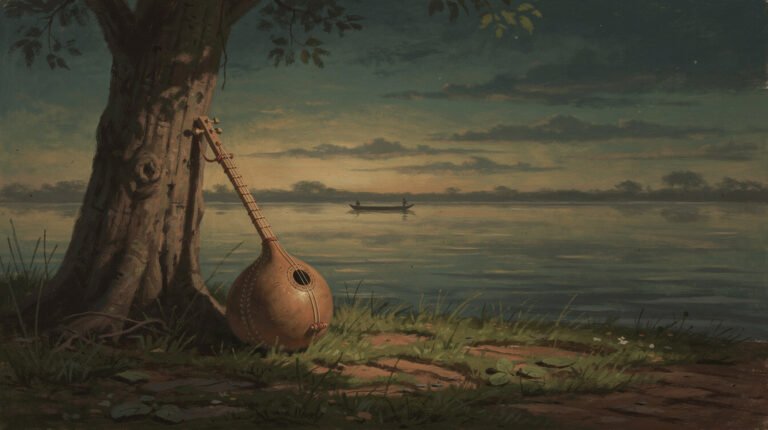
The Baul play the ektara, a one-string instrument made from a gourd and split bamboo, and the dotara, a long-necked wooden lute. Its name means “two strings,” but it usually has four. Add a bamboo flute, a dhol drum, and a pair of small brass cymbals, and you have the sound of a village evening.
Then the poets. Rabindranath Tagore, who won the Nobel Prize in Literature in 1913, wrote Amar Shonar Bangla, the national anthem. Kazi Nazrul Islam, the “rebel poet,” is the national poet of Bangladesh, and his songs, called Nazrul Geeti, are sung at weddings and school functions alike. Ask any Bangladeshi parent to recite a few lines of Nazrul or Tagore, and most of them can. Poetry is not homework here. It is something you know by heart.
Threads: jamdani, nakshi kantha, and what we wear
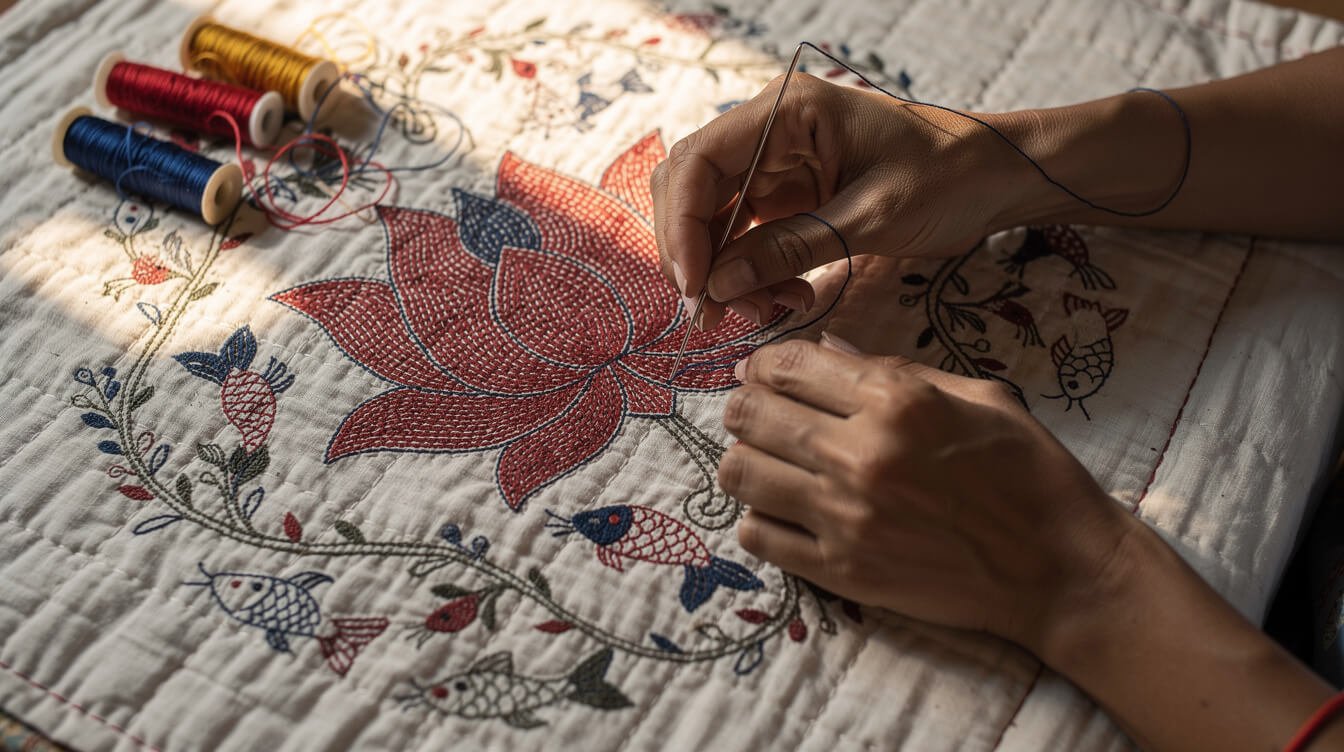
Bangladeshi textiles are some of the finest in the world, and Bangladeshis know it.
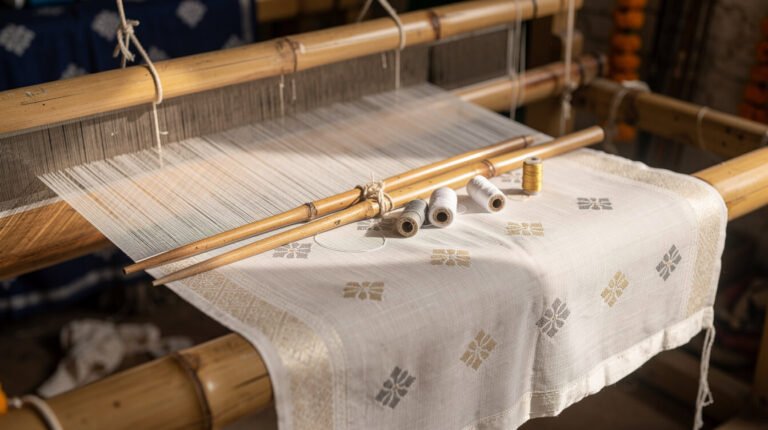
Jamdani is a sheer cotton muslin woven by hand on the banks of the Shitalakshya River in Narayanganj, near Dhaka. The patterns are not printed. Each flower and diamond is added by hand, thread by thread, as the cloth is woven, with the design drawn on graph paper beneath the loom. It was once simply called Dhakai, “from Dhaka.” UNESCO added jamdani weaving to its heritage list in 2013, and a good jamdani sari is still the one that gets saved for the wedding.
Nakshi kantha is the embroidered quilt, and it is the one that makes people cry at family gatherings. Women layered old saris and lungis, stitched them together with the simple running stitch called the kantha stitch, and then embroidered them: a lotus at the center, vines and fish and birds and household objects around it. No two are the same. The poet Jasimuddin wrote a whole poem about one, Nakshi Kanthar Math, “The Field of the Embroidered Quilt.” Kantha is shared heritage with West Bengal too, and on both sides of the border, the quilt your nani stitched is the one nobody is allowed to throw away. If you want that lotus pattern on your sofa, our Traditional Nakshi Kantha Floral Motif Sherpa Blanket borrows the motif for a cold night.
Shital pati, the “cool mat” from Sylhet, is woven from split cane and stays cool to sleep on in the summer heat. It joined UNESCO’s list in 2017.
For everyday clothes, women wear the shari (sari) or salwar kameez, and men wear the panjabi on festival days, the fotua (a short cotton tunic) when it is hot, and the lungi at home. Weddings bring out everything at once. The gaye holud (“turmeric on the body”) is the pre-wedding party where family smear turmeric paste on the bride or groom, everyone dressed in yellow and orange. Then come the wedding itself, the biye, and the bou bhaat, the reception hosted by the groom’s family. And yes, the bride’s cousins will block the door and demand a “gate fee” from the groom. Pay them. It is tradition.
Bangladeshi culture in the diaspora

Bangladeshi culture travels well. In Jackson Heights in Queens, in Hamtramck near Detroit, in Paterson, on Brick Lane in London, and along the Danforth in Toronto, you will find the sweet shops, the fish markets, the Saturday Bangla classes, and the aunties who know everybody.
Growing up between two countries means you carry both. You answer the phone in English and then switch to Bangla when Ammu (Mom) calls. You eat rice for dinner even after a whole day of pizza. Your friends learn that “come over” means “come over and eat.” Your parents’ living room has a kantha on the sofa and a Pohela Boishakh calendar on the wall, and you do not realize until college how much you missed it.
The second generation is doing something interesting with all this. We are wearing jamdani to prom, putting rickshaw art on laptops, and teaching our friends the word adda. We are also asking our nanis for the real recipes before it is too late. Call her this week. She will tell you the pitha recipe, and three stories you have never heard.
Bangladeshi culture is not something you visit once. You keep it by doing it: by feeding the guest, touching the elder’s feet, learning the song, and saving the quilt. Want to start somewhere small? Learn what the shapla means, or the story behind the red and green of the Bangladesh flag.
Frequently asked questions about Bangladeshi culture
What is Bangladeshi culture known for?
Hospitality, rice and fish, sweets, poetry and music, and folk art. UNESCO has recognized Baul songs, jamdani weaving, the Pohela Boishakh procession in Dhaka, shital pati weaving, and Dhaka’s rickshaws and rickshaw painting as intangible cultural heritage.
Is Bangladeshi culture the same as Bengali culture?
They overlap a lot. Bengali language, literature, food, and festivals are shared by Bangladesh and the Indian state of West Bengal. Bangladeshi culture is Bengali culture shaped by its own history, its Muslim-majority population living alongside Hindu, Buddhist, Christian, and Indigenous communities, and the Language Movement of 1952.
What language do Bangladeshis speak?
Bangla (Bengali) is the national language. Many people also speak a regional language or dialect such as Sylheti or Chittagonian, and Indigenous communities have their own languages, such as Chakma and Marma.
What is the traditional dress in Bangladesh?
For women, the sari and salwar kameez. For men, the panjabi on special occasions, the lungi at home, and the fotua in hot weather. Jamdani saris are the most prized.
What are the main festivals in Bangladesh?
Pohela Boishakh (April 14), Eid al-Fitr, Eid al-Adha, Durga Puja, Buddha Purnima, Christmas, Nabanna, and winter pitha festivals, plus the national days on February 21, March 26, and December 16.
Before you go
Get the next story by email
We write about Bangladeshi heritage and diaspora life every day. The best of it lands in one short weekly email.