Jamdani Saree: The Dhaka Weave That UNESCO Recognized, Explained
Somewhere in your mother’s almari (the steel wardrobe every Bangladeshi home seems to have) there is a jamdani saree wrapped in soft white cloth, and nobody is allowed to touch it. It comes out for weddings, for Eid, maybe for Pohela Boishakh. You were told the price once and decided never to spill anything near it again.
That saree is one of the oldest stories Bangladesh tells. A jamdani saree is woven by hand on a bamboo loom near Dhaka, with its flowers and diamonds built into the cloth thread by thread rather than printed or stitched on afterward. In 2013, UNESCO added the traditional art of jamdani weaving to its list of the intangible cultural heritage of humanity. In 2016, jamdani became Bangladesh’s first registered Geographical Indication product.
Most pages about jamdani are shops. This one is the explainer: what jamdani is, where the name comes from, how a jamdani saree is actually woven, what the motif names mean, how the craft got from Mughal Dhaka to UNESCO, and why your khala in Kolkata has one too. Then the part that matters most to the second generation: what a jamdani means once it crosses an ocean.
What is a jamdani saree?

A jamdani saree is a handwoven saree (also spelled sari) made from very fine, sheer cotton, with patterns woven into the fabric on the loom. UNESCO’s description is the cleanest one: jamdani is “a vividly patterned, sheer cotton fabric, traditionally woven on a handloom by craftspeople and apprentices around Dhaka,” and its motifs “are created directly on the loom.”
That last part is the whole point. Hold a jamdani up to a window and the background is almost see-through, light and airy, while the motifs look heavier and seem to float on top of it. They are not embroidery and they are not print. The weaver adds each motif while the cloth is being made, so the pattern is part of the fabric itself.
Jamdani belongs to the muslin family. Banglapedia, Bangladesh’s national encyclopedia, calls it “a fine cloth of muslin group,” and ICHCAP calls it “the only surviving variety of traditional muslins,” the legendary fine cotton that Dhaka was once famous for around the world. If you have heard Bengali grandparents talk about muslin so fine it could be pulled through a ring, jamdani is the branch of that tradition that never stopped being woven.
Most jamdani is a saree, but not all of it. Banglapedia lists jamdani scarves, kurtas, turbans, handkerchiefs, and even screens and tablecloths, and today you will see jamdani panjabis at weddings too. Traditionally the yarn is cotton. These days you will also find half-silk and full-silk jamdani, and the researcher Saifur Rashid, writing for UNESCO’s Asia-Pacific heritage centre (ICHCAP), lists nylon versions as well.
Jamdani vs. muslin vs. tant
People mix these up, so here is the short version. Muslin is the umbrella: very fine handwoven cotton, historically from the Dhaka region. Jamdani is figured muslin, meaning muslin with motifs woven in. A tant saree (from tant, the Bangla word for loom) is the everyday cotton handloom saree, usually heavier and simpler, the one a lot of Ammus actually wore to work.
Where the name “jamdani” comes from
Before it was called jamdani, this cloth was simply called Dhakai, “from Dhaka.” Plenty of Bangladeshis still say Dhakai jamdani or just Dhakai. The word jamdani came into wide use under the Mughals, whose court language was Persian, and it is a Persian word.
What exactly it means is less settled than the internet suggests. Two readings show up in serious sources:
- “Flower vase.” Saifur Rashid, writing for ICHCAP, derives it from jam (floral) and dani (a vase or container), named for the floral patterns of Dhakai muslin. This is the version you will see most often.
- “Diapered cloth.” Banglapedia says the origin of the word is uncertain, and offers jama (cloth) plus dana (buti, a small repeated motif), which would make jamdani “cloth covered in small motifs.”
Both describe the same thing you see: plain cloth with flowers scattered across it. If your nana tells you a third version at dinner, nod respectfully. Words this old usually have more than one story.
One more word worth knowing: Banglapedia notes that the fine fabric made in Mosul, in present-day Iraq, was called mosuli or mosulin, which is where the English word “muslin” comes from. So the cloth Dhaka became famous for carries a name from somewhere else entirely.
How a jamdani saree is woven
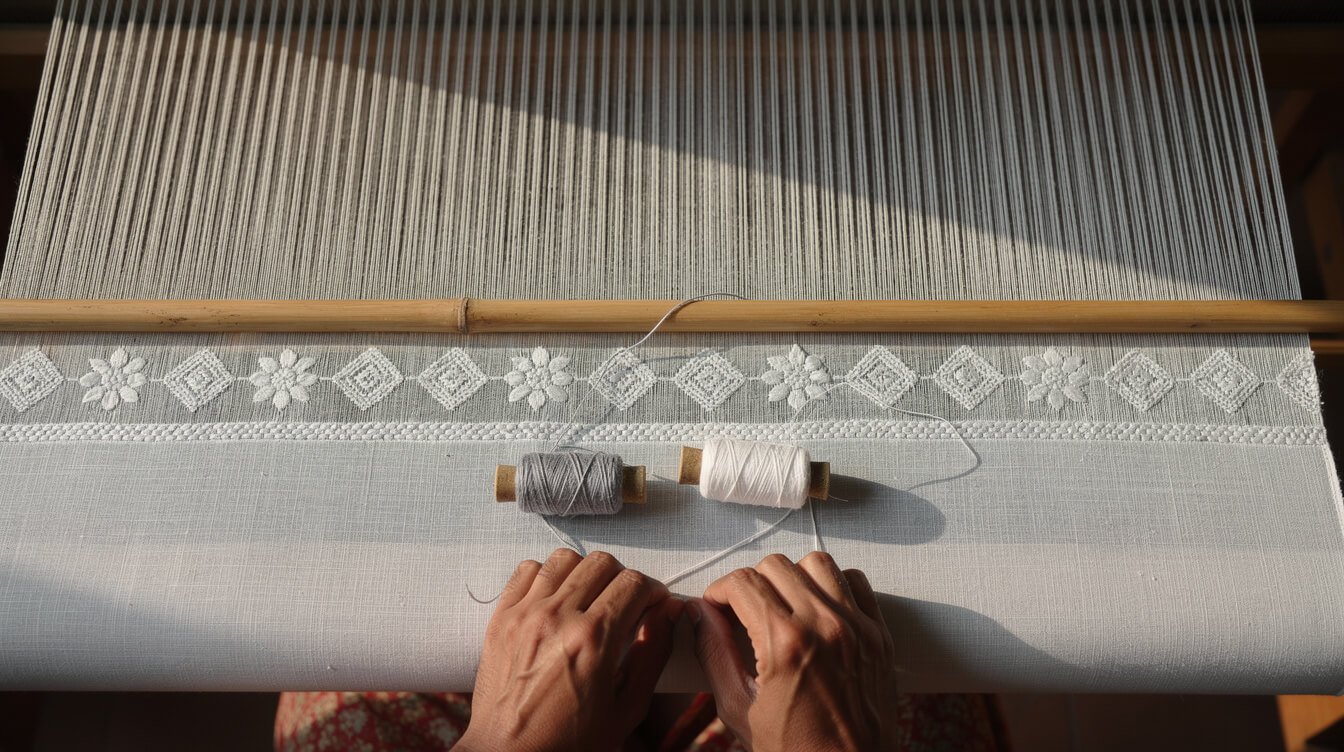
Here is the technical bit, in plain English. Every woven cloth has two sets of threads: the warp, which runs the length of the loom and stays put, and the weft, which the weaver passes back and forth across it. In a jamdani saree, there is a normal fine weft that makes the sheer background, plus a second, thicker supplementary weft that makes the motifs.
That supplementary weft is the magic. It does not run edge to edge. For every single flower, diamond, or vine, the weaver takes a small spool of thicker thread and works it into the warp by hand, using a fine bamboo stick, then goes back to the plain weave, then adds the next piece of the motif on the next pass. UNESCO calls this the “discontinuous weft technique.” Wikipedia’s summary puts it simply: each motif “is added separately by hand.”
Two weavers, one loom
A traditional jamdani loom seats two people side by side. Banglapedia and ICHCAP both describe the pair working together on the delicate designs, passing a small shuttle called a maku for the plain weave and adding the motifs by hand. The loom itself, which weavers call a tant, is often built largely from bamboo. ICHCAP’s photo essay shows looms set up inside family homes along the river, wherever the room allows.
Pattern from memory
Some weavers place a pattern drawn on graph paper underneath the warp and follow it. But the master weavers are famous for not needing one. Banglapedia says expert weavers “do not need to draw the design on paper” and work from instinct, and ICHCAP notes that there is no written record of the many traditional motifs. They live in people’s hands and memories, which is why UNESCO stresses that jamdani is passed down “by parents to children in home workshops.”
Rice starch and patience
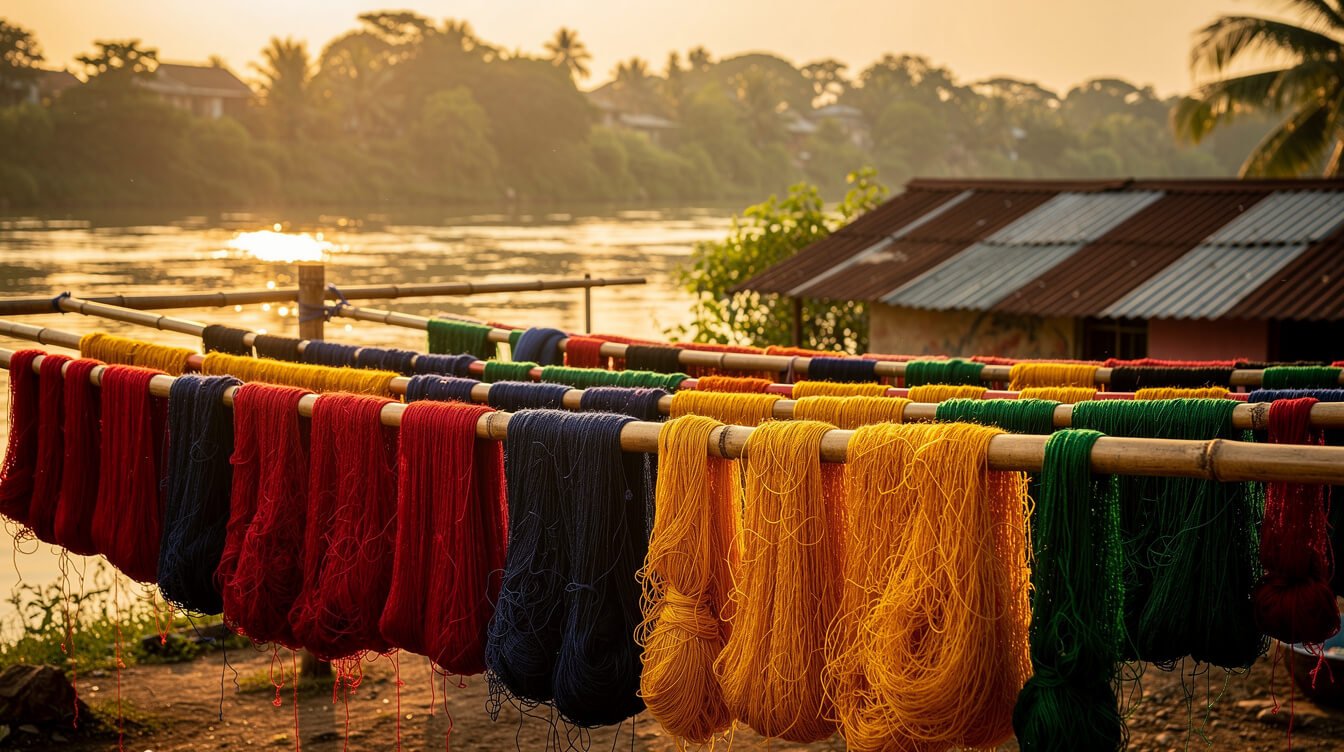
The yarn is dyed, starched with rice starch, sun-dried, and starched again during weaving to make the fine threads strong enough to handle. Then comes the slow part. Banglapedia says a standard jamdani saree takes one to two months to make. The densest designs take far longer: the Indian designer Gaurang Shah told Vogue India that a weaver may complete only a quarter of an inch to one inch of a heavily patterned jamdani in a day.
So when Ammu says “do you know how long that took,” she is not exaggerating. She might be underselling it.
Jamdani saree motifs and what their names mean

Every jamdani motif has a name, and the names are half the fun. Some master weavers say there are about 160 traditional motifs. Some are geometric, some are flowers, some are animals and everyday objects, and many have Persian names from the Mughal era. Here are the ones you are most likely to hear, with meanings taken from Banglapedia and from Saifur Rashid’s work for ICHCAP:
- Panna hajar: “a thousand emeralds.” Small motifs scattered like gems across the whole saree.
- Kalka: the paisley, the curved teardrop shape you have seen on everything from shawls to wedding cards.
- Butidar: a saree covered in small flowers, buti, dotted evenly over the body.
- Tercha (also written tersa or tesra): the same small flowers, arranged in reclining diagonal rows.
- Jalar: when the design spreads like a net (jal) across the entire field of the saree.
- Fulwar: rows of flowers set in straight lines.
- Duria: spots all over. Charkona: small four-sided, rectangular motifs.
Banglapedia’s longer list reads like a walk through a Bengali village. There is shaplaful, the water lily that became the national flower of Bangladesh. There is prajapati, the butterfly, angurlata, the grapevine, and kachupata, the leaf of the kochu (taro) plant your nani cooks with shrimp. Banglapedia adds that modern jamdani backgrounds feature roses, jasmine, lotus, and even bunches of bananas and ginger. Weavers have always woven what they saw.
Red jamdani and white-on-white
Two color stories worth knowing. Banglapedia notes that jamdani work on red fabric became very popular in the 1960s, which may be why so many family wedding photos from that era have a red jamdani in them. At the other end of the scale is the classic white-on-white jamdani, white motifs on white muslin, so subtle you see the pattern only when the light hits it. Banglapedia mentions that the Victoria and Albert Museum in London holds a fine collection of that white-on-white work.
The kalka and the creeping vine, or lata, turn up all over Bengali folk art, not just in jamdani. You can see the same floral vocabulary of a central lotus, paisleys, and vines running around the border on our Traditional Nakshi Kantha Floral Motif Sherpa blanket. To be clear, it is a printed, kantha-inspired design, not a woven jamdani, but it is the closest thing in the shop to sitting under Nani’s good embroidery on a cold night.
Letters from home
A little more desh in your inbox
One short email a week: the story behind a symbol, a festival, or a dish, plus new designs from the shop. No spam. Unsubscribe anytime.
From Mughal Dhaka to UNESCO: a short history of jamdani
Fine cloth from Bengal was famous long before anyone called it jamdani. Banglapedia points out that the ancient Indian treatise the Arthashastra mentions Vanga, the old name for this region, as home to a very delicate textile, and that Bengal’s fine fabrics appear in the Greek trading guide called the Periplus of the Erythraean Sea and in the accounts of Arab, Chinese, and Italian travelers. Ibn Battuta praised the cotton of Sonargaon in the 14th century, and in the late 16th century the English traveler Ralph Fitch and the Mughal historian Abul Fazl did too.
The Mughal golden age
Jamdani reached its peak under the Mughals. Wikipedia and ICHCAP both place the flowering of figured muslin in the reigns of Akbar or Jahangir, and paintings show the emperors wearing jamdani sashes. The court took it seriously enough to create a job for it. According to Banglapedia, an official called the daroga-i-mulmul was posted in Dhaka to oversee the weaving of the finest muslin, engaging master artisans and paying them in advance. Only royal and aristocratic families could afford the top pieces. If you have read our guide to Lalbagh Fort, this is the same Mughal Dhaka.
Decline and survival
By the late 18th and early 19th centuries, the trade was falling apart. Banglapedia records that Dhaka’s muslin exports to England, worth millions of rupees a year in the 1780s, had stopped completely by 1817. It names the major causes as the industrial revolution in Britain, the collapse of the Mughal aristocracy that had been jamdani’s main customer, and the rise of cheaper machine-made textiles. Weaving villages that had been famous for jamdani, like Madhurapur and Jangalbari in Kishoreganj, slowly went quiet.
But jamdani itself never died. The weaving moved and concentrated. ICHCAP’s Saifur Rashid writes that in the early 20th century the home of the craft began shifting from Sonargaon to Rupganj, along the Shitalakshya River in Narayanganj district, about an hour’s drive from Dhaka. A village there called Rupshi is popularly known as the “Jamdani Village.” Banglapedia lists more than a dozen weaving villages around Tarabo and Rupganj, plus pockets in Sonargaon and in Boalmari in Faridpur district.
Revival, UNESCO, and the GI
After independence, a jamdani village was established at Demra near Dhaka to support weavers, according to Banglapedia. The Bangladesh Small and Cottage Industries Corporation (BSCIC) later built a Jamdani Industrial Estate and Research Centre in Noapara village, Tarabo union, Rupganj, between 1993 and 1999. In 2013, UNESCO inscribed the “Traditional art of Jamdani weaving” on its Representative List of the Intangible Cultural Heritage of Humanity, as an element of Bangladesh.
Then, in November 2016, Bangladesh’s Department of Patents, Designs and Trademarks registered jamdani as the country’s first Geographical Indication (GI) product, as The Daily Star reported. A GI certifies that a product’s qualities come from its place and its traditional methods, the way Champagne has to come from Champagne. Bangladesh’s second GI, the following year, was ilish, the hilsa fish. A country that registers its saree first and its fish second knows exactly what it loves.

Bengali florals for cold nights
A lotus at the center, paisleys and vines running around a folk-art border, all on a warm cream ground. It is a printed, kantha-inspired design on a soft sherpa blanket, made for the couch rather than the almari.
Dhakai jamdani and West Bengal jamdani: one weave, two countries

Search “jamdani saree” from the US and most of the shops you find are in India, and many of them write from the West Bengal side. That is not a mistake, and it is not something to fight about. Bengal was one place for most of jamdani’s history, and the craft lives on both sides of the border today.
Here is how that happened. After the Partition of 1947, many weaving families from East Bengal resettled in West Bengal. Wikipedia’s entry on Phulia notes that skilled weavers from Dhaka settled around Shantipur in Nadia district and Ambika Kalna in Bardhaman, both already old handloom centers, and that Dhatrigram and Kalna became known for their jamdanis. Among them were many weavers from the Basak families of Tangail, whose ancestors, Wikipedia notes, came from old muslin-weaving centers in Dhaka district. They carried their skills, and in some cases their looms, with them.
So the jamdani your khala bought in Kolkata and the one your Ammu bought in Dhaka are cousins. People will tell you one is softer, finer, or more “real” than the other. We are not going to referee that at a family dinner. What the record shows is that the technique was born around Dhaka, that UNESCO lists it as Bangladesh’s heritage, and that weavers in West Bengal, many of them descended from East Bengal weaving families, keep the same tradition alive. The technique has travelled even further since. Vogue India’s reporting points to jamdani weaving in Andhra Pradesh too, in Venkatagiri, Srikakulam, and Uppada.
That is the shared story of the Bengali people in miniature: one language, one food culture, one weave, two countries. Credit both and you will never be wrong.
How to tell a handwoven jamdani from a machine copy
Because jamdani is slow and expensive to make, power-loom copies are everywhere. The most useful tip comes from textile experts quoted by Vogue India: turn it over. In a handloom jamdani, the front and back look almost like mirror images, and the extra weft makes neat U-shaped turns at the edge of each motif. A machine-made copy usually shows long loose threads floating across the back. Handwoven motifs also carry small irregularities, the signature of a person rather than a machine. And if the price seems too good to be true, it is.
The jamdani saree in diaspora life
UNESCO’s description of jamdani includes a line that could have been written about Jackson Heights, Hamtramck, or the Danforth: the saree is “the principal dress of Bengali women at home and abroad,” and “a symbol of identity, dignity and self-recognition.” For a lot of us abroad, the jamdani saree is the most Bangladeshi object in the house.
The saree that crossed the ocean
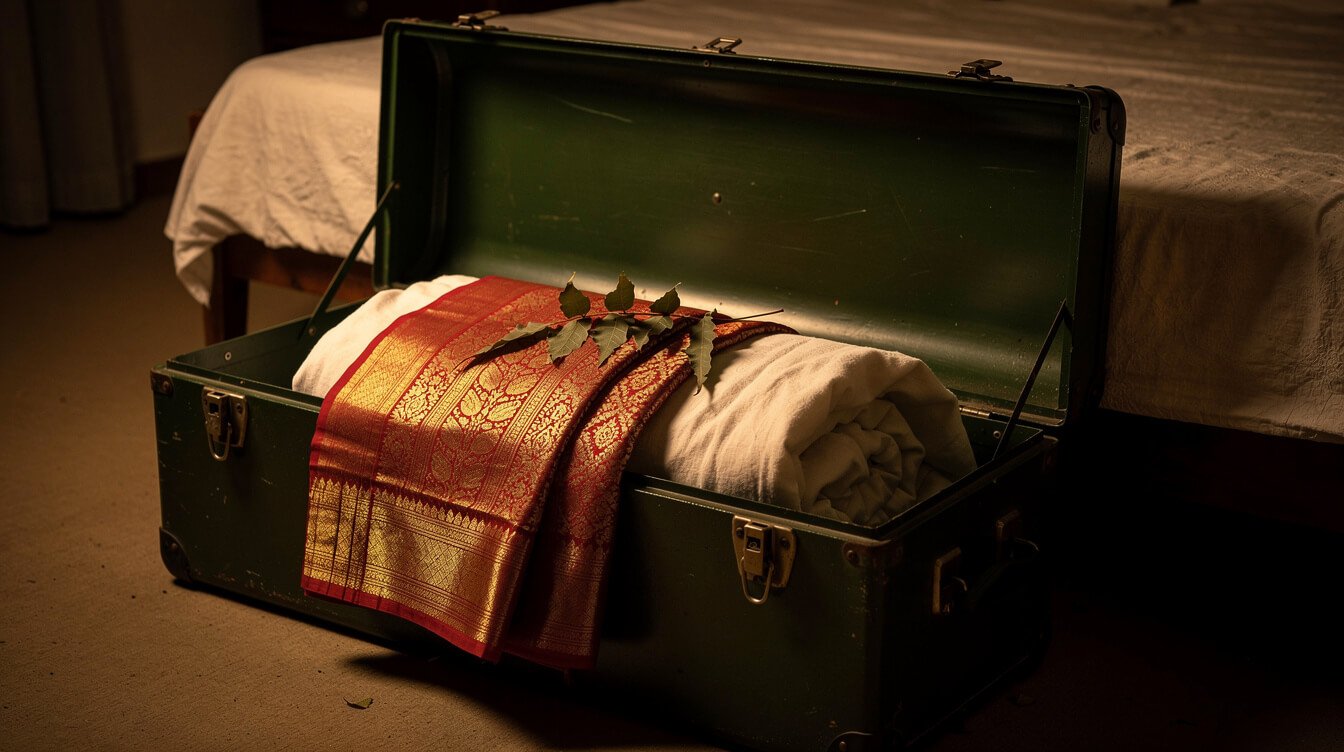
Ask around and you will hear the same story in different accents. Ammu brought two or three good sarees when she moved, and at least one was a jamdani. It was her wedding saree, or her mother’s, or the one Nani gave her the week before the flight. It has lived in a suitcase, then a closet, then a plastic storage tub in the basement, and it still comes out every time there is a Bengali wedding worth dressing up for.
Then there is the borrowing economy. Every second-gen girl knows the routine: a cousin’s gaye holud is on Saturday, you have nothing to wear, and suddenly you are negotiating with your mother like a diplomat. You get the jamdani on conditions. No food near it. No sitting on the floor. Bring it back the same night. The blouse has to be altered, the safety pins have to be found, and somehow it all ends up in a tote bag. In our house that is the Six Seasons of Bangladesh Tote Bag, which has carried more borrowed sarees, bangles, and emergency hairpins than I can count.
Prom, Boishakh, and the jamdani panjabi
The second generation is doing something new with all this. You see jamdani at prom, at graduation, at Pohela Boishakh on campus, styled with sneakers or a denim jacket. Men are wearing jamdani panjabis at weddings and Eid. It is one of the ways a kid who grew up between two countries says where they come from without having to explain it.
Looking after the family jamdani
If the family saree is coming to you, treat it like the heirloom it is. The textile experts interviewed by Vogue India recommend airing jamdani out occasionally, storing it rolled rather than folded so creases do not set in over the years, and wrapping it in cotton cloth to keep dust and insects off. Most Ammus already wrap theirs in soft white cloth. The rolling part might be news to her. Tell her gently.
Frequently asked questions about the jamdani saree
What is a jamdani saree?
A jamdani saree is a handwoven saree of fine, sheer cotton muslin with motifs woven directly into the cloth on the loom using a supplementary (discontinuous) weft. It was traditionally woven around Dhaka, Bangladesh, and is recognized by UNESCO as intangible cultural heritage.
Is jamdani from Bangladesh or India?
The craft developed around Dhaka, in what is now Bangladesh, and UNESCO inscribed the traditional art of jamdani weaving in 2013 as an element of Bangladesh. Jamdani is also woven in West Bengal, India, largely by weaving families who resettled there after 1947, and in parts of Andhra Pradesh. It is shared Bengali heritage.
Why is jamdani called Dhakai?
Because it comes from Dhaka. Dhakai was the cloth’s original name, and “Dhakai jamdani” is still the common way to describe jamdani woven in Bangladesh.
How long does it take to weave a jamdani saree?
Banglapedia puts a standard jamdani saree at one to two months of work, with two weavers sharing the loom. Densely patterned pieces can take much longer, because every motif is added by hand.
Is jamdani cotton or silk?
Traditionally cotton. Today you will also find half-silk and full-silk jamdani, as well as cheaper synthetic versions.
What is the difference between jamdani and muslin?
Muslin is the broader family of very fine handwoven cotton. Jamdani is muslin with motifs woven into it, which is why it is sometimes called “figured muslin.”
When did jamdani get its GI tag?
In November 2016, jamdani became Bangladesh’s first registered Geographical Indication product. Ilish (hilsa) became the second in 2017.
Final thoughts: the saree in the almari
A jamdani saree is a strange and wonderful thing to inherit. It is a piece of cloth light enough to see through, made by two people on a bamboo loom by the Shitalakshya, carrying motif names that are older than the country. It outlived the Mughals, survived the mills and Partition, and now it travels in our suitcases to weddings in New Jersey and Toronto and London.
So the next time Ammu takes hers out of the almari, ask her where it came from, who gave it to her, and what the pattern is called. If she does not know the motif, now you do. That conversation is the real heirloom.
Before you go
Get the next story by email
We write about Bangladeshi heritage and diaspora life every day. The best of it lands in one short weekly email.