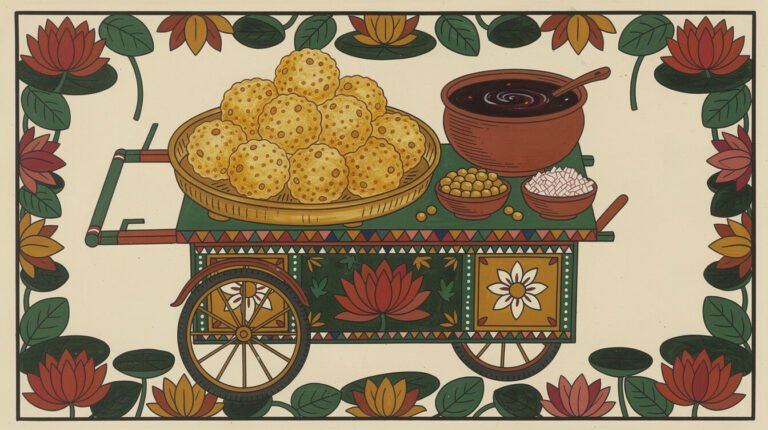
Bengali Sweets: A Guide to Mishti, From Porabari to Bogura
In a Bangladeshi house, good news has a sound: the rustle of a white cardboard box being opened on the dining table. Inside are Bengali sweets, or mishti: white roshogolla sitting in syrup, brown chomchom dusted with milk crumbs, pale shondesh, and, if somebody really loves you, a clay pot of mishti doi. Somebody passed an exam, got a job, got engaged, or had a baby, and before anyone explains, somebody is handing you a plate.
This guide covers what Bengali sweets are made of, why they show up at every happy moment, the classics you will find in any sweet shop, and the part most English-language guides skip: the Bangladeshi map of mishti, where Porabari, Bogura, Muktagachha, Comilla, and Natore each have a sweet they are famous for. We’ll finish with the homemade sweets, the One Bengal story of who invented what, and where to find good mishti abroad.
What are Bengali sweets? Milk, chhana, and syrup

Most Bengali sweets start with milk, and most of the famous ones start with chhana: fresh milk curdled with a little acid, drained in a cloth, and kneaded smooth by hand. That soft fresh cheese is what makes a roshogolla spongy and a shondesh melt. Banglapedia, Bangladesh’s national encyclopedia, makes the key point in its entry on sweetmeats: unlike northern Indian and Pakistani sweets, which are mostly built on khir (milk boiled down until thick), Bengali sweets are mostly built on curdled milk. That one difference explains why a plate of Bengali sweets looks paler, softer, and juicier than a box of North Indian mithai.
Chhana is not the oldest layer, though. Banglapedia notes that the earliest Bengali sweets grew up around rice and sugarcane: gur (jaggery) made from sugarcane, palm, or date palm juice, mixed with coconut, chira (flattened rice), or muri (puffed rice). Those village sweets are still made at home, especially in winter.
Then there are the people who make the shop sweets. A sweet maker is a moyra, and a sweet shop is usually called a mishtanno bhandar or a sweetmeat shop. Many of the famous shops in Bangladesh are family businesses that have been handed down for generations, and every town will tell you its own moyra is the best one.
A few words you will see again and again:
- Chhana: fresh curdled-milk cheese, the base of roshogolla, chomchom, shondesh, and roshmalai.
- Mawa (or khoya): milk cooked down to dry solids, often crumbled on top of chomchom.
- Rosh: syrup, or juice. A sweet with “rosh” in its name is going to be wet.
- Gur: jaggery. In winter, khejur gur (date palm jaggery) flavors everything.
Why good news always comes with a box of mishti

If you grew up Bangladeshi abroad, you probably learned this before you learned to read Bangla: you do not visit empty-handed, and you do not share good news without sweets. Banglapedia lists the occasions: births, engagements, weddings, success in exams, Hindu pujas, and the end of a Muslim milad. Sweets are handed to neighbors and relatives as goodwill. It is one of the customs every community in Bangladesh shares.
In practice it works like this. Your cousin gets her results, and by evening there is a box on the table. A proposal is accepted, and the groom’s family arrives with sweets, and the bride’s family sends sweets back. A new baby comes home, and the box makes the rounds of the building. When guests visit, the first plate out of the kitchen often has two or three pieces of mishti on it, next to a cup of cha.
There are unwritten rules, too. You take the sweet you are offered. You say you are full, and then you eat it anyway. And if you are visiting from America, someone will ask why you brought chocolates instead of a box from the local sweet shop. (Answer: because the nearest sweet shop is forty minutes away.)
The box itself has a look: plain white or printed cardboard, tied with string, sometimes with a sheet of paper on top so the syrup does not stick. Some shops sell mixed boxes; most families know exactly which three sweets they want and in what proportion.
The classics every Bengali sweet shop sells

Walk into any Bengali sweet shop, in Dhaka, Kolkata, or Jackson Heights, and you will find most of these behind the glass. Spellings vary a lot in English, so we give the common Bangladeshi spelling first and the version you might see on a menu second.
Roshogolla (rasgulla)
Soft white balls of chhana cooked in light sugar syrup until the syrup soaks all the way in. The name means roughly “syrup ball.” A good one is springy, not rubbery, and full of syrup all the way to the middle. Banglapedia calls it the sweet that “set the trend for the main sweets of today,” and lists rajbhog, roshmalai, and chhanar mudki among the sweets that grew out of it.
Chomchom (cham cham)
Oval and cylindrical, denser than roshogolla, and usually brown on the outside, with crumbled mawa on top. It also keeps longer than the soft sweets, which is one reason it travels well as a gift. More on the famous Porabari chomchom below.
Kalojam, pantua, and ledikeni
These are the fried ones. Chhana dough is shaped into balls, deep-fried until brown, and soaked in syrup. Pantua is usually flavored with cardamom. Ledikeni is named after Lady Canning, wife of the Governor-General Charles Canning, and the story is that a Kolkata confectioner made a special version in her honor. Kalojam (“black jam,” after the dark purple fruit) is the darker version. If you know gulab jamun, you know the family, but pantua is made with chhana where gulab jamun is made with khoya.

Shondesh (sandesh)
The dry sweet. Chhana is cooked with sugar to different firmness levels and often pressed into carved moulds, so shondesh comes in flowers, conch shells, and fish. The simplest version is makha shondesh (“kneaded”), tossed lightly with sugar over low heat. In winter, nolen gurer shondesh made with new date palm jaggery turns caramel brown and sells out fast. Dhaka has its own soft version called pranhara, which roughly means “heart stealer.”
Mishti doi
Sweet yogurt, set in a clay pot. Milk is boiled until slightly thickened, sweetened with sugar or gur, and left to ferment overnight. The earthenware matters: the porous walls let water evaporate slowly, which thickens the doi and keeps the temperature right while it sets. Good mishti doi is thick enough to hold a spoon upright.
Jilapi and amriti
Not every Bengali sweet is milk-based. Jilapi and amriti are made from a batter of ground pulses and flour, piped into hot oil in loops, and soaked in syrup. Banglapedia names them, along with pranhara, as old specialties of Dhaka.
Bengali sweets by district: the Bangladesh mishti map

Here is the part most English guides to Bengali sweets miss. In Bangladesh, sweets are local. Ask anyone where to get the best chomchom and they will say Tangail. Ask about doi and they will say Bogura, and they will look at you as if you asked which way is up. Several of these sweets are now registered as Geographical Indication (GI) products, which works like France’s protected names for Champagne or Roquefort: the name is legally tied to the place. In Bangladesh, GI status is granted by the Department of Patents, Designs and Trademarks under the Ministry of Industries, under a 2013 law.
Porabari chomchom (Tangail)
Porabari is a small union about 6 km west of Tangail town, on a branch of the Dhaleshwari River. Its chomchom became famous partly because steamers stopped at the river landing there and carried the sweets far and wide. Accounts of who made the first one differ, and so do the dates: Banglapedia says about 150 years ago, and Tangail’s sweet makers say closer to 200. What makes it different, according to one of Tangail’s oldest sweet makers in a 2025 Daily Star feature, is that it is cooked in caramelized sugar syrup, which gives it the golden-brown color and a slightly smoky taste, and that a properly made one keeps for days without refrigeration. The government recognized Porabari chomchom as a GI product on April 25, 2024. Today, most of it is actually made in the sweet shops of Tangail town rather than in Porabari itself.
Bogurar doi (Bogura)
Bogura’s sweet yogurt is so famous it is simply called “Bogura’s doi.” Banglapedia explains the origin: in the dry season, herders in North Bengal used to put up large temporary cow and buffalo sheds called bathan, and a yogurt trade grew up around them. The milk was boiled down to about a quarter of its volume, which is why Bogura doi is so rich it is almost like khir. It became a GI product in June 2023.

Muktagachha monda (Mymensingh)
Muktagachha, an upazila in Mymensingh district, is known across the country for monda, a kind of soft shondesh. It joined the GI list in February 2024.
Comilla roshmalai (Cumilla)
Comilla’s roshmalai is small cylinders of chhana soaked in thickened, sweetened milk rather than syrup. The most famous maker is Matri Bhandar, which two brothers from the Sengupta family opened in 1930 and which their family still runs. Its roshmalai was approved as a GI product on January 1, 2024. So many shops in Comilla use a version of the Matri Bhandar name that finding the original is a local sport. In Dhaka and Rangpur, roshmalai is made round, like small roshogolla, instead.
Natore kanchagolla (Natore)
Kancha means raw, and kanchagolla is a soft, barely cooked chhana sweet: the chhana is worked with sugar over low heat and shaped into balls, so it stays milky and fresh-tasting. It won GI status in August 2023 as Bangladesh’s 17th GI product, and Natore puts its history at around 260 years.
Kushtia tiler khaja (Kushtia)
A crisp, flaky bar of pulled sugar covered in sesame seeds. If you have taken a bus or train in Bangladesh, you have heard the hawkers call “khaja, khaja.” The factories are clustered near the shrine of Lalon in Kushtia, the same Lalon at the heart of Baul music, and the sweet is now on the GI list too.
And the rest of the map
Banglapedia adds more: Faridpur’s malaikari, a flattened roshogolla covered in thick cream; Rajshahi’s roshkodom, a round sweet coated in tiny sugar beads so it looks like a kadam flower; and Savar’s roshogolla, cooked until it turns the color of baked clay. In 2025 Tangail added a second sweet GI, for the shondesh of Jamurki in Mirzapur. Every district has a candidate, and every family has an opinion.
Letters from home
A little more desh in your inbox
One short email a week: the story behind a symbol, a festival, or a dish, plus new designs from the shop. No spam. Unsubscribe anytime.
Mishti and cha: how Bengali sweets are served at home

Mishti almost never arrives alone. When a guest sits down in a Bangladeshi home, the first plate usually has a couple of sweets and something savory, a singara or some chanachur, and right behind it comes a cup of milky cha. The sweet makes the tea taste less bitter, the tea cuts the sugar, and between the two, the conversation can go on for hours. That long, aimless, very important conversation has a name: adda.
A few things every Bangladeshi kid learns about the guest plate:
- The guest goes first. And gets the best piece.
- Roshogolla gets a spoon or a fork. Shondesh and chomchom can be picked up by hand.
- “No thank you” is the opening line of a negotiation. Expect a second offer and a third.
- Syrup sweets are squeezed a little. Some people press out extra syrup with the spoon before eating. Some people drink it. No judgment.
That pairing of sweet and tea is so central that there is a saying for it: cha gorom, alap norom, “hot tea, soft talk.” It is also why our Cha Gorom Alap Norom Tea Lover Bengali T-Shirt exists, for anyone who believes every visit should end with a second cup and one more chomchom. If you want more on the snack side of that plate, our guide to fuchka covers the street food that comes before dessert.
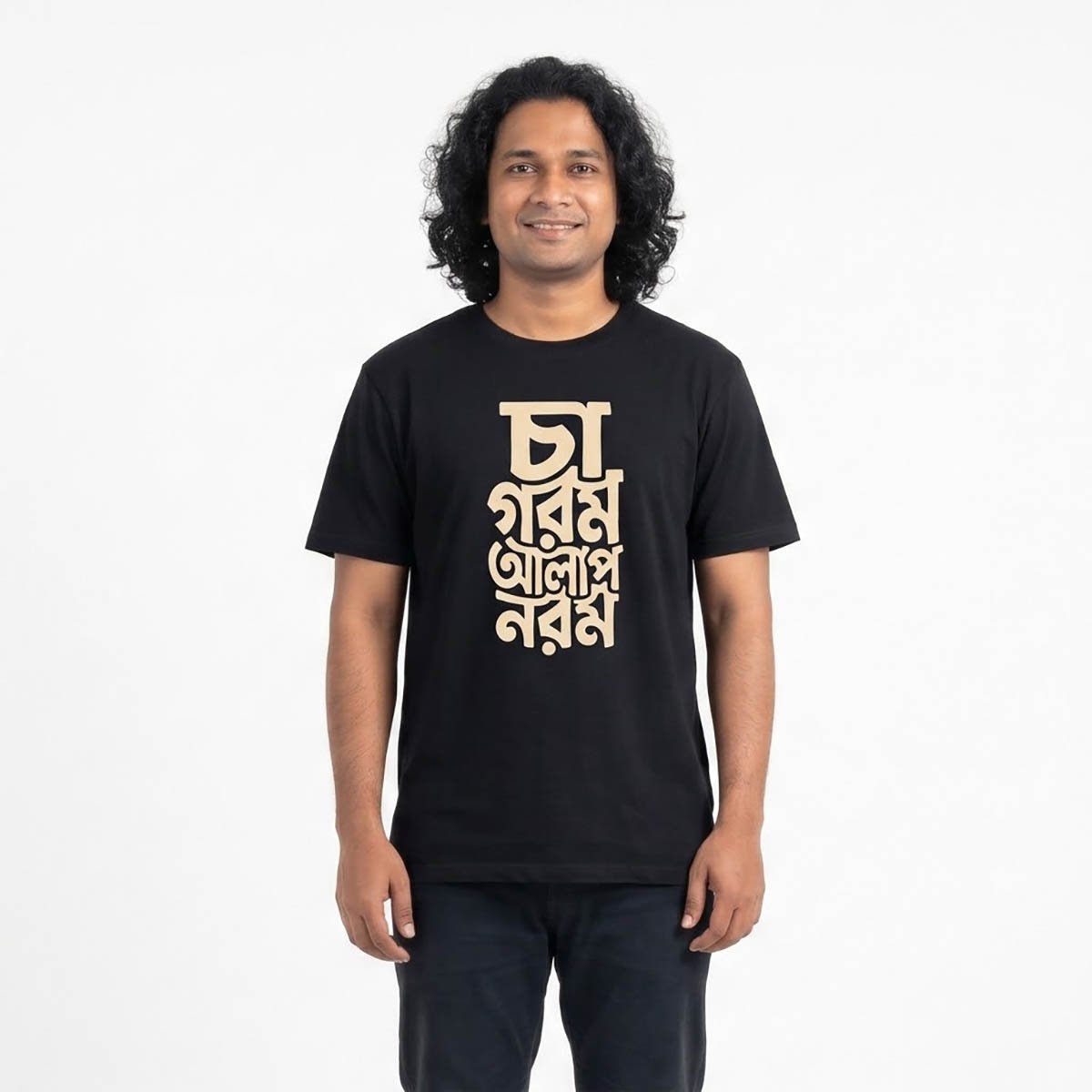
Hot tea, soft talk, one more chomchom
Cha gorom, alap norom: hot tea, soft talk. The house rule for every guest, every adda, and every box of mishti that shows up with good news.
Homemade sweets: payesh, shemai, and winter gur

Shop sweets get the fame, but the sweets most of us actually grew up eating were made at home. Nobody’s nani buys payesh.
Payesh is rice cooked slowly in milk with sugar or gur until it turns thick and creamy, finished with cardamom, raisins, and cashews. Bangladeshi homes often use a small, fragrant rice for it, and in winter many families swap the sugar for khejur gur, which turns the payesh light brown and makes the whole kitchen smell like caramel. Payesh is the birthday dish, the “you came home” dish, and the thing that appears when someone in the family needs cheering up.
Shemai is thin vermicelli cooked in milk with sugar, and on Eid morning it is on almost every table in Bangladesh, often before anyone has eaten anything else. Some families make it soupy; others fry the vermicelli in ghee first and make it nearly dry. Both camps are sure they are right.
Then there is the winter layer, which goes back to those oldest gur-based sweets. When the new aman rice comes in and the date palm trees are tapped for juice, the season of pitha begins: rice cakes steamed, fried, or soaked in milk and gur. That harvest moment is the scene on our Golden Harvest Bengal Nabanna Mug, which is a good place to keep your cha warm while the payesh cools.
Homemade sweets are also where families get specific. One nani adds bay leaf to her payesh. One khala insists on full-fat milk only. One chacha says shemai should only ever be eaten on Eid. Write it down while you can.
One Bengal, two countries: who made the first roshogolla?
Bengali sweets belong to all of Bengal, on both sides of the border, and the honest answer to “who invented it” is often “it depends who you ask.”
Take the roshogolla. Banglapedia credits the first one to Haradhan Maira, a sweet maker from Phulia in present-day West Bengal, and says the spongy version we know today was first made in Bagbazar, Kolkata, in 1868. That Kolkata confectioner is usually named as Nobin Chandra Das. Odisha has its own long roshogolla tradition, and the two Indian states argued over the name for years. In 2017, West Bengal received GI status specifically for Banglar rosogolla, Bengal’s rosogolla.
Roshmalai has the same kind of debate. Comilla’s Matri Bhandar is often credited with making it popular, while the K.C. Das family in Kolkata claims it as their invention. Ledikeni is a Kolkata story. Chomchom is a Tangail story. A sweet called shondesh shows up in medieval Bengali literature, long before anyone drew a border.
West Bengal has its own sweet map, too: Banglapedia mentions Burdwan for sitabhog and mihidana, and Krishnanagar for sarbhaja and sarpuria. A Bangladeshi and a Kolkata Bengali can argue for an hour about whose roshogolla is better and still finish the box together. That is the whole point. As we wrote in our guide to Bengali people: one Bengal, two countries.
Frequently asked questions about Bengali sweets
What is the most famous Bengali sweet?
Internationally, roshogolla. In Bangladesh, people are more likely to name a place: chomchom from Tangail, doi from Bogura, roshmalai from Comilla, monda from Muktagachha, or kanchagolla from Natore.
What are Bengali sweets made of?
Mostly milk. The shop sweets are usually made from chhana (fresh curdled-milk cheese), sugar or jaggery, and sometimes a little flour or semolina. Mishti doi is sweetened yogurt. Older village sweets use gur, coconut, rice, flattened rice, and puffed rice.
What is the difference between roshogolla and roshmalai?
Both start as chhana cooked in syrup. Roshogolla stays in the syrup. Roshmalai pieces are smaller, often flattened or cylindrical, and are soaked in thickened, sweetened milk instead, so they are creamier and richer.
Is mishti doi the same as yogurt?
It is a yogurt, but sweetened and set differently: the milk is boiled and thickened first, sweetened with sugar or gur, and set overnight in a clay pot. The result is thicker, sweeter, and more caramel-colored than plain yogurt.
How long do Bengali sweets last?
It varies a lot. Dense sweets like chomchom keep longer than soft ones, and a well-made Porabari chomchom keeps for days without refrigeration, according to its makers. Anything soaked in milk, like roshmalai, and anything set from milk, like mishti doi, belongs in the fridge. When in doubt, ask the shop.
Where can I buy Bengali sweets in the US or UK?
Look for Bangladeshi and Indian sweet shops in neighborhoods with big Bengali communities, like Jackson Heights in Queens, Hamtramck near Detroit, and Brick Lane in London. Canned roshogolla is sold in South Asian grocery stores outside the subcontinent, and it’s fine in an emergency. For the real thing, find the shop your local aunties use.
Are Bengali sweets the same as Indian sweets?
Bengali sweets are one regional family within South Asian sweets, shared by Bangladesh and the Indian state of West Bengal. They are known for being chhana-based, so they are softer and wetter than many North Indian sweets, which are more often made from khoya.
If you are building the full picture of how Bangladesh eats, start with our guide to Bangladeshi food and our look at Bangladeshi culture from inside the family. And the next time you have news, any news, you know what to bring.
Before you go
Get the next story by email
We write about Bangladeshi heritage and diaspora life every day. The best of it lands in one short weekly email.