
Fuchka: Bangladesh’s Favorite Street Snack, Explained
If you grew up Bangladeshi, you probably remember your first fuchka better than your first day of school. A crisp, hollow shell, cracked open with a thumb, stuffed with spiced peas and potato, buried under grated egg, then dunked in sour tamarind water and eaten in one bite before it falls apart. Fuchka is the street snack Bangladeshis argue about, travel across Dhaka for, and hunt down the minute they land somewhere new.
This guide explains what fuchka is, how Bangladeshi fuchka differs from pani puri, golgappa, and Kolkata phuchka, what goes inside it, how it relates to its cartmate chotpoti, how to eat it without wearing it, and where the diaspora finds it today.
What is fuchka?
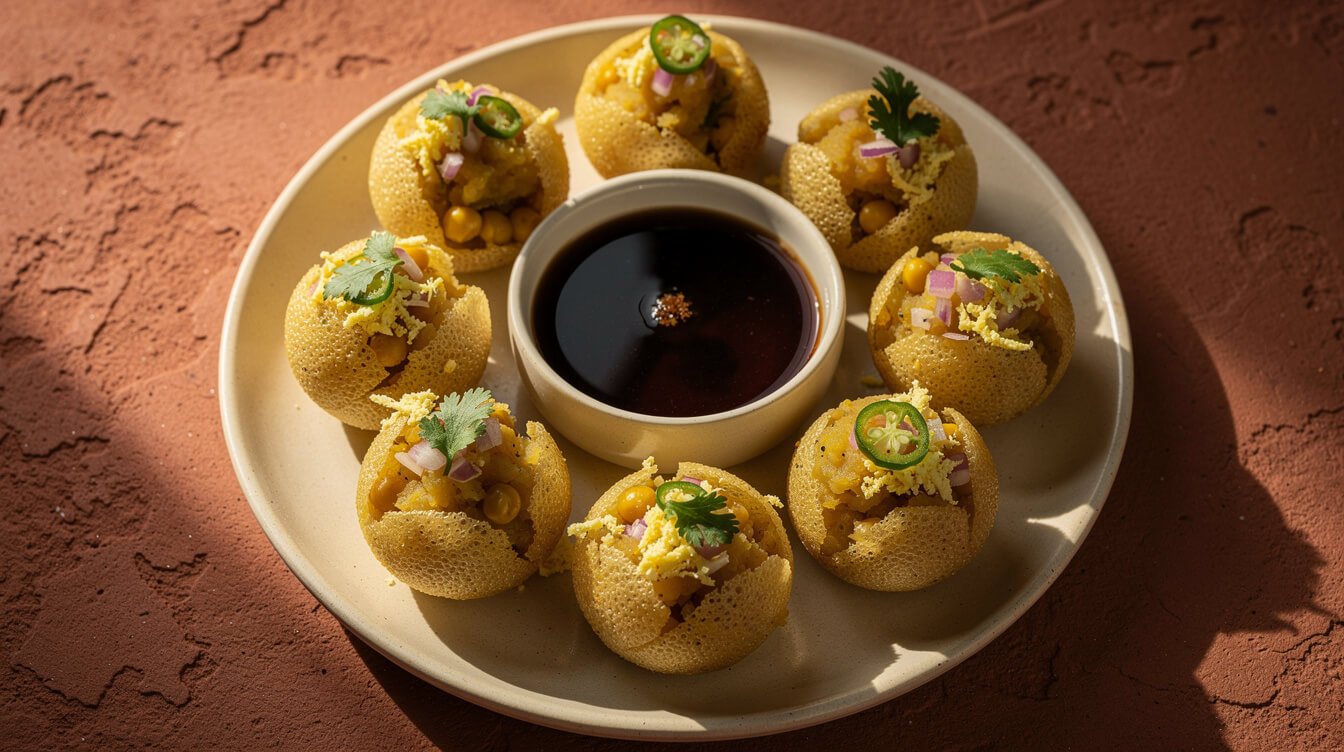
Fuchka (ফুচকা, also spelled phuchka, puchka, or fuska) is a small, round, deep-fried shell, hollow inside, filled with a spiced mixture and eaten with tamarind water. It belongs to the same family as the pani puri and golgappa of India, Nepal, and Pakistan. In Bangladesh it has its own filling, its own toppings, and its own loyal fans.
The name is fun to say for a reason. Wikipedia’s entry on the panipuri family describes phuchka as an onomatopoeia for the sound of eating it: that crack and burst when the shell gives way. The Business Standard, a Dhaka newspaper, adds that the name came from Assam.
The shell starts as a thin circle of dough, a few centimeters across, that puffs up in hot oil into a hollow ball. Dough made with oil instead of only water forms less gluten, which is what makes the shell crisp instead of chewy. A Dhaka plate usually comes with semolina shells, which are thicker and crunchier than wheat-flour ones and hold up better against the tamarind water.
Fuchka also travels well as a point of pride. In 2022, CNN put Bangladeshi fuchka on its list of 50 of the best street foods in Asia, and The Business Standard reported that Bangladeshis online went “gaga” over the news.
How do you pronounce fuchka?
Say it roughly like “PHOOCH-kah,” with the “oo” of “book.” The first sound in Bangla is a breathy “p” that many English speakers hear as an “f,” which is why you see both phuchka and fuchka in English. Bangladeshis mostly write fuchka. Many West Bengalis write phuchka or puchka. Nobody is wrong, and the snack tastes the same under every spelling.
Fuchka vs pani puri vs golgappa vs Kolkata phuchka
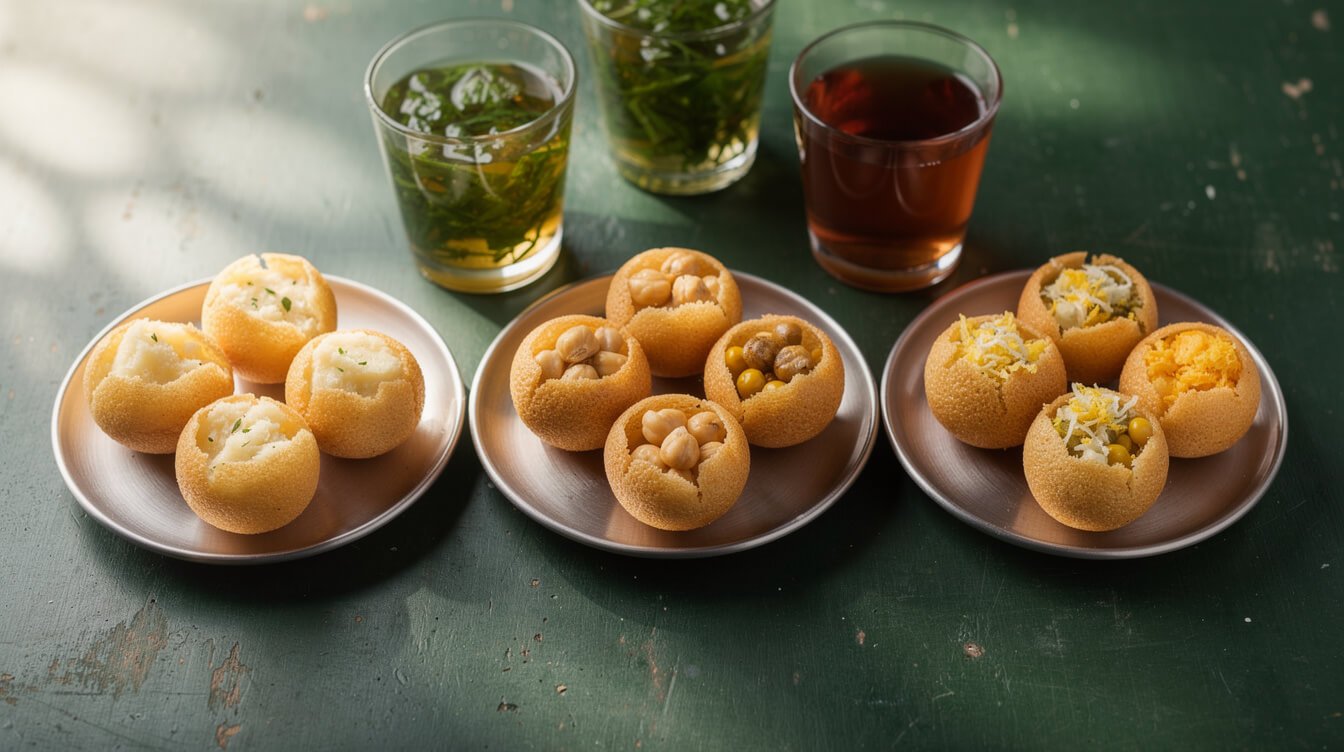
Here is the question every Bangladeshi has been asked by a friend: “Isn’t that just pani puri?” The honest answer is that they are cousins. Same shell idea, same one-bite rule, but different fillings and very different water. Here is how the main versions compare, based on Wikipedia’s panipuri entry and its sources.
| Version | Where | Filling | The water | The tell |
|---|---|---|---|---|
| Fuchka | Bangladesh | Chotpoti-style yellow peas, potato, onion, green chili | Sour tamarind water (tok), in a cup on the plate | Grated hard-boiled egg on top |
| Phuchka | Kolkata and West Bengal | Mashed potato with green chili and spices | Sour, citrusy tamarind water, often with gondhoraj lime | Larger, thinner wheat-flour shells |
| Golgappa | Delhi and much of North India | Potato and black chickpeas | Spicy green water plus sweet tamarind water | Two waters, one spicy and one sweet |
| Pani puri | Mumbai and western India | Ragda (a warm white-pea curry) or potato | Spicy mint-coriander water plus sweet tamarind water | The warm ragda |
The biggest difference is the water. North and West Indian versions pair a spicy green water with a sweet tamarind one. The Bengal side of the family, in both Dhaka and Kolkata, leans sour. Wikipedia notes that in Bengali the tamarind water is called tok jol, literally “sour water.” Ask anyone from either Bengal and they’ll tell you sweet water is the wrong answer, with total confidence.
There is a second difference that is easy to miss. In Bangladesh, fuchka and pani puri are separate items. Pani puri there means smaller shells filled with potatoes, chickpeas, and peas. According to Wikipedia, pani puri and bhelpuri spread through Dhaka in the 2010s and became especially popular with younger crowds, so many carts now sell both side by side.
Bangladesh and West Bengal share this snack the way we share our language, our poets, and our Bengali identity. Kolkata has its own fuchka pride, and a lot of it is earned. Kolkata vendors even keep a tradition of handing you one free, dry phuchka at the end of a round. The rivalry is affectionate. Mostly.
What goes inside Bangladeshi fuchka
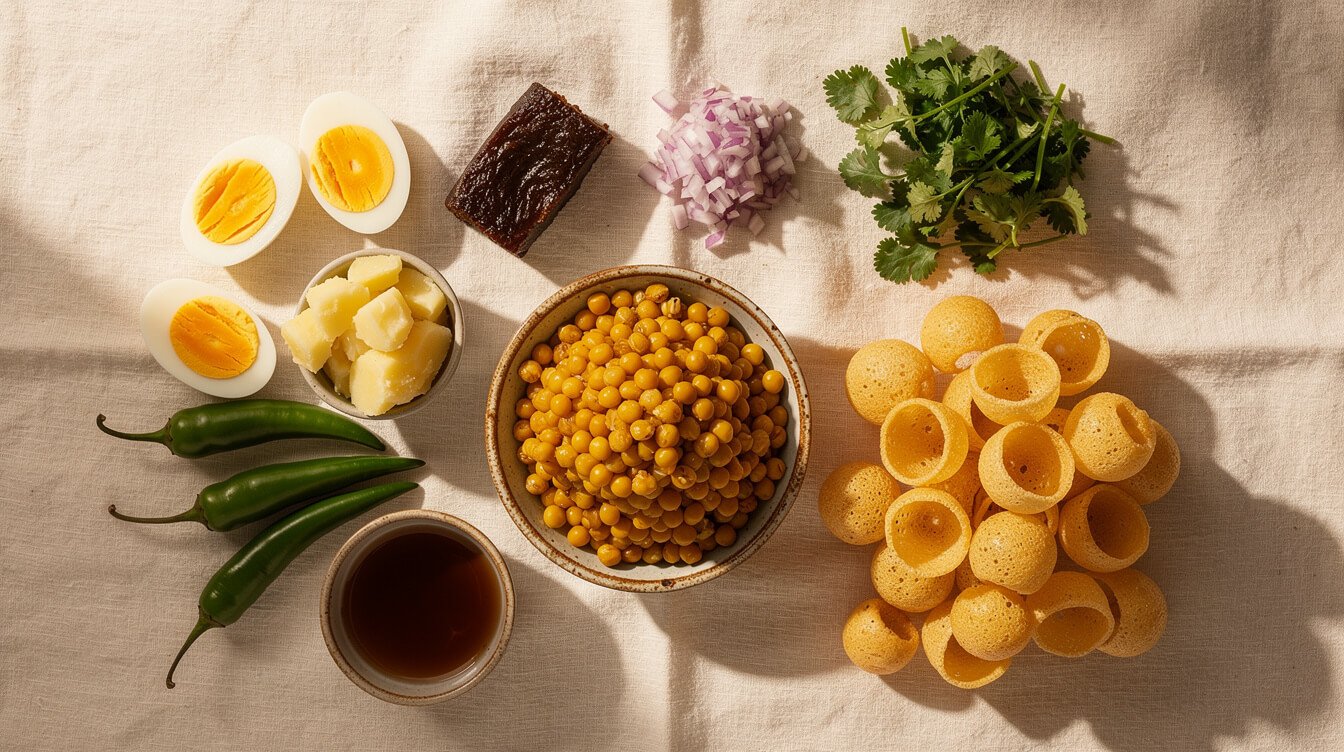
The Daily Star once described the standard Dhaka plate perfectly: 7 or 8 semolina shells filled with seasoned potato, yellow peas, onion, green chili, and cilantro, topped with grated hard-boiled egg, with a cup of tamarind water in the middle “full to the brim.” That is the Bangladeshi fuchka in one sentence. Here is each part.
The shell
Thin, round, and puffed in oil until hollow. A good shell shatters cleanly. A tired shell bends. The vendor punctures the top of each one with a finger before filling it.
The filling
The heart of Bangladeshi fuchka is cooked dried yellow peas mixed with boiled potato, chopped onion, green chili, cilantro, and spices. It is essentially chotpoti (more on that below) spooned into a shell. That pea filling is what separates our fuchka from the plain mashed-potato filling of Kolkata.
The egg
Grated hard-boiled egg, scattered over the top like snow. This is the most Bangladeshi part of the plate, and the detail Wikipedia singles out: in Bangladesh, fuchka is “topped with shredded eggs.” If you’ve only had pani puri, the egg will surprise you. Then you’ll miss it everywhere else.
The tok
Tok (sour) is what everyone calls the tamarind water. It is thin, sour, a little spicy, and usually served in a small cup or bowl in the center of the plate so you can dunk each fuchka yourself. The Daily Star says Dhaka vendors compete hardest on two things: the crunchiest shell and the best tok. Some carts add their own twist, like a chili paste, and regulars will defend their cart’s tok like a family recipe.
Doi fuchka
Wikipedia also describes Bangladeshi doi fuchka: the same filling, but topped with doi (yogurt), beets, and sev (crunchy chickpea-flour strands) instead of being dunked in tok. It is cooler and gentler, and a good first step for a friend who’s nervous about the sour water.
Fuchka vs chotpoti: same cart, different snack
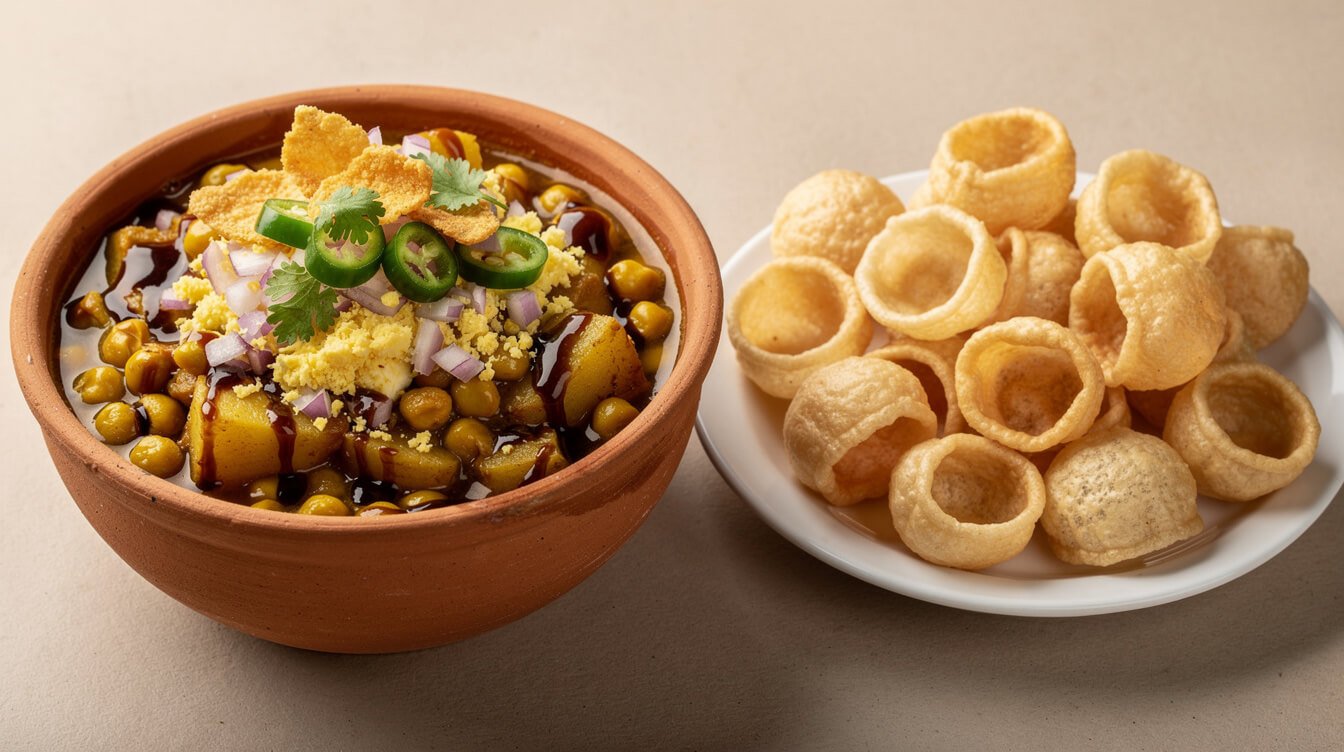
Walk up to almost any fuchka cart in Bangladesh and you’ll see a second pot keeping something warm. That’s chotpoti (চটপটি), and you can’t really understand fuchka without it.
Chotpoti is a warm bowl of cooked dried peas and potato, topped with onion, chili, grated egg, cilantro, cumin, tamarind, and often a handful of crushed puri shells for crunch. Wikipedia says the word means “spicy,” in the sense of many spices rather than simply hot. It is sour and spicy at the same time, and you can ask the vendor to push it either way.
So what’s the difference?
- Chotpoti is a warm, spoonable bowl. You eat it slowly, with a spoon, and the shells are a crunchy topping.
- Fuchka is the same flavor packed into individual shells, dunked in cold tok, and eaten in single bites. The shell is the whole point.
Most groups order both: one plate of fuchka, one bowl of chotpoti, shared. Watching someone choose between them is a decent personality test. The chotpoti person wants comfort. The fuchka person wants drama.
Chotpoti also explains why Bangladeshi fuchka tastes so different from its Indian cousins. When the pea filling from one pot goes into the shells from the other, you get fuchka the Dhaka way. If you want the wider picture of what we eat beyond the cart, start with our insider’s guide to Bangladeshi food.
Letters from home
A little more desh in your inbox
One short email a week: the story behind a symbol, a festival, or a dish, plus new designs from the shop. No spam. Unsubscribe anytime.
How to eat fuchka like you grew up with it

There is a technique, and your cousins will judge you on it. Here’s the full method.
- Order, then wait. Tell the vendor how spicy and how sour you want it. A good vendor fills each shell to order.
- Dunk it fast. Pick up one fuchka, dip it into the tok so the water floods the hole in the top, and lift it straight out.
- One bite. No hesitation. The whole thing goes in your mouth at once. Wikipedia’s panipuri entry notes that taking multiple bites is considered improper, and anyone who has tried knows why: half a fuchka is a shirt stain waiting to happen.
- Keep moving. The shell softens within seconds of meeting the water. People eat these quickly and leave, which is part of the fun.
- Finish the tok. When the plate is empty and there’s sour water left in the cup, nobody will stop you from drinking it.
Fuchka is also social. In Dhaka, The Daily Star describes rows of stalls along the city’s lakes and a favorite cart in nearly every neighborhood, each with regulars who swear theirs is the best. The Business Standard’s guide to Dhaka’s best fuchka vendors includes a cart beside Armanitola School in Old Dhaka that has been feeding students since 1960. Fuchka is what you eat after school, after an exam, on a first outing with friends, or in the middle of a long adda (aimless, sacred hangout talk).
And after the tok sets your mouth on fire, the next stop is usually a cup of cha. If that’s your ritual, our Cha Gorom Alap Norom Bengali Tea Lover Hoodie says it for you: hot tea, soft talk.

Fuchka after school, bhaat for dinner
For everyone who will cross town for the best fuchka cart and still needs a plate of rice by night. A vintage-style tee for the house where the rice cooker is always on.
Fuchka in the diaspora: Jackson Heights and beyond

For years, the only fuchka most of us got abroad was homemade, or a disappointing restaurant plate with sweet chutney where the tok should be. That changed in Queens.
According to The New York Times, Bangladeshi-style fuchka arrived on New York’s streets by 2018, when Bangladeshi immigrant Naeem Khandaker started a fuchka cart called Tong in Jackson Heights. Other carts opened on the same block in the years that followed, mostly started by people who had worked for him. By 2023, the Times counted more than 8 fuchka carts on that one block. Its headline called it “a Bengali street food’s N.Y. origin story.”
That is a very diaspora story. One cart becomes a training ground, the people trained there open carts of their own, and suddenly a corner of Queens smells like evening in Dhaka. If you’ve stood in that line on a cold night, eating fuchka with your gloves stuffed in your pocket, you know the feeling.
Outside New York, look in the neighborhoods where Bangladeshi families cluster: Hamtramck in Michigan, Paterson in New Jersey, Brick Lane in London, and the Danforth area in Toronto. Bangladeshi restaurants and sweet shops there are the first places to ask. Carts, menus, and hours change often, so check before you make the trip.
Fuchka is also a way back in. For a lot of second-gen kids, it’s the first Bangladeshi food we ever ordered on our own, in our own words, without a parent translating. And it’s the thing we drag our non-Bangladeshi friends to try. Fuchka is the snack, but for most of us, Bhaat Is My Comfort Food Bangladeshi Rice T-Shirt still says the truer thing about how we eat at home.
Making fuchka at home: the honest version

Fuchka is street food, and even in South Asia the whole family of snacks is rarely eaten at home. That said, a fuchka night at home is a great weekend project, and it’s easier than you’d think if you skip the hardest part.
Buy the shells
Making shells that puff evenly takes practice. South Asian grocery stores sell ready-made puri shells in boxes or bags, usually labeled for pani puri or golgappa. They work fine for fuchka. Wikipedia notes that many restaurants buy pre-made shells too, so you’re in good company.
Make the filling
Soak and cook dried yellow peas until soft, then mix them with boiled, diced potato, chopped onion, green chili, cilantro, and your family’s spice mix. If you’ve made chotpoti before, you already know this filling.
Make the tok
Soak tamarind in water, strain it, and season it until it’s properly sour with a little heat. Taste as you go. The tok should make you blink.
Set it up like a cart
Put everything in separate bowls: shells, filling, grated hard-boiled egg, onion, chili, cilantro, and a big bowl of tok. Let everyone build their own. Fill each shell right before eating, because a pre-filled shell goes soggy fast.
We’re not giving exact quantities here, because every family’s fuchka is different and the right ratio is the one your Ammu uses. Call her. She’ll tell you the real recipe, and she’ll probably tell you yours is wrong.
Fuchka FAQ
What does fuchka mean?
Fuchka is the Bangla name for a hollow, crisp shell filled with spiced peas and potato and eaten with tamarind water. The word is usually explained as an imitation of the sound the shell makes when you bite it.
What is fuchka called in English?
There’s no true English name. English speakers usually call it fuchka, phuchka, or pani puri. In Britain the dish family is sometimes called “water balls,” but that name doesn’t capture the Bangladeshi version.
Is fuchka the same as pani puri?
They’re relatives. Bangladeshi fuchka uses a chotpoti-style pea and potato filling, grated egg on top, and sour tamarind water. Pani puri usually uses potato or ragda with a spicy green water and a sweet tamarind water. In Bangladesh, pani puri is sold as a separate item.
Is fuchka vegetarian?
The shell, filling, and tok are vegetarian. The usual Bangladeshi topping is grated hard-boiled egg, so ask the vendor to leave the egg off if you don’t eat eggs.
Is it fuchka or phuchka?
Both. Fuchka is the most common spelling in Bangladesh. Phuchka and puchka are common in West Bengal, and you’ll also see fuska. Same snack, same one-bite rule.
What’s the difference between fuchka and chotpoti?
Chotpoti is the warm pea-and-potato mixture served in a bowl and eaten with a spoon. Fuchka puts that mixture inside crisp shells, dunks them in cold tok, and you eat each one in a single bite.
One bite, then another
Fuchka is small and over in a second, which is exactly why it matters so much. It’s the taste of the cart outside school, of an evening with cousins, of a first trip back to the desh where you eat three plates and regret nothing. It’s also the snack that taught a lot of diaspora kids that our food could stand on its own, with its own name, on its own block in Queens.
So next time someone asks if it’s “just pani puri,” hand them a plate. Tell them about the egg, the peas, and the tok. Then tell them to eat it in one bite, fast, and watch their face.
Before you go
Get the next story by email
We write about Bangladeshi heritage and diaspora life every day. The best of it lands in one short weekly email.


