Kacchi Biryani: Why Dhaka’s Wedding Biryani Is Cooked Raw (and How It Differs From Tehari)
Every Bangladeshi wedding has the same moment. The speeches are done, the photographer has finally put the camera down, and someone at your table leans over and asks the only question that matters: “Is it kacchi?” If the answer is yes, the whole room relaxes. Kacchi biryani (also spelled kachchi; কাচ্চি বিরিয়ানি in Bangla) is the dish of Dhaka’s celebrations: mutton and rice cooked together in one sealed pot, with a golden potato hiding in every serving.
If you grew up in the diaspora, you probably ate it long before you knew why it was different from the biryani at the Indian place down the road. This guide explains what kacchi biryani actually is, why “kacchi” means raw, what goes into a proper Dhaka pot, how it became the wedding dish, what to drink with it, how it differs from tehari, and how to find it (or make it) far from Old Dhaka. Send it to the friend who asked why you got so excited about a rice dish.
What is kacchi biryani?
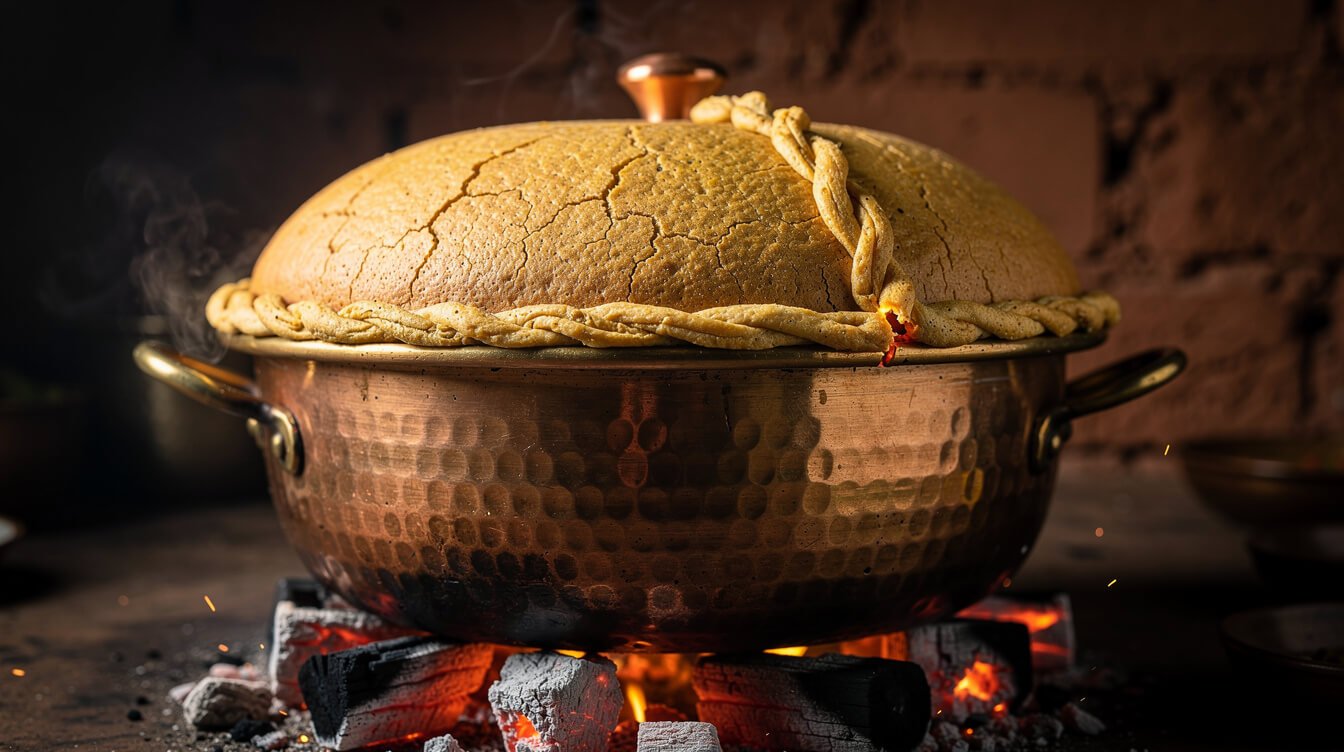
Kacchi biryani is a biryani made by layering raw, marinated meat at the bottom of a heavy pot, covering it with partly cooked rice, sealing the lid, and letting the whole thing cook slowly in its own steam. The word kacchi means raw or uncooked. It describes the method, not a single recipe.
That slow, sealed cooking is called dum. Traditionally the lid is sealed to the pot with a rope of dough so no steam escapes. The marinade, the fat, and the juices from the meat rise up through the rice, and the rice cooks in everything the meat gives off. When the pot is opened, the bottom layers are rich and red-gold, the top is fluffy and fragrant, and there is no going back to a quick weeknight version.
In Bangladesh, kacchi usually means mutton or goat, often khashi (castrated male goat, prized for tender meat), and sometimes beef. Writing in The Daily Star, the food writer Sabina Khan points out something that surprises a lot of people: across most of India and Pakistan, biryanis follow the cooked method, but in Bangladesh, kacchi “is the standard.”
Where kacchi came from
Biryani as a family of dishes traces back to Persian rice-and-meat cooking that arrived in the subcontinent over centuries. In her Daily Star piece “The Biryani excavation,” Khan connects Dhaka’s kacchi to the Awadhi (Lucknow) kitchen. She argues that when the Mughals made Dhaka the capital of Bengal in 1610, officials arrived with their cooks and the raw-meat dum technique. Lucknow later moved toward the cooked method, while Dhaka kept the older one. It is a lovely theory, and it explains why Dhaka cooks are so proud of doing things the hard way.
Kacchi biryani vs pakki biryani: raw vs cooked
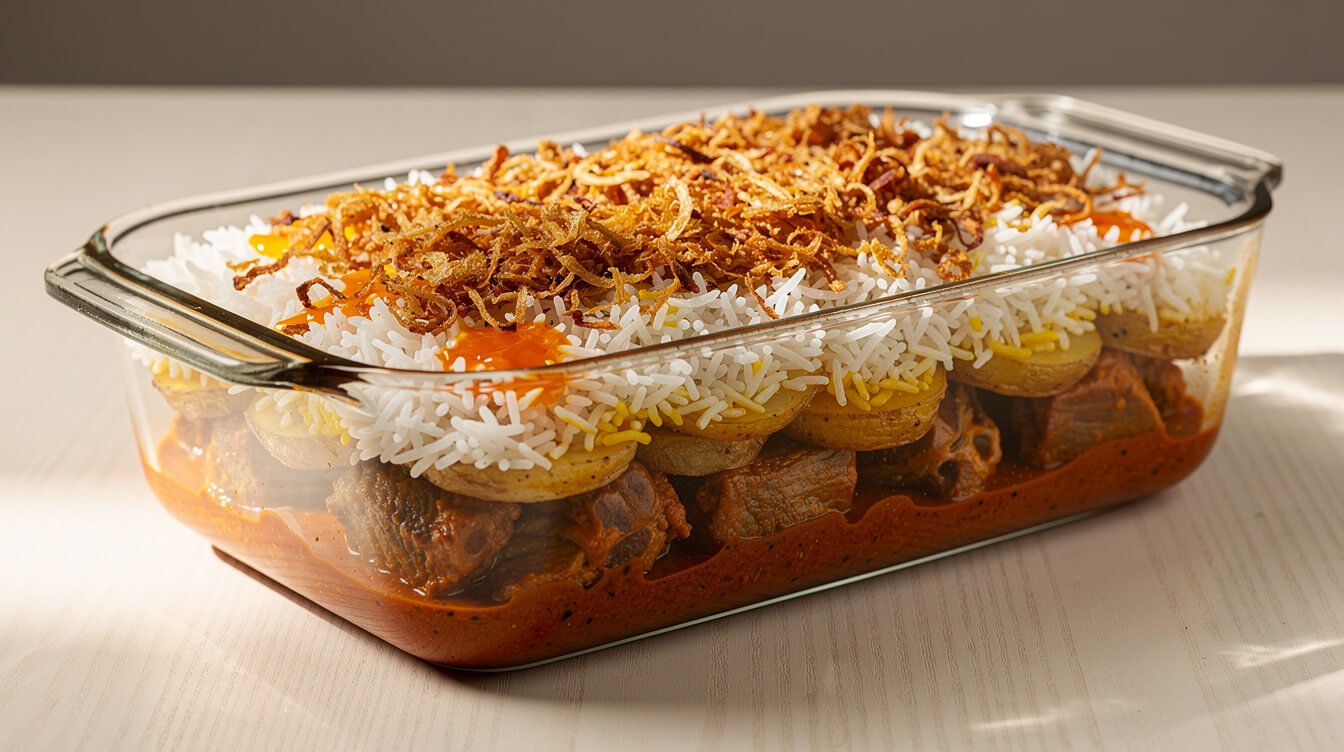
This is the question people actually search: what is the difference between biryani and kacchi biryani? The honest answer is that kacchi is biryani. It is one of the two ways to make it.
- Pakki biryani (pakki means cooked): the meat is cooked first, often into a full curry, and then layered with rice and finished on low heat. Most biryanis across India and Pakistan are made this way.
- Kacchi biryani: the meat goes into the pot raw, marinated in yogurt and spices, and cooks together with the rice under a sealed lid.
Wikipedia’s biryani entry puts it simply: in a pakki biryani the ingredients are cooked separately, at least in part, and then arranged in layers; in a kacchi biryani the layers are arranged in a pot that is sealed and cooked slowly so the food steams in its own liquid.
Why does it matter? Taste and texture. With pakki, the cook controls each layer and can fix things along the way. With kacchi, there is one shot. The meat has to be cut to the right size, the marinade has to be acidic enough to tenderize it, and the rice has to be parboiled to just the right point so that it finishes at the same moment the meat does. Get it right and the meat falls off the bone while every grain stays separate. Get it wrong and you have tough mutton under mushy rice.
One small warning for anyone searching for recipes in English: plenty of recipes online are labelled “kacchi” but tell you to cook the meat for an hour before layering. That is a perfectly tasty biryani, but it is pakki. If your nani would raise an eyebrow, trust the eyebrow.
What goes into a Dhaka kacchi biryani

Every family and every baburchi (cook) has a secret, but the core of a Dhaka-style kacchi is consistent. The kacchi biryani recipe in Food and Travel magazine’s “Made in Bangladesh” feature is a good map of what goes in:
- Meat on the bone. Their recipe uses 1.2 kg of mutton leg, cut into large pieces. Bone-in meat gives the rice its depth.
- Yogurt marinade. Yogurt, ginger, garlic, and a spice blend, usually left overnight.
- Potatoes. Peeled, halved, and fried golden before they go into the pot. More on this below, because it is serious.
- Beresta. Thinly sliced onions fried slowly until deep brown and crisp. Some go into the marinade, some into the layers, and the rest go on top.
- Aloo bokhara. Dried sour plums that give little pops of tang against all that richness.
- Whole green chillies laid over the meat for perfume more than heat.
- Ghee, saffron, and kewra. Kewra water (screwpine essence) is the floral smell that drifts across every wedding hall in Dhaka. Rosewater is the common substitute.
- Rice. The Food and Travel recipe calls for chinigura or basmati. Chinigura is a small, fragrant Bangladeshi rice; long-grain basmati is the more common choice for biryani abroad.
The potato question
Let us settle this. A Dhaka kacchi has aloo. For many Bangladeshis, the potato is the best thing in the pot: it soaks up the ghee, the meat juices, and the saffron, and it is the piece cousins fight over. Sabina Khan’s theory is that the potato joined Dhaka’s kacchi after it reached Bengal in the late 1700s, long after the method itself was established.
Across the border, Kolkata’s biryani is famous for its potato too. That style is usually traced to the cooks of Wajid Ali Shah, the last Nawab of Awadh, who was exiled to Calcutta in 1856. Two cities, one Bengal, and the same love of a ghee-soaked potato. We share more with West Bengal than our biryani arguments suggest.
If rice is the real love language in your house, our Golden Harvest Bengal Nabanna Mug puts the paddy harvest that feeds every biryani pot on your morning cha.
Why kacchi biryani means a wedding

Wikipedia calls mutton kacchi “the quintessential wedding dish” of Old Dhaka, and anyone who has been to a biye (wedding) in Dhaka or Queens would agree. It was not always this way.
According to a Daily Star feature on Old Dhaka weddings, the classic wedding dish of the old city used to be murg polao, a slow-cooked chicken polao made with fine chinigura rice, raisins, nuts, aloo bokhara, ghee, cream, and saffron. Zeenat Parveen, president of the Jahanara Foundation Museum, told the paper that kacchi gained prominence as a wedding dish after the migrations that followed 1947. She credits its rich, warming nature for making it ideal for winter celebrations, and its completeness for keeping it there.
Another Daily Star piece, “How kachchi biriyani became the symbol of wedding prestige,” says that even three decades ago, kacchi was mostly reserved for the elite weddings of Dhaka. Today it is served at functions across every part of society. Part of the appeal is practical. Older menus needed polao, chicken roast, mutton rezala, and more. Kacchi is a “one dish wonder”: rice, meat, and potato, a full feast in a single pot.
That same piece notes that tehari was the old choice for smaller events like engagements and the gaye holud (the turmeric ceremony before the wedding). These days, of course, many families serve kacchi at every event, then add roast, rezala, kebabs, and sometimes fish, because nobody wants to be the family that ran out of food.
If you have ever stood near the catering trays at a Bangladeshi wedding in New Jersey or Michigan, you know the other half of the story: the uncle checking whether the kacchi has arrived, the aunties assessing the potato-to-meat ratio, and the quiet competition to get a plate from the first deg (the giant cooking pot) before it runs out.
Letters from home
A little more desh in your inbox
One short email a week: the story behind a symbol, a festival, or a dish, plus new designs from the shop. No spam. Unsubscribe anytime.
Old Dhaka and the names on the pot
In Dhaka, a biryani is often known by who cooked it. Wikipedia notes that some biryani variants take the name of the shop that sells them, and it lists Fakhruddin in Dhaka as an example.
In The Daily Star, Sabina Khan writes that Fakruddin Munshi learned dum cooking from a cook for the Nawabs of Murshidabad and started in the 1960s running the canteen at Viqarunnisa Noon School. She also tells the story every Dhaka kid of a certain age will recognize. Her mother would mention a distant colleague’s niece’s wedding, she would groan, and then her mother would add the magic words: “They’re serving Fakhruddin biryani.” Suddenly the wedding was not optional.
Not every famous Old Dhaka biryani is a mutton kacchi with ghee. Haji Biryani in Nazira Bazar started in 1939 as a roadside food corner run by Haji Mohammad Hossain, and it is known for its own goat biryani cooked with mustard oil, served with borhani. Old Dhaka has room for more than one style, and long-running arguments about which is better are part of the fun.
Biryani is only one part of Old Dhaka’s food identity. The other is bakarkhani, the flaky, layered, almost biscuit-like flatbread baked in tandoors along the old city’s lanes and often eaten with cha. The culinary historian Utsa Ray called it the “pride” of Dhaka’s gastronomic culture. If you have Old Dhaka in your blood, our Bakarkhani Old Dhaka Breakfast Nostalgia T-Shirt is a love letter to those mornings, before the biryani shops even light their fires.
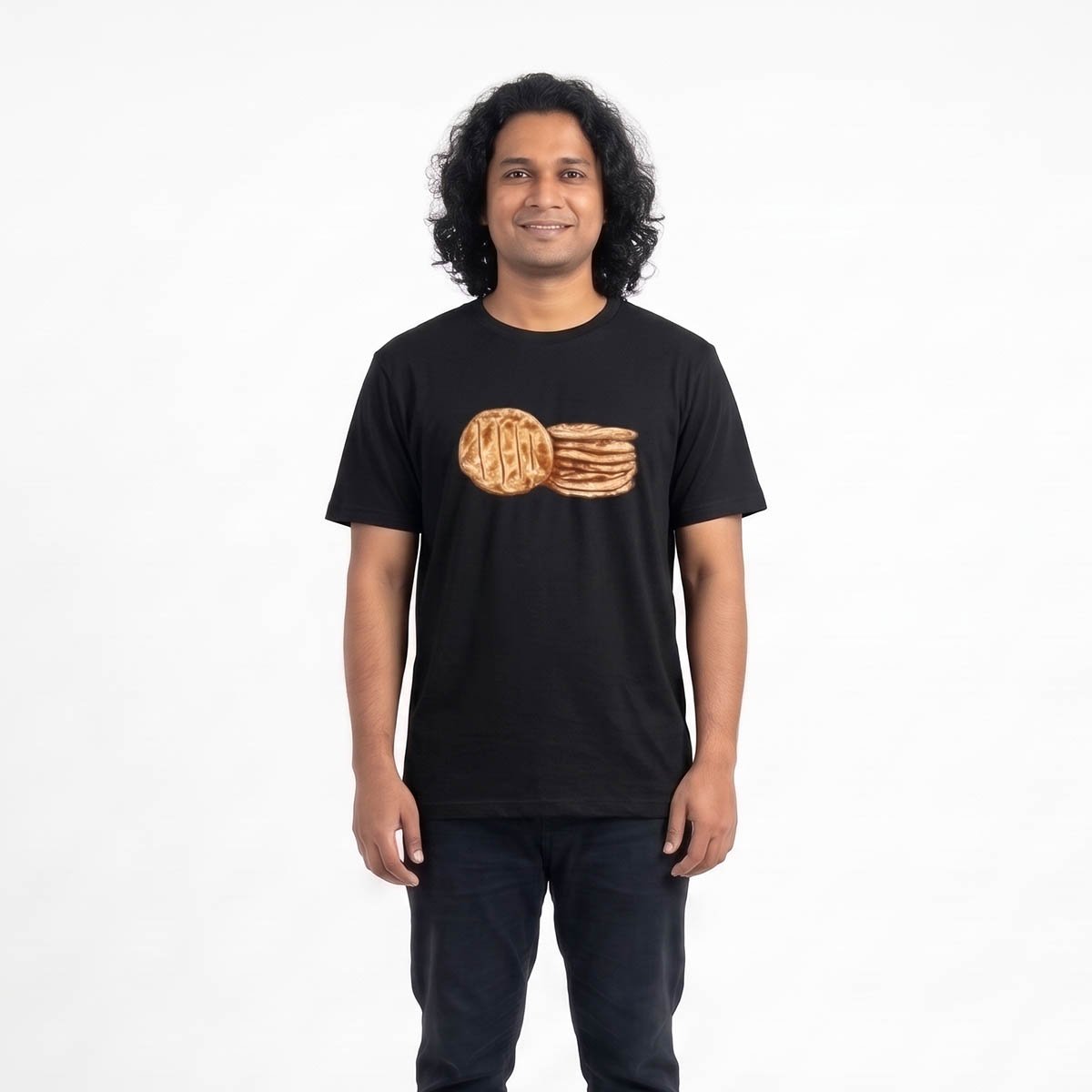
Old Dhaka, before the biryani fires are lit
Our Bakarkhani Old Dhaka Breakfast Nostalgia T-Shirt is for anyone whose idea of home smells like the old city: flaky bakarkhani, hot cha, and a deg of kacchi somewhere down the lane.
Borhani, jorda, and the rest of the plate

A plate of kacchi biryani is never alone. At a Dhaka wedding you will almost always find a tall glass of borhani next to it.
Borhani is a savoury, spiced yogurt drink made from sour yogurt, green chilli, mustard seeds, black salt, coriander, and mint. It is tangy, salty, a little hot, and flecked with herbs. It is especially common in the Dhaka and Chittagong (Chattogram) regions, where it is served at weddings and at iftar gatherings, usually alongside heavy rice dishes like biryani, morog polao, and tehari. If you are bringing a non-Bangladeshi friend to their first wedding, warn them: it is not a lassi, and the first sip is a surprise. The second sip is when people fall in love with it.
Here is what else tends to share the table:
- Chicken roast, the sweet, buttery, onion-rich wedding roast that often comes right after the kacchi.
- Kebabs, whichever kind the caterer is known for.
- Salad: sliced cucumber, onion, green chilli, and a wedge of lime, to cut through the richness.
- Dessert: jorda (sweet saffron rice with raisins and nuts), firni, or mishti doi. The Daily Star’s Old Dhaka feature notes that old-city weddings traditionally followed borhani with jorda or mutanjan, a sweet rice that even has shreds of sweetened meat in it.
If you want the full story on what comes after the main course, our guide to Bengali sweets covers the mishti that ends every celebration.
Kacchi vs tehari: the short version
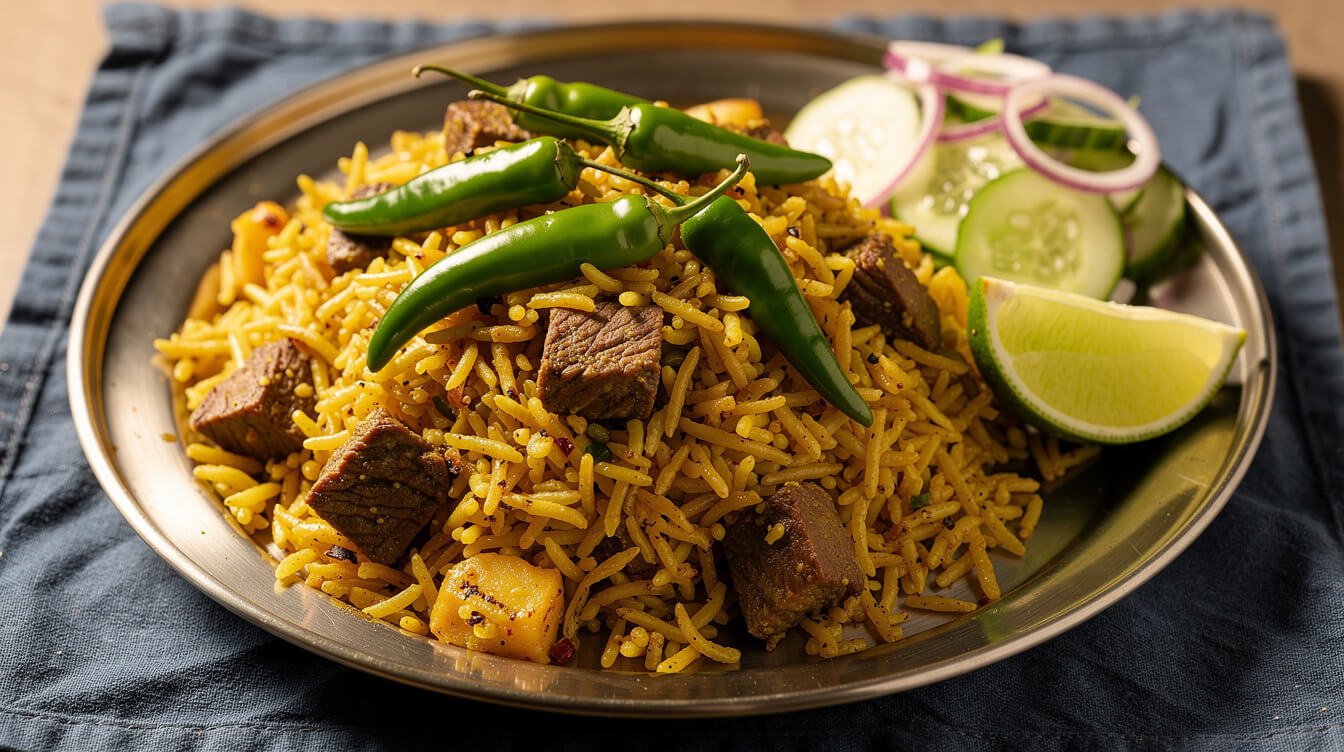
Kacchi’s everyday cousin is tehari, and the two get confused all the time online. The short version:
- Kacchi biryani: raw marinated meat layered with parboiled rice, sealed, and cooked on dum. Usually mutton or goat, with ghee, saffron, kewra, potatoes, and aloo bokhara. Celebration food.
- Tehari: in Dhaka, a one-pot rice dish of short-grain aromatic rice cooked with curried meat, usually beef, along with mustard oil and plenty of green chillies. It is spicier, punchier, more affordable, and much more of a weekday lunch.
Tehari also has a long history of its own. The word comes from the Awadh region, where tehri began as a spiced yellow rice that was often vegetarian. Dhaka turned it into a beef-and-mustard-oil classic. Tehari deserves its own guide, and we will give it one. For now, if a menu lists both, kacchi is the one with the saffron and the potato, and tehari is the one with the green chillies on top.
Eating kacchi in the diaspora (and making it at home)
If you grew up abroad, your kacchi memories are probably a mix of weddings, Eid lunches, and the big aluminum catering trays that show up for every dawat (dinner party). In Jackson Heights, Hamtramck, Brick Lane, Paterson, and the Danforth, Bangladeshi restaurants and caterers are where a lot of families get it, because almost nobody makes a wedding-sized deg in an apartment kitchen.
We are not going to rank restaurants, because menus, hours, and cooks change. A few questions will tell you a lot about any kacchi you order, though:
- Is it kacchi or pakki? A place that knows the difference usually cooks the difference.
- Is there aloo? For a Dhaka-style kacchi, there should be.
- Mutton, khashi, or beef? All three are common. Ask what is in today’s pot.
- Is there borhani? If they have it, get it.
Making kacchi biryani at home
Kacchi at home is a weekend project, but it is completely doable. Use a heavy pot or a Dutch oven, and follow a tested recipe for the ratios. The Food and Travel kacchi biryani recipe uses 1.2 kg of mutton on the bone, 600 g of potatoes, and 600 g of chinigura or basmati rice, with a homemade spice blend and an overnight marinade. The general sequence:
- Marinate the meat in yogurt, ginger, garlic, and spices, ideally overnight.
- Fry the onions slowly into beresta, then fry the potatoes golden in the same oil.
- Spread the raw marinated meat across the bottom of the pot. Layer the potatoes, most of the beresta, the aloo bokhara, and the green chillies on top.
- Parboil the rice with whole spices for just a few minutes, until it is only partly cooked, then drain it and spread it over the meat.
- Finish with ghee, saffron milk, kewra or rosewater, and the last of the beresta.
- Seal the pot tightly (dough, or foil under the lid), cook on high heat briefly to build steam, then let it cook low and slow. Food and Travel finishes it in a 120°C oven for 1 hour 20 minutes.
- Rest it, then serve by scooping from the sides so every plate gets meat, rice, and a potato.
For more of the dishes that fill a Bangladeshi table, start with our guide to Bangladeshi food. If you are more of a street-food person, our explainer on fuchka covers the snack that comes before the feast.
Kacchi biryani FAQ
What does “kacchi” mean in kacchi biryani?
Kacchi means raw. It refers to the method: the meat goes into the pot raw and marinated, and it cooks together with the rice under a sealed lid.
What is the difference between biryani and kacchi biryani?
Kacchi is a type of biryani. Most biryanis in India and Pakistan are pakki, which means the meat is cooked first. In kacchi, raw meat and partly cooked rice finish together on dum.
Is kacchi biryani the same as Hyderabadi biryani?
Not quite. Hyderabad has its own raw-meat biryani, kachche gosht ki biryani, so the method is shared. The dish is not. Dhaka kacchi has its own profile, with potatoes, aloo bokhara, ghee, kewra, and usually mutton or goat.
Why are there potatoes in kacchi biryani?
Because Dhaka cooks put them there, and nobody has been able to take them out since. Potatoes soak up the ghee and the meat juices, and in Bangladesh they are an expected part of a proper kacchi.
What do you drink with kacchi biryani?
Borhani, a spiced yogurt drink with mint, coriander, green chilli, mustard seed, and black salt. It is the traditional pairing at Dhaka weddings.
Is kacchi biryani spicy?
It is aromatic more than hot. The green chillies add fragrance, and the heat is usually moderate. If you want real heat, order the tehari.
The next time someone at a wedding asks “Is it kacchi?”, you will know exactly why the room goes quiet while the deg is opened. Save a potato for your cousin. Or don’t. That is how family stories start.
Before you go
Get the next story by email
We write about Bangladeshi heritage and diaspora life every day. The best of it lands in one short weekly email.