Pitha: The Rice Cakes of Bengali Winter, Explained
If you grew up Bangladeshi, you know winter by smell before you know it by the calendar: rice flour steaming under a cloth, date-palm molasses bubbling in a pan, and someone’s nani calling you to eat while it’s hot. That is pitha. Pitha are Bengali rice cakes, steamed, fried, or griddled, sweet or savory, and they are the reason a lot of us still associate cold mornings with joy.
This guide explains what pitha is, why the season starts with the rice harvest, the winter jaggery that makes the best ones, the types you will meet first, the patterned pitha made to impress guests, and how pitha festivals keep the tradition going from Dhaka to the diaspora.
What is pitha?
Pitha (in West Bengal often said pithe) is the umbrella word for traditional homemade cakes made mostly from rice flour. Some are made with wheat flour, and a few with palm fruit or other local ingredients, but rice is the heart of it. Banglapedia, Bangladesh’s national encyclopedia, describes pitha as cakes that are mostly not part of the daily menu. They come out for occasions: receiving a new bride or groom, entertaining guests, a family gathering, or simply because a child or a grandparent asked for them.
A pitha can be steamed, fried in oil or ghee, cooked on a griddle, or soaked in milk or syrup after cooking. Most are sweet, a few are savory and spicy. Many have two parts with their own Bangla names: the khol (literally “container”, the shell or pouch) and the pur (the filling). Classic fillings are grated coconut, jaggery, and kheer (milk thickened by slow cooking). Savory ones may hold vegetables or meat.
How many kinds are there? Nobody has a final count, and every district will argue for its own. One checkable number: in 1991 the Bangladesh Shishu Academy held a pitha exhibition that displayed 106 categories of pitha, according to Banglapedia. The same pitha can also go by different names in different areas, which is why your khala and your fupi may fight about what to call the one on the table.
Pitha is shared Bengali heritage
Pitha belongs to the whole eastern side of the subcontinent. Bangladesh and West Bengal share most of the Bengali repertoire, and Tripura, Assam, Odisha, and Bihar each have their own pitha traditions. Assam makes pitha for Bihu, and Odisha has temple pitha. If you want the bigger picture of how one culture spans two countries, our guide to Bengali people covers it.
Why pitha season starts with the rice harvest
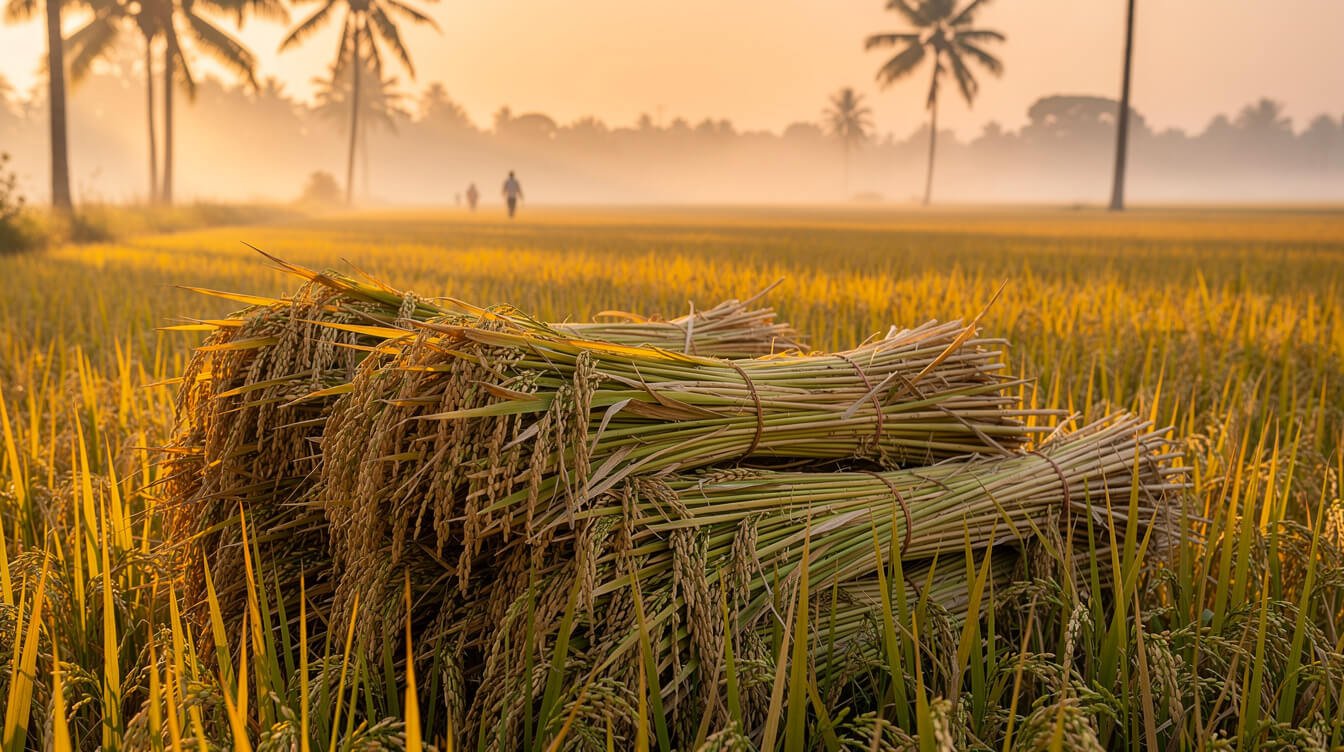
Pitha can be made any time, but the real pitha season is late autumn and winter, and that is not an accident. Banglapedia puts it plainly: the pitha season in Bangladesh starts in late autumn, when farmers harvest the paddy. New rice means fresh rice flour, and fresh rice flour means pitha.
Nabanna, the festival of new rice
The harvest is marked by Nabanna (from nava, new, and anna, food or rice), the festival of the new aman crop. In Bangladesh it is celebrated on 1 Agrahayan on the Bangla calendar, which falls on November 16. In Dhaka, the Jatiya Nabanna Utshab Udjapan Parishad (National Harvest Festival Committee) has organized a Nabanna celebration on that day since 1998, with folk songs, dance, and plenty of pitha. Programs at the Fine Arts Faculty of Dhaka University are a regular part of the day.
Banglapedia notes that Nabanna began as a Hindu agricultural festival in which the new rice was first offered to ancestors, and that today it is observed by all communities. Indigenous communities in Bangladesh keep their own harvest festivals too, including the Santal soharay and the Garo wangala. Nabanna melas often bring in folk musicians, including the Baul singers, so the new rice arrives with a soundtrack.
Our Golden Harvest Bengal Nabanna Mug was designed around exactly this moment: ripe paddy, harvest light, and the cha you drink while the first pitha of the year comes off the stove.
Poush and Magh: deep pitha season
After Agrahayan come Poush and Magh, the two winter months of the Bangla calendar (roughly mid-December to mid-February). This is when pitha is everywhere. In Bangladesh and West Bengal, Poush Sankranti, the last day of Poush around January 14, is a classic pitha day, which is why many families call the whole affair Poush parbon (the Poush festival).
Khejur gur: the winter sweetness pitha waits for
Ask any Bangladeshi what makes winter pitha better than summer pitha and you’ll hear two words: khejur gur, jaggery made from the sap of the date palm. Banglapedia says the pithas of the winter season are the most delicious because date juice and date molasses are only available then.
How the sap is collected
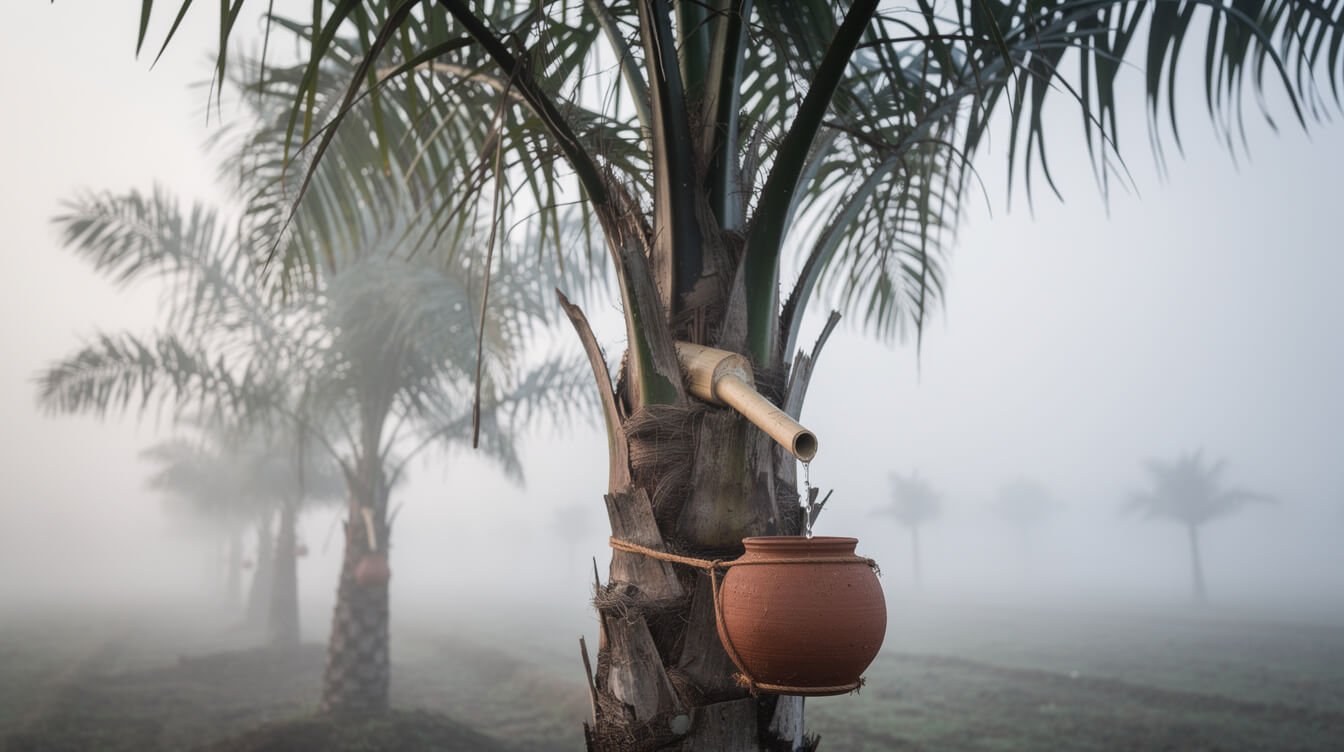
The sap is collected by gachhi, the tree climbers who tap date palms in the cold months. A gachhi shaves a patch near the top of the trunk, fixes a small bamboo spout, and ties an earthen pot underneath. The sap drips into the pot overnight and is brought down in the morning. Fresh sap is khejur rosh (date juice). Boiled down, it becomes runny new-season molasses, often called nolen gur, or hard cakes of patali gur.
Jashore (Jessore) in the southwest is the most famous date-palm district. The local saying is “Jashorer jash, khejurer rosh”, which means roughly “Jashore’s glory is its date sap”. The district has around 1.6 million date palms, The Financial Express reported in 2025.
One safety note on raw sap
Drinking fresh khejur rosh at dawn is a famous village winter ritual, but health authorities advise against drinking it raw. The World Health Organization says freshly collected date palm juice should be boiled first. Gur and boiled syrup are already cooked, so the pitha on your plate is not the issue. If someone in the desh hands you a glass of raw rosh, it is fine to smile and ask for it warm.
The pitha you will meet first

There are more than a hundred pitha, but these few show up on almost every winter table, in Bangladesh and in diaspora kitchens alike.
Bhapa pitha
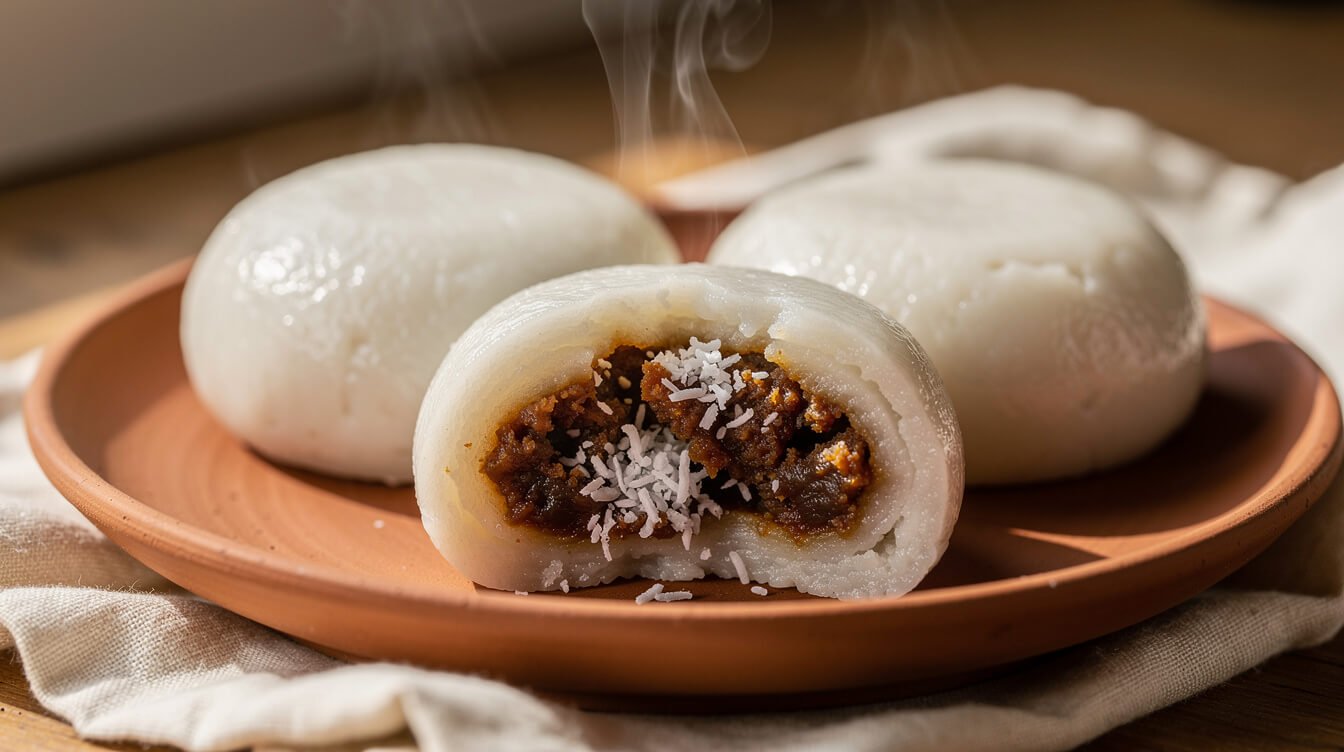
Bhapa means steamed. Bhapa pitha is a soft round cake of fresh rice flour with a layer of date gur and grated coconut inside, steamed over a pot of boiling water, usually wrapped in a thin cloth. It is the pitha that roadside stalls make in Dhaka on winter evenings, straight from the steamer to your hand. If you only try one pitha, try this one, hot.
Chitoi pitha
Chitoi (in West Bengal, ashke pithe) is the plain one, and that’s the point. It’s just rice flour, water, and a pinch of salt, cooked in small clay moulds so it comes out spongy on top and smooth underneath. Eat it two ways. Savory: with a sharp bhorta of mustard or green chili, or with meat or fish curry. Sweet: dipped in date molasses. Soak chitoi overnight in sweetened, flavored milk and it becomes dudh chitoi or rosher pitha.
Patishapta
Patishapta is a thin, soft crepe rolled around a filling of coconut and gur or of kheer. It is the pitha most likely to appear at a diaspora dawat (dinner invitation), because it works with a non-stick pan in any kitchen in the world.
Puli pitha
Puli is a half-moon dumpling of rice dough with coconut and gur inside. Banglapedia notes that its edges are pinched to look like flower petals. It can be steamed, fried, or simmered in milk as dudh puli. Savory puli, filled with vegetables or meat, also exists.
And a few more
- Pakan pitha: patterned dough, fried and soaked in syrup.
- Teler pitha: tel means oil, so this is the fried one. In Sylhet the jaggery version is known as hondesh.
- Taler pitha: made with the pulp of the palmyra palm fruit (tal), a late-summer pitha rather than a winter one.
- Jhal pitha: anything savory and spicy, such as vegetable or meat-filled versions.
For the rest of the Bangladeshi table, from bhorta to biryani, see our insider’s guide to Bangladeshi food.
Letters from home
A little more desh in your inbox
One short email a week: the story behind a symbol, a festival, or a dish, plus new designs from the shop. No spam. Unsubscribe anytime.
Nakshi pitha and the pitha made for guests
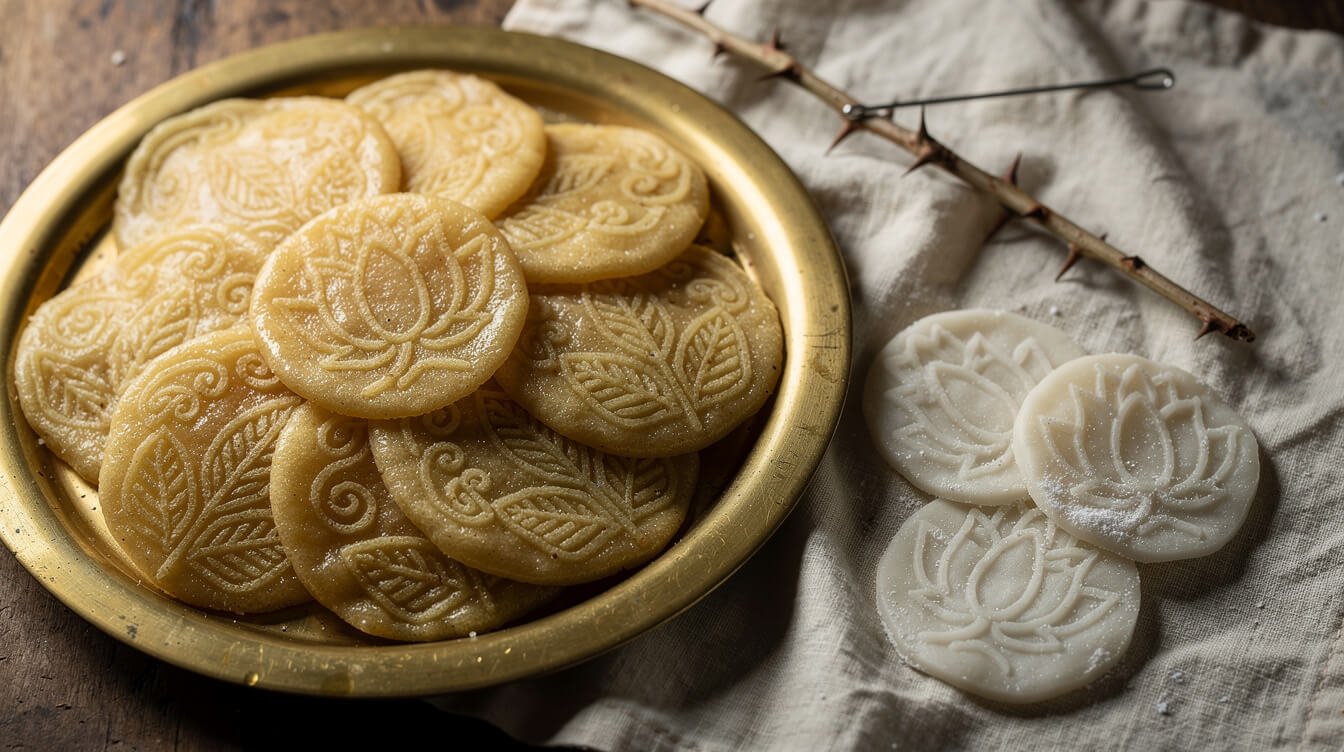
Some pitha are made to eat. Some are made to show off. Nakshi pitha (patterned pitha) is the second kind, and Banglapedia calls it “both a culinary art and an important women’s folk art”.
Here is how it works. Rice-flour dough is cooked, rolled out, and then decorated by hand. Designs of plants, creepers, and flowers are pricked out with whatever is at hand, such as date thorns, hairpins, needles, jute sticks, and twigs. Lotus and interlocking circles are favorite motifs. The finished pieces are fried and soaked in sugar syrup, or dried and stored for a later occasion. Some patterns have their own names, and the women of greater Mymensingh are especially famous for their skill. If you know nakshi kantha, the stitched quilts, you will recognize the same instinct: everyday material turned into something worth keeping.
Pitha for the jamai
Pitha is also hospitality made visible. Banglapedia records that when a family receives a new jamai (son-in-law), it makes special pitha in his honor, with intricate designs and colors. One is called bibiana, which Banglapedia translates as “the bride’s skill”. Another is jamai bhulana, a pitha whose name says it is meant to win over the son-in-law. Every family has a version of this story, usually involving a nervous new jamai and a plate that never seems to empty.

New rice, hot cha, and a plate of pitha
The golden fields of Nabanna, wrapped all the way around a mug. For the cha that goes next to the chitoi, and for anyone who still counts winter by the arrival of new gur.
Pitha utsob: festivals from Dhaka to the diaspora

As cities grew, homemade pitha got harder to find, and pitha festivals stepped in. Banglapedia notes that urban pitha exhibitions have become popular events, alongside specialist shops and small vendors on street corners.
In Bangladesh
The best-known is the Jatiya Pitha Utsab (National Pitha Festival) at the Bangladesh Shilpakala Academy in Dhaka, held every winter with pitha makers from across the country. Dhaka University, neighborhoods, schools, and offices all hold their own pitha utsob (pitha festival) or pitha mela (pitha fair) through Poush and Magh. The Daily Star’s winter pitha feature lists the usual suspects you will find on the tables: bhapa, chitoi, patishapta, pakan, and dozens more.
In the diaspora
Bangladeshi student associations and community groups abroad run their own pitha utsob every winter. One lovely example comes from Finland. The Bangladeshi community in Oulu has held a Pitha Uthsob since 2016. It started as a small family gathering of about 40 to 60 people and grew into an organized public celebration as the community passed 500. The festival is now an entry in Finland’s Wiki-inventory for Living Heritage. Bhapa pitha and patishapta made it all the way to the Arctic Circle’s doorstep.
In Jackson Heights, Hamtramck, Brick Lane, and every other Bangladeshi neighborhood, keep an eye on community Facebook groups from December onward. Pitha events are usually announced only a week or two ahead.
Making pitha far from the desh
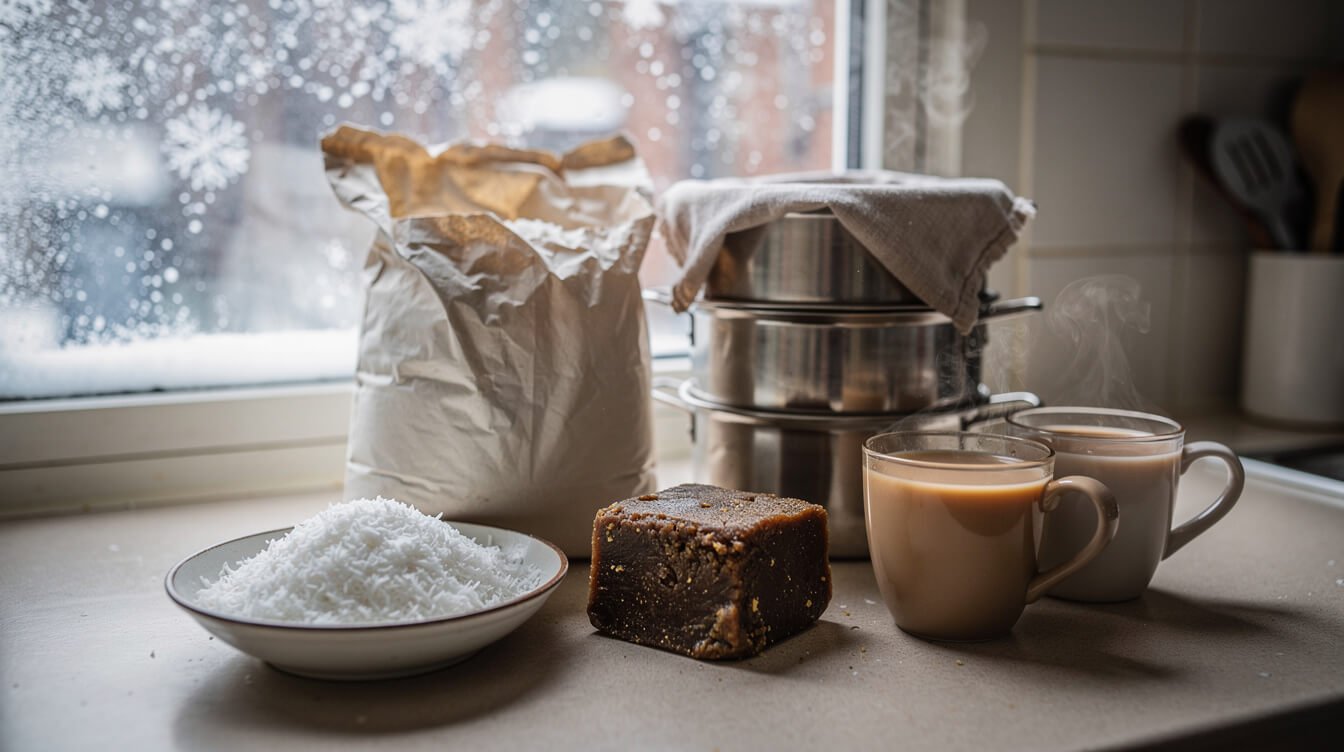
If you grew up abroad, pitha probably meant one of two things: a care package from someone flying in from Dhaka, or your Ammu up at dawn on a Saturday with a steamer and an old cotton cloth. Both count.
What you actually need
- Rice flour. Any South Asian grocery has it. Many cooks prefer flour from fresh-milled rice for bhapa and chitoi, so ask your elders what they buy.
- Gur. Date-palm gur is the prize. Desi stores often stock patali gur in winter. Sugarcane jaggery works in a pinch, but it tastes different, and your nani will notice.
- Coconut. Fresh grated is best, and frozen grated coconut is the diaspora hero.
- Patience. Chitoi especially takes practice. The first few are for the cook.
We are not going to give you a recipe here, because every family’s ratios are different and the best recipe is the one in your nani’s hands. Call her. Ask her how much water she adds for chitoi, and write it down this time.
For cold-morning kitchen duty there is our Bhaat Is My Comfort Food Hoodie, a nod to the rice behind every pitha you have ever eaten.
Pitha is a reason to gather
The part of pitha that travels best is not the recipe, it is the gathering. Banglapedia describes neighboring families making pitha together and turning it into a long chat and a shared meal. That is the same energy as a diaspora winter Saturday: three aunties, two pans, a pot of cha, and the kids running plates to the living room.
Pitha FAQs
What is pitha in English?
Pitha is usually translated as “rice cake”, though some pitha are closer to pancakes, crepes, or dumplings. Because none of those words fits every pitha, most English writing keeps the Bangla word.
Is pitha sweet or savory?
Both. Most pitha are sweet (coconut, jaggery, kheer, or syrup), but chitoi with bhorta, vegetable puli, and meat-filled patishapta are savory.
When is pitha season?
Late autumn through winter. It starts with the aman rice harvest and Nabanna (November 16 in Bangladesh) and peaks in Poush and Magh, roughly mid-December to mid-February.
Is pitha Bangladeshi or Indian?
Both, and more. Pitha is shared across Bangladesh and the Indian states of West Bengal, Tripura, Assam, Odisha, and Bihar, each with its own varieties and names.
Is pitha gluten-free?
Many pitha are made only from rice flour, which is naturally gluten-free, but some use wheat flour, and shared kitchens and festival stalls mix ingredients. If it matters for your health, ask the cook what went in.
What is the most popular pitha?
Bhapa pitha, chitoi pitha, patishapta, and puli are the most widely known, and you will find them at nearly every winter pitha festival.
Before the next cold morning
Pitha is the Bengali way of saying the year turned out all right. The rice came in, the date palms gave their sap, and somebody had the time and love to turn flour into something patterned, filled, and still warm. Wherever you are this winter, find the nearest pitha utsob, or make your own: one pan, one phone call to your nani, and one plate that goes to the neighbors first.
Hungry for more? Read about fuchka, the street snack that keeps Dhaka going between pitha seasons.
Before you go
Get the next story by email
We write about Bangladeshi heritage and diaspora life every day. The best of it lands in one short weekly email.