Khichuri: The Rainy-Day Rice and Lentil Dish Every Bangladeshi Home Knows
The sky over the building goes dark at 3 p.m., the first fat drops hit the window, and before the thunder even arrives, someone in the family group chat has typed one word: khichuri? Nobody needs to answer. The rice is already soaking. If you grew up Bangladeshi, at home or abroad, you know this reflex in your body. Rain means khichuri, and khichuri means somebody loves you.
This is a guide to khichuri from inside a Bangladeshi kitchen: what it is, why it belongs to rainy days, the soft and dry styles, what goes on the plate next to it, the festival version shared across Bengal, how old the dish really is, and how to make a good pot in an American apartment when the rice in your cupboard isn’t the rice your nani used.
What is khichuri? Rice and lentils, one pot

Khichuri is rice and lentils (dal) cooked together in a single pot with turmeric, whole spices, ginger, green chillies, and fat, usually ghee, oil, or both. The rice and dal cook until they stop being two things and become one. Add potatoes, cauliflower, peas, beef, or eggs and it’s still khichuri. Take away the lentils and it isn’t.
The same dish exists across South Asia under related names. Bengali speakers on both sides of the border say khichuri. Sylheti speakers say kisuri. Hindi and Urdu speakers say khichdi or khichri, and Assamese and Odia speakers have their own versions of the word. So if a friend asks whether khichuri is “basically khichdi,” the honest answer is yes: same family, different accent. The Bangladeshi version just tends to be bolder, with more ghee, more whole spice, more green chilli, and a plate full of fried things beside it.
Is there an English word for it? Not really. Recipe sites call it “rice and lentil porridge,” which fits the soft kind and misses the dry kind entirely. The closest English relative is kedgeree, the British breakfast of rice, egg, and smoked fish, which NPR’s food history of khichuri traces back to khichri. Most of us just say khichuri and let people taste it.
The basic building blocks:
- Rice. Ordinary rice works. For special pots, Bangladeshi cooks reach for small, fragrant grains like kalijira, a short-grained aromatic rice mostly grown in Bangladesh that now holds a geographical indication.
- Dal. Split yellow moong (mug dal) is the classic, often dry-roasted first until it smells nutty. Red lentils (masoor dal) give a softer, quicker pot. Some cooks mix two or more.
- Whole spices. Bay leaf, green cardamom, cinnamon (cassia), and cloves, bloomed in hot fat.
- Turmeric, ginger, and green chillies. Turmeric gives the color that makes khichuri look like sunshine on a grey day.
- Fat. A spoon of ghee on top at the end is not optional in most houses.
Why rain means khichuri in a Bangladeshi home

Bangladesh counts its year in six seasons, two months each, and the second one is borsha, the monsoon. In the Bangladesh calendar, borsha covers the months of Asharh and Shrabon, which run from June 15 to mid-August. These are the months when rain arrives in sheets and everybody who can stays home. It’s also when khichuri season peaks.
Nobody passed a law about this. It’s a habit so old and so shared that Bangladeshi writers treat it as fact. “Rain is almost synonymous with eating Khichuri for Bengalis,” The Daily Star wrote in one of its khichuri recipe roundups. This year, The Business Standard’s guide to rainy-day food in Dhaka opened with “a steaming plate of khichuri” before it got to tea, shingara, or fuchka. In West Bengal it’s the same story. The NPR writer Rhitu Chatterjee, who grew up there, remembered monsoon khichuri from her childhood and noted that her Bangladeshi friends told her they link the dish to the monsoon too.
Why rain? Ask five aunties and you’ll get five answers. It’s warm and filling when the air turns damp. It cooks in one pot, so nobody needs to go to the bazaar in a downpour. It turns the frying pan into a party, because rain is also the season for bhaja (fried things). Mostly, though, it’s memory. You ate it on rainy days as a child, so rain makes you want it, so your kids eat it on rainy days, and the loop closes.
That loop survives emigration remarkably well. A grey November afternoon in Queens, a sleety one in Hamtramck, or a drizzly Tuesday in London is not borsha, but the body doesn’t care. If you want the six seasons where you can see them every morning, the Six Seasons of Bangladesh White Glossy Mug wraps all six around one cup, monsoon skies included, and it holds a rainy-day cha just fine.
Naram vs bhuna khichuri: the two big styles
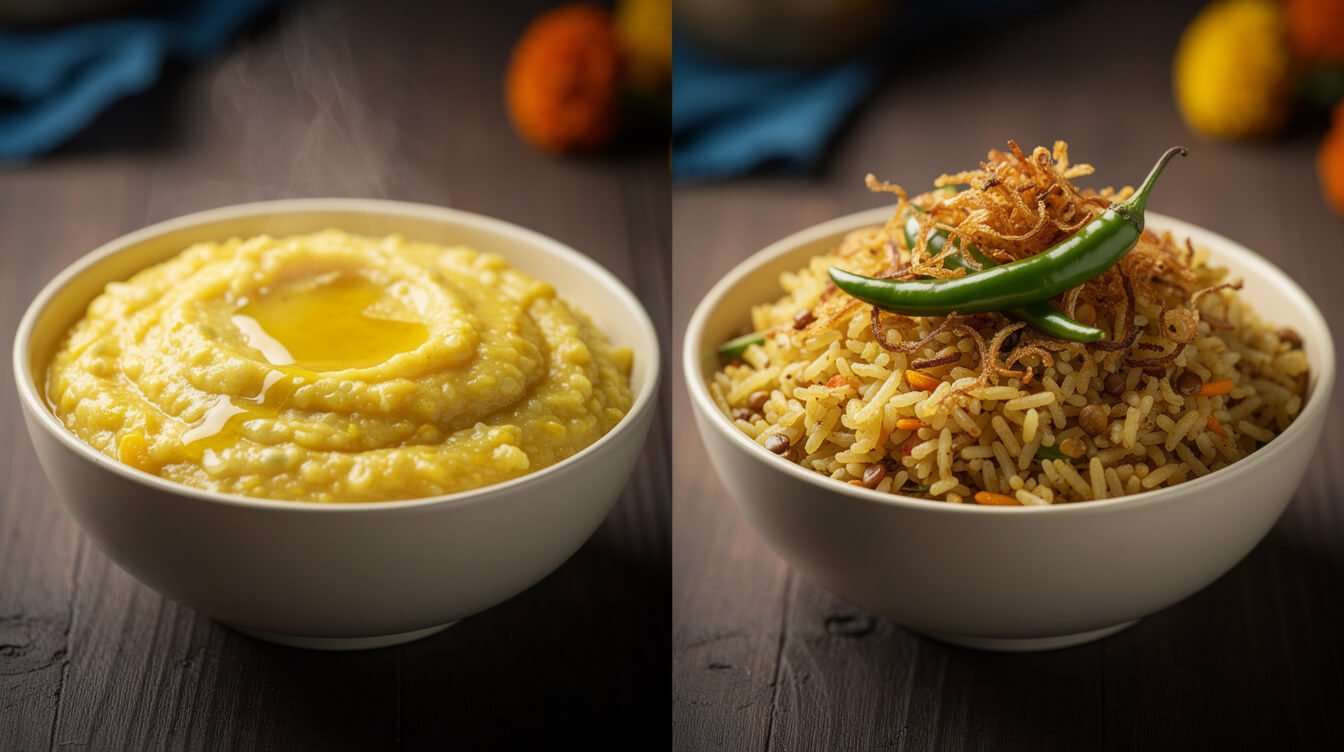
Every family argues about this, so let’s settle the vocabulary first. Bangladeshi kitchens make two broad kinds of khichuri, and they’re closer to two different dishes than two textures.
Naram (soft) khichuri
Naram (also written norom) means soft. This khichuri is wet, loose, and spoonable, somewhere between a thick porridge and a risotto. The lentils break down and melt into the rice. It’s the version people make with red lentils when they want dinner fast, and the one many families make for small children. The Daily Star notes it’s one of the first foods many Bangladeshi parents give babies, somewhere around six to nine months. A pool of ghee on top, a squeeze of lime, a green chilli bitten on the side, and you’re done.
Bhuna (dry, fried) khichuri
Bhuna means fried or roasted, and here it describes the method. The moong dal is dry-roasted in a heavy pan until it smells toasty, then rice and dal are fried in fat with the whole spices before water goes in. The result is drier and fluffier, and every grain stays separate, closer to a polao than a porridge. In her cookbook Ammu, the London chef Asma Khan writes that roasting the dal keeps it from breaking down and gives bhuna khichuri “a wonderful smoky, earthy fragrance.” She finishes hers with caramelized onions and serves it with a couple of bhortas.
Asma Khan also tells a story every second-gen reader will recognize. In her family, the watery version was cooked when someone was sick, and because nobody was going to cook a separate meal, the healthy siblings had to eat it too. Ask around and you’ll find that grievance in a lot of families.
Which one is “right”? Both. Soft khichuri is a weeknight hug. Bhuna khichuri is what you make for guests, for a rainy Friday when everyone is home, or for a festival. If someone in your family says khichuri should be one or the other, they’re telling you about their mother’s kitchen, and that’s the best kind of fact.
What to eat with khichuri: the Bangladeshi plate

Search “what can we eat with khichuri” and you’ll get papad and pickle. Fine, but a Bangladeshi khichuri plate on a rainy day is a full production. Here is what usually shows up next to the pot.
- Ilish bhaja (fried hilsa). The national fish, rubbed with turmeric and salt and fried crisp, with a spoon of the fish-scented oil poured over the khichuri. A 2009 Daily Star feature called fried hilsa with khichuri on a rainy day, eaten with family, “the perfect meal,” and very few Bangladeshis would argue.
- Dim bhuna (egg curry). Hard-boiled eggs, fried until blistered, then cooked down in onion masala. Cheap, quick, and loved by every kid at the table.
- Begun bhaja (fried eggplant). Thick rounds of eggplant, salted, turmericked, and pan-fried until the middle goes creamy.
- Beef or mutton bhuna. A dark, dry meat curry spooned over the top turns khichuri into a feast.
- Bhorta. Mashed potato, eggplant, or dried fish with mustard oil, onion, and chilli. Two bhortas and a khichuri is a complete meal in a lot of homes.
- Achar (pickle). Mango, lime, or boroi (jujube) achar for sharpness.
- Raw onion, green chilli, and lime. The free garnish that is never really optional.
The rule is contrast. Khichuri is soft, warm, and mild, so everything around it should be crisp, sour, oily, or hot. That’s why a khichuri plate looks like a small festival even when it’s only Tuesday.
If this plate is your love language, the Bhaat Is My Comfort Food Bangladeshi Rice T-Shirt says it for you: a brass plate of rice, fried fish, dal, and lime, drawn by people who know exactly where the fish goes. For more of the everyday table, our insider’s guide to Bangladeshi food walks through dal, bhaji, bhorta, and the rest.
Letters from home
A little more desh in your inbox
One short email a week: the story behind a symbol, a festival, or a dish, plus new designs from the shop. No spam. Unsubscribe anytime.
Meat and egg khichuri: from Ammu’s pot to a Padma ferry ghat
Vegetarian khichuri is the base, but a lot of Bangladeshi khichuri has meat in it. Beef khichuri is a Dhaka favorite. The meat is marinated, then cooked tender with onion and whole spices before roasted moong dal and rice go in the same pot, so the grains soak up the meat juices. The Daily Star’s beef bhuna khichuri recipe follows exactly that order: roast the dal, cook the beef until the oil separates, then add rice, dal, and water and finish it low and slow with fried onions on top. Some families do the same with mutton or chicken. Egg khichuri, with boiled eggs folded in or served on top, is the fast weeknight version.
The best story about beef khichuri comes from the banks of the Padma, Bangladesh’s great river. The Business Standard tells how, about 30 years ago, a man named Mohammad Alamgir Khan opened a small eatery at the Kathalbari ferry ghat, serving rice and hilsa to travelers from the southern districts before they boarded their ferries. At night, when ferry traffic slowed, he started cooking egg khichuri to keep the kitchen busy. Years later he added beef to the pot, and word spread from the ghat to Mawa and then to Dhaka. People began arriving with one question: where’s Molla’s khichuri? (“Molla” was his nickname.)
When the Padma Bridge opened in 2022 and the ferries slowed, the restaurant moved near the new hub at Naodoba. Today his son Shahjahan Khan runs it and serves beef bhuna khichuri with salad and a seasonal pickle of mango, olive, or hog plum. Staff told the paper that hardly anyone leaves without a parcel for the family back home. Most of us will never eat there, but every Bangladeshi family has a version of this story: a stall, a river, a rainy night, a plate of khichuri you still compare every other plate to.
One note on names, because it confuses people: khichuri is not haleem, the thick, slow-cooked stew of meat, lentils, and grain. Khichuri is rice-forward and holds its shape on a plate. And it’s not biryani either, although a good beef bhuna khichuri gets close enough to start arguments. (For the real biryani debate, see our guide to kacchi biryani.)

For everyone whose rainy-day plan is rice
The Bhaat Is My Comfort Food T-Shirt puts a brass plate of steaming rice, golden fried fish, dal, and a wedge of lime across your chest in vintage saffron, teal, and crimson. Wear it to the khichuri dinner, or send it to the cousin who always asks for seconds.
Bhoger khichuri: the festival plate both Bengals share

Khichuri also has a festival life. During Durga Puja, which The Daily Star describes as perhaps the biggest religious and cultural festival for Hindus in Bangladesh and West Bengal, the community meal served at temples and mandaps is called bhog. Its centerpiece is bhoger khichuri.
Bhoger khichuri is vegetarian. A typical niramish (vegetarian) puja plate, the paper says, has khichuri, an assortment of bhaja (fritters and fried vegetables like eggplant and pumpkin), and labra, a soft mixed-vegetable curry. Chutneys and payesh are usually close behind. In West Bengal, the version is famous for its short, fragrant gobindobhog rice and roasted moong dal. The Bengali cooking channel Bong Eats writes about a grandmother’s ghee-rich bhuna khichuri, cooked on the day of Lokkhi Puja as an offering and remembered by the whole neighborhood.
Here’s what makes this part of the story so Bengali. Many Bangladeshis of every faith remember a plate of puja khichuri from a neighbor, just as many remember a bowl of Eid shemai passed over the wall. The rice and dal are the same in every kitchen. Bengali food belongs to Bangladesh and West Bengal together, and khichuri may be the clearest example. (Our guide to who Bengali people are covers that shared story in more depth.)
A very old dish: Ibn Battuta, Akbar’s kitchen, and kedgeree
Khichuri is old. Very old. Colleen Taylor Sen, author of several books on Indian food history, told NPR that archaeological records suggest people on the subcontinent ate rice and legumes as far back as about 1200 B.C. Written records come later but leave no doubt.
- Around 1350: the Moroccan traveler Ibn Battuta described khichri in India as a dish of rice and mung beans with butter.
- The 16th century: the Ain-i-Akbari, the record of Emperor Akbar’s court written by his vizier Abu’l Fazl, gives a khichri recipe of rice, split dal, and ghee in equal weights, five seers each, enough for seven dishes. That’s a lot of ghee. Sen’s verdict to NPR: “Very rich!”
- The 17th century onward: the British took khichri home, and it became kedgeree, made with rice, boiled egg, and haddock. The food writer Clifford Wright told NPR it later crossed to New England too. He also argues khichri is an ancestor of Egypt’s koshary, made with rice, lentils, and macaroni.
Think about that the next time someone at work calls khichuri “just rice and lentils.” The dish in your pot has fed ferry passengers on the Padma, Mughal emperors, medieval travelers, and British colonial officers at breakfast. It survived empires because it’s cheap, flexible, and impossible to stop craving. The one thing that never changed is the core: rice, dal, fat, salt, and heat.
Khichuri isn’t the only Bengali food with a calendar of its own, either. Winter has pitha season, when the date-palm molasses comes in, and celebrations have their sweets. Rain has khichuri.
Making khichuri in an American kitchen
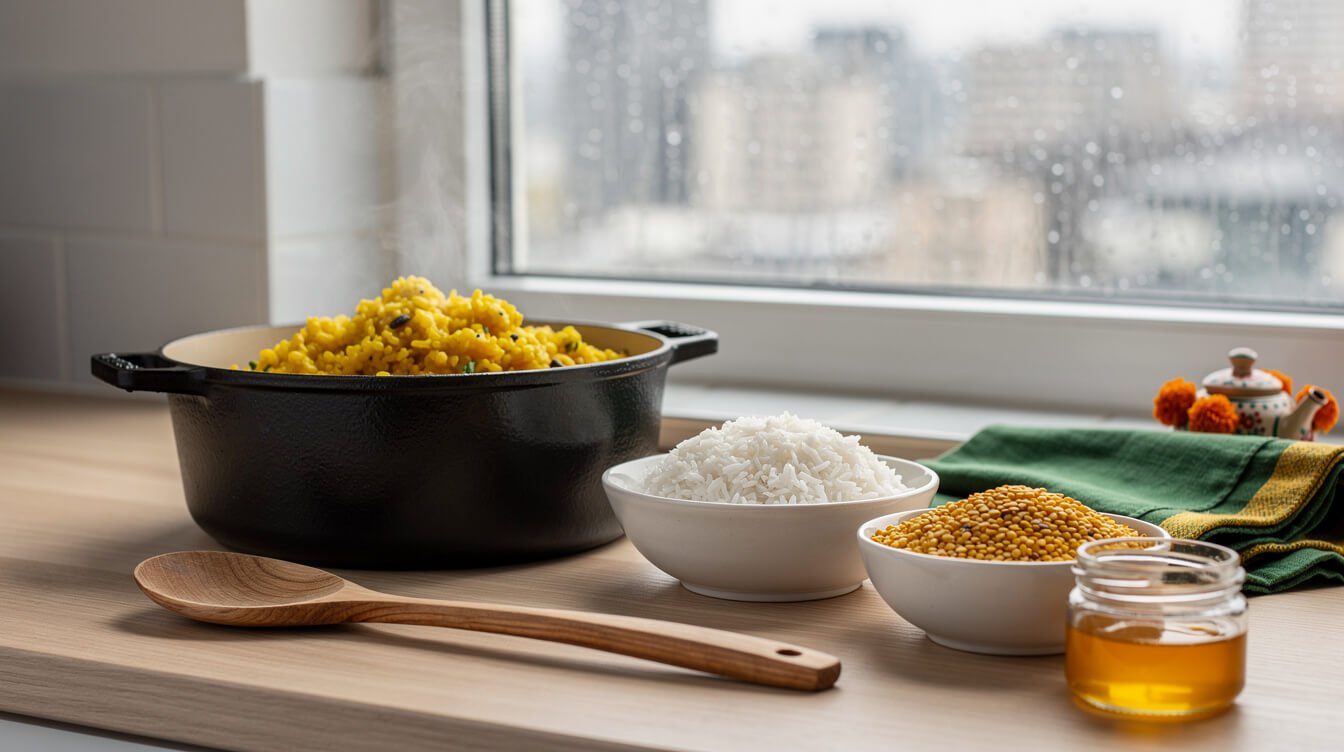
Calling Ammu for the recipe is still the best method. She’ll say “a little of this, a little of that, you’ll know.” While you wait for her to call back, here’s how to get close.
Rice
Short, fragrant Bengali rice like kalijira or chinigura is the dream, and you’ll find it at Bangladeshi grocers in Jackson Heights, Hamtramck, Paterson, or Brick Lane. If all you have is basmati or jasmine, use it. Basmati gives a drier, more separate bhuna khichuri. Jasmine goes soft and suits a naram pot. Wash the rice until the water runs clear.
Dal
For bhuna khichuri, dry-roast split moong dal in a heavy pan over medium heat, stirring constantly, until about half the grains turn light brown and it smells nutty. Then rinse it. For a quick naram khichuri, red masoor dal needs no roasting and melts into the rice.
Ratios
Don’t take ratios from me. Take them from a recipe you trust. NPR’s home recipe uses equal parts rice and moong dal (half a cup of each) with roughly four cups of water when cooked in a pot, for a thick, porridge-like khichuri, and it suggests adding more water as it cooks if you want it looser. Drier bhuna khichuri uses noticeably less water, and Asma Khan’s version rests, covered, off the heat for about 30 minutes before serving. Start there, then adjust to taste.
The method, in short
- Heat ghee or oil. Add bay leaf, cardamom, cinnamon, and cloves. Let them sizzle.
- Add sliced onion and fry until golden. Add grated ginger.
- Add the drained rice and dal with turmeric and salt and stir until every grain is coated.
- Add hot water, bring it to a boil, cover, and cook on low until the water is absorbed and the grains are tender.
- Fold in slit green chillies, add a spoon of ghee on top, and rest it covered before serving.
A Dutch oven or a heavy pot is your friend here, and an electric pressure cooker works well for the naram style. The most important ingredient doesn’t come from the store, though. Wait for rain, text the family chat, and set the table for more people than you planned.
Khichuri questions, answered
What is khichuri in English?
There’s no exact English word. Khichuri is a South Asian dish of rice and lentils cooked together with spices, sometimes described as a rice and lentil porridge (soft style) or a rice and lentil pilaf (dry, bhuna style). The British dish kedgeree descends from it.
Is khichuri the same as khichdi?
Yes. They’re the same dish in different languages. Khichuri is the Bengali name and khichdi or khichri is the Hindi and Urdu name. Bangladeshi khichuri tends to use more whole spice, ghee, and green chilli, and often comes with fried fish, egg, or meat on the side.
Which dal is used for khichuri?
Split yellow moong dal, often dry-roasted first, is the classic choice, especially for bhuna and bhoger khichuri. Red masoor dal makes a softer, quicker pot. Some recipes mix several dals.
What do you eat with khichuri?
In Bangladesh, the classic sides are fried hilsa (ilish bhaja), egg curry (dim bhuna), fried eggplant (begun bhaja), beef bhuna, bhorta, achar, raw onion, green chilli, and lime.
Is khichuri vegetarian?
It can be either. Plain and vegetable khichuri, including the bhoger khichuri served at Durga Puja, is vegetarian. Beef, mutton, chicken, and egg khichuri are all common in Bangladesh too.
Why do Bengalis eat khichuri when it rains?
It’s a long-standing cultural habit in both Bangladesh and West Bengal, tied to borsha, the monsoon season. A hot one-pot meal with fried sides feels right on a wet day, and generations of rainy-day memories keep the tradition going.
So the next time the sky goes dark over your block, you know what to do. Soak the rice, roast the dal, fry something, and call your nani to ask what you’re doing wrong. She’ll tell you. Then she’ll ask whether you’ve eaten.
Before you go
Get the next story by email
We write about Bangladeshi heritage and diaspora life every day. The best of it lands in one short weekly email.