
Lalbagh Fort: The Unfinished Mughal Fort of Old Dhaka, Explained
Ask anyone who grew up spending summers in Dhaka about Lalbagh Fort and you will get a story before you get a fact. A school trip in a crowded bus. A photo by the long water channel, squinting into the sun. An uncle explaining, very confidently, that the tunnels go all the way under the river. Lalbagh Fort (Lalbagh Kella, লালবাগ কেল্লা, “the Lalbagh fort”) is the Mughal fort in Old Dhaka that shows up in so many Bangladeshi family albums, and the strangest thing about it is that it was never finished.
This is the full story, told for the second-gen kid who saw it once on a summer trip and wants to know what they were looking at: who started it, why it was abandoned twice, who is buried in the middle of it, what archaeologists have dug up, which tunnel stories are history and which are legend, and how to see it with your own family.
What is Lalbagh Fort?
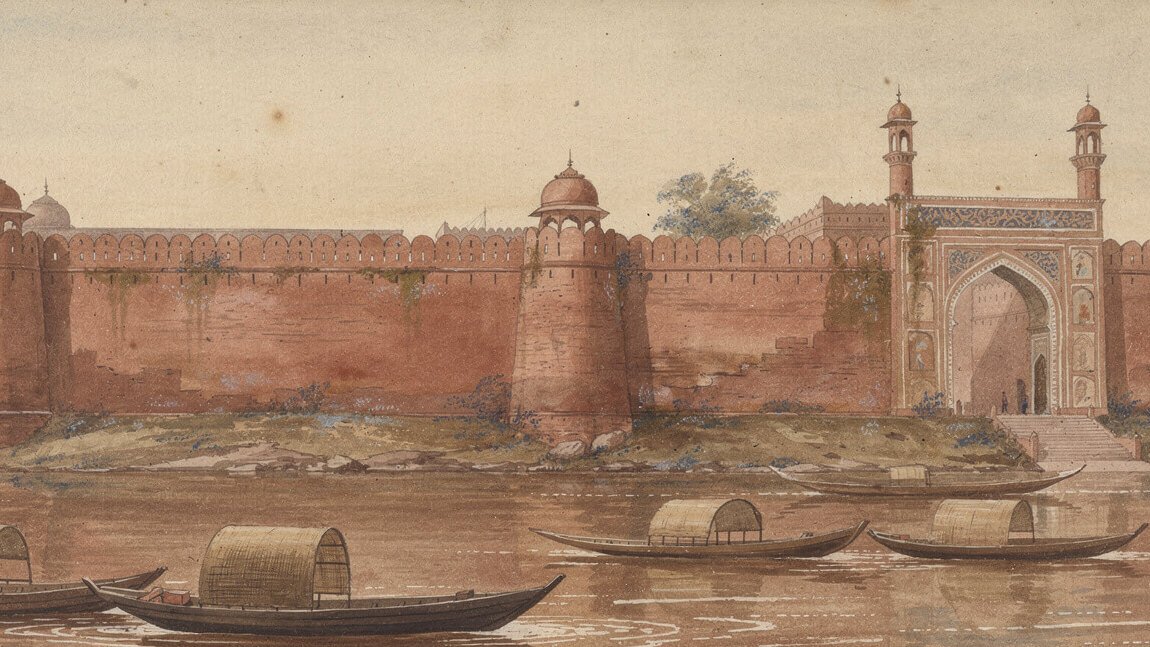
Lalbagh Fort is a 17th-century Mughal palace fortress in the southwestern part of Old Dhaka (Puran Dhaka, the old city). It was originally called Fort Aurangabad, or Qila Aurangabad, after the emperor Aurangzeb. The name Lalbagh comes from the neighborhood around it: lal means red and bagh means garden. Lalbagh replaced Aurangabad in 1844, and the fort has been Lalbagh Fort ever since.
Today the walled site covers about 18 acres. Most visitors remember three buildings standing in a line across a garden: a two-storey hall with a bathhouse attached, a square domed tomb in the middle, and a small three-domed mosque at the western end. Around them are long stretches of red-brick wall, bastions, gateways, lawns, and water channels that once ran with fountains.
The fort used to stand in the river
Here is a detail most guidebooks skip. Lalbagh Fort was built on the bank of the Buriganga, the river that made Dhaka worth fighting over. According to Banglapedia, the national encyclopedia of Bangladesh, a painting by Charles D’Oyly from 1809 to 1811 shows more than half of the fort’s southern side touching the water. The river has since moved south, and today you reach Lalbagh through lanes and traffic, not by boat. The Buriganga still flows past Old Dhaka, just not at the fort’s feet anymore.
Why does that matter? Because Mughal Dhaka was a river city first. Dhaka was the capital of Mughal Bengal from 1610 to 1717, and its forts were built to control the waterways. In 2023 Bangladesh submitted “Mughal Forts on Fluvial Terrains in Dhaka” to UNESCO’s World Heritage Tentative List. The group pairs Lalbagh with three river forts near Dhaka: Hajiganj, Sonakanda, and Idrakpur. A tentative listing is not World Heritage status. It is the first step, and the reason it exists is that these forts adapted Mughal design to a delta of rivers and monsoon floods.
Why Lalbagh Fort was never finished
The story of Lalbagh Fort is really the story of two men and one loss.
A prince who was called away
Construction began in 1678 under Prince Muhammad Azam, the third son of the emperor Aurangzeb. Azam was serving as the subahdar (governor) of Bengal, and he stayed in the province for about 15 months. Before the fort was finished, his father recalled him. The UNESCO tentative-list entry says he was called away to fight the Marathas. Some older articles give 1677 as the start date, but Banglapedia, Wikipedia, and the UNESCO entry all say 1678.
A governor who could not bear it
Azam’s successor was Shaista Khan, one of the most famous governors Bengal ever had. He governed Bengal from 1664 to 1688, with a break of a little over a year in 1678 and 1679 while Azam was in charge. He came from the highest circle of the Mughal court: his sister was Mumtaz Mahal, the empress for whom the Taj Mahal was built, which made him Aurangzeb’s uncle.
Shaista Khan carried on with the fort at first. Then, in 1684, his daughter Iran Dukht, known to everyone as Pari Bibi (“Lady Fairy”), died there. Banglapedia records that her death was such a shock that he came to see the fort as ominous and stopped building it. He stayed in Dhaka until 1688, but the fort stayed as it was.
After Shaista Khan left, the Mughal capital of Bengal moved from Dhaka to Murshidabad, and the fort lost its purpose. It was abandoned, then slowly rediscovered as a monument. A local body called the Dhaka Committee began looking after it in 1844, and the government’s Department of Archaeology took charge of it in 1910.
First abandoned by a prince, then shunned by a grieving father. That is why the most photographed fort in Bangladesh has walls that simply stop.
Shaista Khan and the price of rice
One more Shaista Khan detail, because it is too good to leave out. Banglapedia says that in his time rice was so cheap it sold at 8 maunds per rupee (a maund is an old measure of weight). When he left Dhaka, he is said to have had an inscription put on the city’s western gate: let only the man who can sell rice this cheaply open this gate. A whole province judged a governor by the price of bhaat. Some things about Bengal have not changed at all.
Pari Bibi and the tomb at the heart of Lalbagh Fort

The square building in the middle of the fort is the tomb of Pari Bibi, and Banglapedia calls it the most impressive of the fort’s surviving buildings. Shaista Khan built it for his daughter and spent heavily on it, bringing in costly building materials from north India.
Who was Pari Bibi?
Her full name, according to Banglapedia, was Iran Dukht Rahmat Banu. She was Shaista Khan’s daughter and was connected to Prince Azam, though sources disagree on how. Banglapedia’s entry on her says she married Azam in 1668 and lived with him in Dhaka. Other accounts, including the UNESCO entry and Banglapedia’s own Shaista Khan article, describe her as his fiancée. For a while some writers also argued she was an Ahom princess from Assam. Banglapedia points to a document of Shaista Khan’s, kept today at the Katra Waqf office in Dhaka, which it says shows beyond doubt that she was his daughter.
What everyone agrees on: she died young, in 1684, and her father never finished the fort after that.
What the tomb looks like up close
- Nine rooms. Eight rooms surround a square central room that holds her grave.
- A brass dome. The central room is covered by a false dome, octagonal in shape and wrapped in brass plate. Banglapedia says it was originally gilded.
- Marble inside. The inner walls of the central room were faced entirely in white marble.
- Glazed tiles. The corner rooms were skirted with glazed floral tiles. Only two originals survived, and the restorers used them as the pattern for the rest.
- A temple roofing method. Banglapedia notes that the tomb is roofed by stacking stone blocks one above another, which it describes as a Hindu system of roofing temples. A Mughal governor’s daughter rests under a roof built the way Bengal’s temples were built. That is shared Bengali heritage in stone.
A smaller grave in the southeastern corner room is popularly said to belong to Shamsad Begum, described in different sources as a relative or a daughter of Pari Bibi.
Three buildings in a line: the Diwan-i-Aam, the tomb, and the mosque

Stand in the middle of Lalbagh Fort and you notice the layout before you notice any single building. Three structures sit in one east-west line, but not at equal distances: the Diwan-i-Aam with its hammam to the east, Pari Bibi’s tomb in the middle, and the mosque to the west. A water channel with fountains at regular intervals once connected all three, and two more channels crossed it from south to north. It is the classic Mughal garden idea, the same geometry you see in the forts of north India, laid out on Bengal’s soft riverbank soil.
The Diwan-i-Aam and the hammam
The Diwan-i-Aam is a two-storey building on the east side that served as the residence and audience hall of the Mughal governor. English trading records suggest Shaista Khan himself lived there. On its west side is a single-storey hammam (bathhouse) with a kitchen, an oven, a brick bathtub, a dressing room, and an underground room for heating water. Wikipedia, citing the Asiatic Society of Bangladesh, notes it is one of seven hammams that survive, in ruins or restored, in Bangladesh. In 2021 the Department of Archaeology began a project to restore the hammam and document it in 3D, funded through the US Ambassadors Fund for Cultural Preservation. The building has also housed a small museum of Mughal-era objects such as coins, carpets, swords, and firearms.
The great tank
East of the Diwan-i-Aam sits a huge square water tank, 71.63 meters (about 235 feet) on each side, with stairs at its four corners.
The mosque
At the western end is the Lalbagh Fort Mosque, a three-domed mosque that is small for such a large site, with a water tank in front of it for ablutions. It is still a working mosque, so visitors dress modestly and keep their voices down near it.
If this view is the one you remember from a childhood trip, we made it into art. Our Lalbagh Fort Mughal Watercolor Wall Art Canvas paints the reflecting water, the arched gateway, and the warm terracotta brick, with লালবাগ কেল্লা across the top, for the wall of a home that is a long way from Old Dhaka.
Letters from home
A little more desh in your inbox
One short email a week: the story behind a symbol, a festival, or a dish, plus new designs from the shop. No spam. Unsubscribe anytime.
What archaeologists found under Lalbagh Fort

For a long time, people thought of Lalbagh Fort as just those three buildings, two gateways, and a broken stretch of wall. Excavations by Bangladesh’s Department of Archaeology changed that picture completely. According to Banglapedia, digging inside the present 18-acre site has revealed the remains of 26 or 27 structures.
A working palace, not just a monument
- Plumbing. Two lines of terracotta pipes connected the buildings to a water reservoir on the roof of the southwestern bastion. Between the hammam and the tomb, archaeologists found an extra-strong line made of double pipes, one inside the other.
- Hot water. Excavations at the hammam (1994 to 2009) found the underground room where water was heated, with black fire marks still on it, and terracotta pipes that carried hot and cold water.
- Roof gardens. Above the administrative block on the south side was a roof garden with fountains, a water reservoir, and flowerbeds laid out in rose and star shapes.
- Stables, offices, and sewers. Utility buildings lined the southern wall, and remains of a sewerage line were found in the residential area southwest of the mosque.
The walls and gates
The southern wall is a double wall: the outer one about 6.1 meters high and the inner one about 13.7 meters (45 feet). It had five bastions, and the western wall had two more. Of the three surviving gateways, the southern one is the grandest. From the outside it reads as three storeys with slender minarets, and from inside it looks like two.
Only half a fort
Archaeologists also found the main fort walls continuing east, underneath what is now Shaista Khan Road. Their conclusion is that the fort you visit today is only about half of what Prince Azam planned. The “unfinished fort” is even more unfinished than it looks.
Older than the Mughals
The most surprising finds sit deeper. Banglapedia reports layers from the Sultanate period and from before Islam came to Bengal, including terracotta heads and plaques. The Mughals made Dhaka a capital, but people were living on this ground long before them.

Old Dhaka’s red fort, on your wall
The Lalbagh Fort Mughal Watercolor Wall Art Canvas puts the long reflecting pool, the arched gateway, and that sun-warmed terracotta brick in your living room. For the parents who took you there, or the cousin who still talks about the tunnels.
The tunnel legends: what’s on record and what’s a story
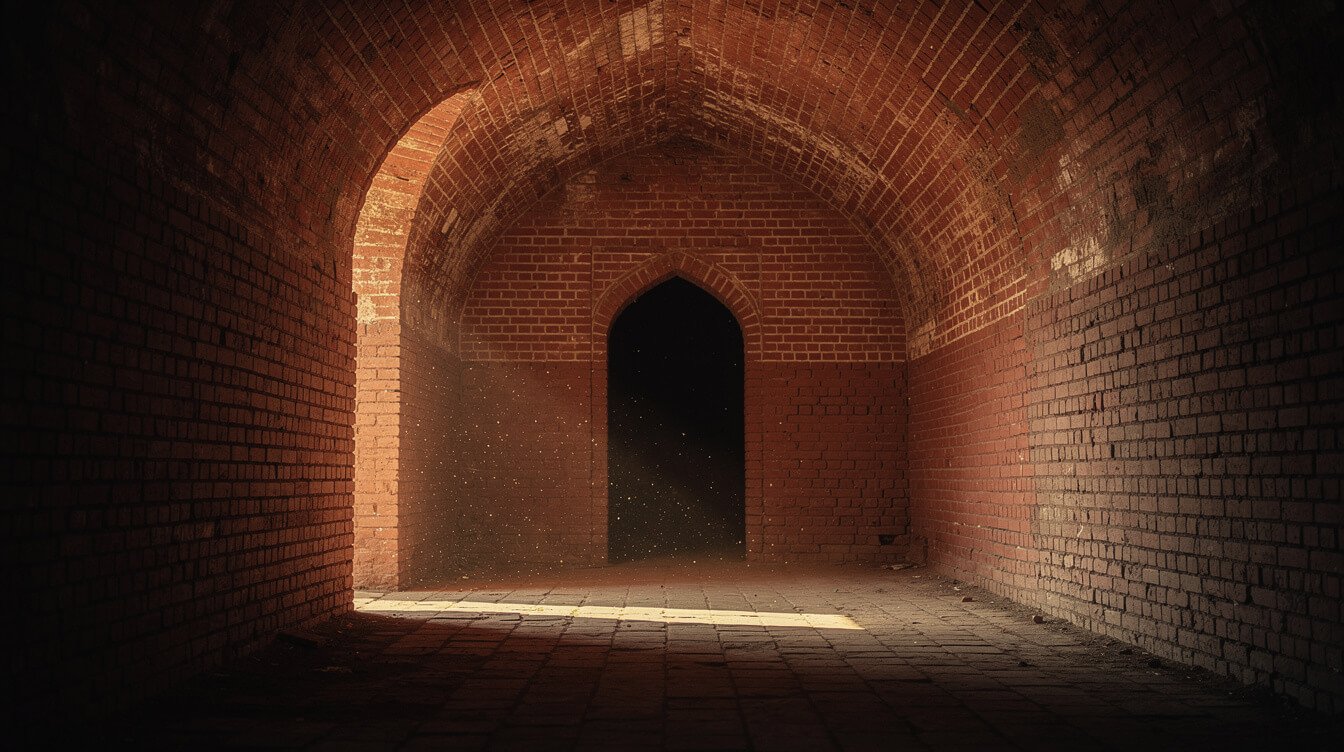
No visit to Lalbagh Fort is complete without someone telling you about the tunnels. So let’s separate the two kinds of story.
On the record
Banglapedia confirms that the biggest bastion, near the southern gate, had an underground tunnel. The central bastion on the southern wall has an underground room with a veranda on three sides, which could be reached from the riverside or from its roof. Remember, the river once lapped at these walls. Underground rooms and passages near the water make practical sense for a riverside fort, and the old passages are sealed today.
The legends
Then come the stories, which a 2016 Star Weekend feature in The Daily Star retold. Two of the tunnels supposedly ran under the Buriganga to the old Zinzira fort on the far bank. Another was supposedly built as a maze to trap intruders. In the most famous version, soldiers fleeing during the 1857 uprising against the East India Company ran into the tunnels and were never seen again, the British troops who chased them never came back either, and an elephant and dogs sent in afterward also vanished, so the tunnels were sealed for good.
Nobody has shown that any of this happened. Treat it the way you treat your Chacha’s stories at dinner: half history, half performance, and the reason everyone remembers the trip.
Lalbagh Fort in family memory

For a lot of Bangladeshi families, Lalbagh is less a monument than a place where things happened. Your Ammu’s school trip, when she lost her shoe in the garden. Your parents’ first photo together, him in a borrowed jacket, her pretending not to smile. The Eid afternoon when every cousin wore new clothes and the whole family walked the long path to the tomb. If you have an old family album, there is a good chance Lalbagh’s arches are in it.
That is part of why the fort hits diaspora kids so hard. You visit for the first time at nine, half asleep from jet lag, and you don’t quite get it. You come back at nineteen and realize your nani has stood on the exact same spot. If Dhaka has that kind of hold on you, our Dhaka Never Leaves You T-Shirt says it without needing a caption.
Seeing it with your own family
A few honest tips, without the details that change:
- Check before you go. Opening hours, ticket prices, and closing days change, so check the Department of Archaeology’s current listing or ask a relative who has been recently. We won’t guess them here.
- Go in the late afternoon. The light is softer and the brick turns properly red. Winter (roughly November to February) is the most comfortable season for walking in Dhaka.
- Respect the mosque and the tomb. Dress modestly, and remember that both are graves and a place of prayer, not only photo backdrops.
- Make a day of Old Dhaka. Lalbagh sits in the old city, so plan to eat afterward. Old Dhaka is where the city’s famous kacchi biryani comes from, and our guide to Bangladeshi food covers the rest of the table. Shaista Khan’s name is also linked to the Chawk Bazar mosque, also in Old Dhaka.
- Bring the kids’ questions. “Why is it not finished?” is a great one. Now you have the answer.
If you are building a Dhaka list for a first trip, pair Lalbagh with Curzon Hall and Doel Chattar at Dhaka University, which we wrote about in our post on the magpie robin, the national bird of Bangladesh.
Lalbagh Fort FAQ
Who built Lalbagh Fort?
Prince Muhammad Azam, the third son of the Mughal emperor Aurangzeb, began it in 1678 while he was governor of Bengal. His successor, Shaista Khan, continued the work for a while but left it unfinished.
Is Lalbagh Fort incomplete?
Yes. Azam was recalled before he finished it, and Shaista Khan stopped work after his daughter Pari Bibi died there in 1684. Archaeologists believe the present site is only about half of the fort as it was planned.
What is inside Lalbagh Fort?
The three main buildings are the Diwan-i-Aam with its hammam, the tomb of Pari Bibi, and the three-domed Lalbagh Fort Mosque. There are also gateways, bastions, a large square tank, gardens, and excavated remains of water pipes, roof gardens, and service buildings.
Who is buried in Lalbagh Fort?
Pari Bibi (Iran Dukht), the daughter of Shaista Khan, lies in the central tomb. A smaller grave in one corner room is popularly said to be Shamsad Begum’s.
What does Lalbagh mean?
Lal means red and bagh means garden, so Lalbagh is “red garden.” The fort was first called Fort Aurangabad, and it took the Lalbagh name in 1844.
Are the Lalbagh Fort tunnels real?
There were underground rooms and at least one tunnel in the bastions, and they are sealed today. The stories about tunnels running under the river, or swallowing soldiers in 1857, are legends with no evidence behind them.
Is Lalbagh Fort a UNESCO World Heritage Site?
Not yet. In 2023 Bangladesh added Lalbagh to UNESCO’s Tentative List as part of “Mughal Forts on Fluvial Terrains in Dhaka,” together with the Hajiganj, Sonakanda, and Idrakpur forts. A tentative listing is the step before a nomination, not World Heritage status itself.
The most beautiful thing in Dhaka was never finished
There is something very Bengali about Lalbagh Fort. A prince started it with enormous plans, a grieving father put down his tools, the river walked away, and the city grew up around it anyway. Three and a half centuries later, families still spread a blanket on its lawn, schoolkids still race down its paths, and diaspora kids still come back to stand where their parents stood.
Next time someone at a dawat (a dinner invitation, usually at a relative’s house) asks where you’re from, tell them about the fort that was never finished. Then send them this, and tell them to ask their own nani about the tunnels. For more about where we come from, start with our guide to Bangladeshi culture from inside the family.
Before you go
Get the next story by email
We write about Bangladeshi heritage and diaspora life every day. The best of it lands in one short weekly email.